Diploria labyrinthiformis
Spot Grooved Brain Coral across Caribbean reefs from Cuba to Colombia. Year-round presence in 25-29 °C waters. ID tips and top dive regions inside.
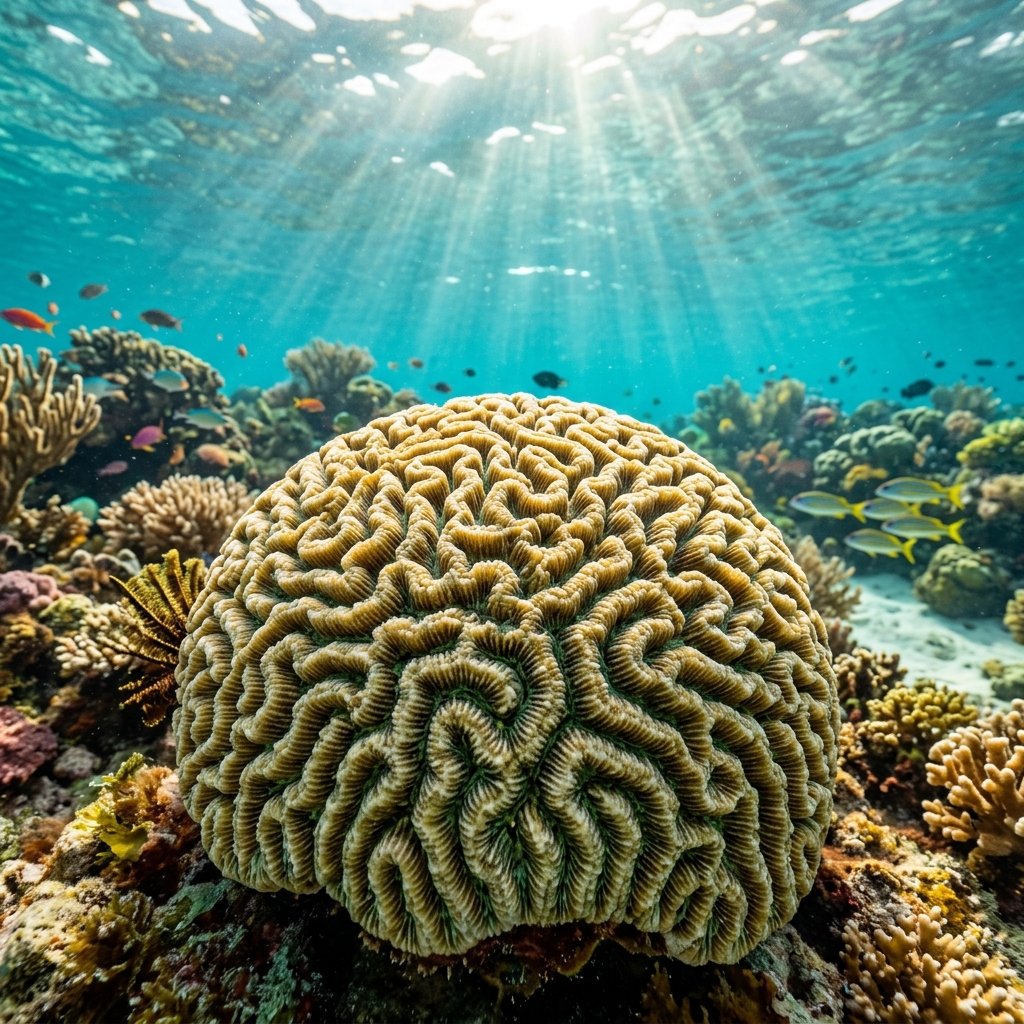
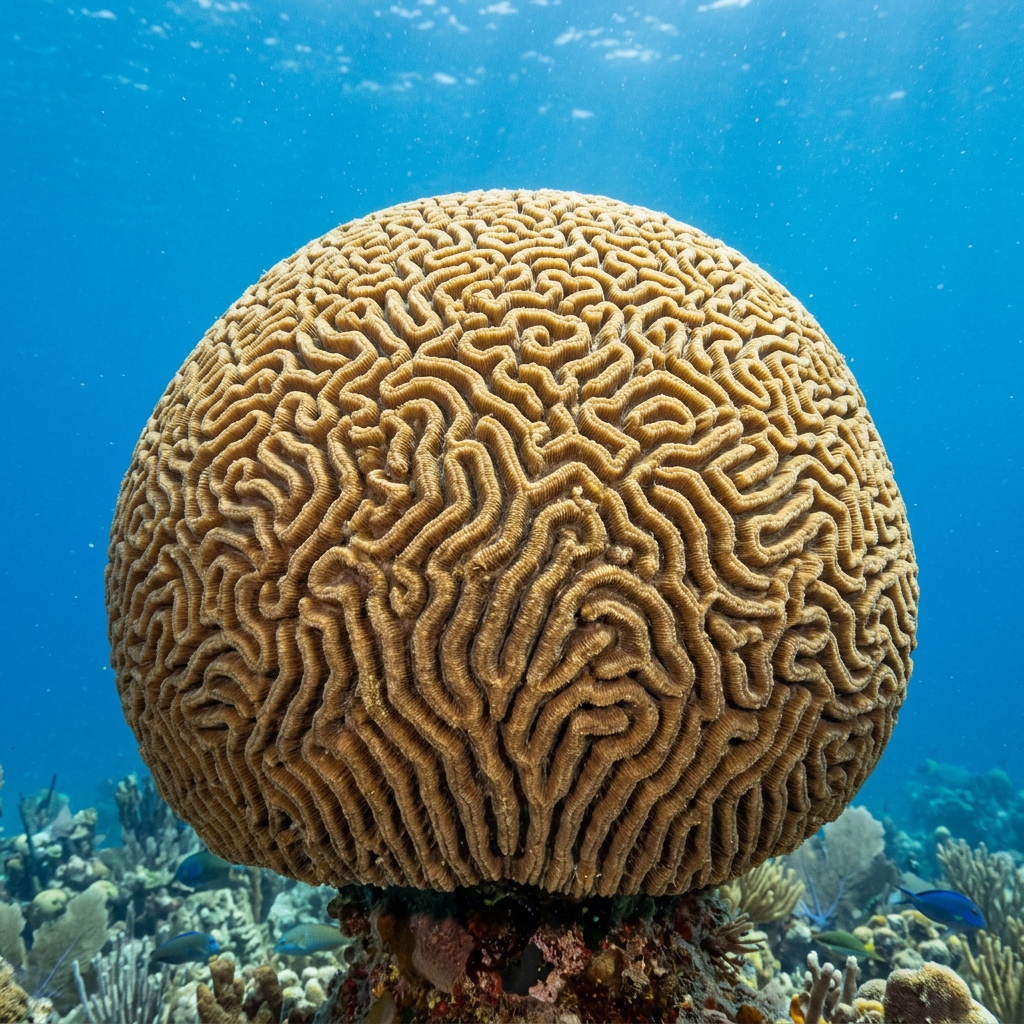
A large, dome-shaped coral colony with a surface covered in continuous, winding ridges and deep grooves that trace maze-like (labyrinthine) patterns across the entire head. Colouration is typically tan, yellowish-brown, or grey-green, with the groove valleys often appearing slightly darker than the ridges. Colonies can grow to boulder size, making them one of the more conspicuous structures on the reef. The unbroken, meandering channel system distinguishes it from corals with discrete, separated bumps or polyp cups.
Being a sessile (permanently fixed) organism, grooved brain coral simply sits on the reef and does not move or react to divers. What makes the encounter worthwhile is watching the community it supports: small reef fish weave through the grooves, and invertebrates like brittle stars and shrimps often tuck themselves into the deeper channels. Light angle matters more than time of day; bright overhead sun in the mid-morning or early afternoon brings out the contrast of the ridges and makes photography most rewarding.
Grooved brain coral is a simultaneous hermaphrodite that spawns by broadcasting both eggs and sperm into the water column in synchronised mass events, typically triggered by lunar cycles after the summer full moons. A single large colony can be hundreds of years old.
No seasonal pattern emerges from the available data, so treat it as a year-round resident. Its observed water-temperature range of roughly 25.6 to 28.9 °C aligns with stable tropical Caribbean conditions, meaning it is present whenever those reefs are diveable.
Most logged across the wider Caribbean, with Cuba, Venezuela, Colombia, and the Bahamas accounting for the bulk of recorded sites. Strong representation is found specifically in Jardines del Rey and the Canarreos Archipelago in Cuba, along Colombia's Caribbean Coast, and in the Florida and Southeast United States region. Belize, Mexico's Yucatán Peninsula, and the Dominican Republic also feature regularly in the site spread.
Mapping where Grooved Brain Coral is logged…
The best bet is the Caribbean, particularly Cuba (Jardines del Rey and the Canarreos Archipelago), Colombia's Caribbean Coast, Venezuela, and the Bahamas. It also appears regularly on reefs in Belize, Mexico's Yucatán Peninsula, and Florida.
There is no defined season for sightings. It lives in stable tropical waters between roughly 25.6 and 28.9 °C, so it is present year-round on Caribbean reefs. Plan your dive around good visibility conditions rather than a particular month.
Look for a large dome or boulder shape with a continuous, winding maze of ridges and valleys covering the entire surface. The unbroken, labyrinthine channel system is the key feature. Colouration is usually tan or yellowish-brown. Other brain corals share a similar overall shape but tend to have different groove patterns or less continuous ridge systems.
Yes. Grooved brain coral is listed as Critically Endangered. Bleaching events, white plague disease, and broader reef degradation have caused widespread decline across the Caribbean. Divers play a role by practising careful buoyancy and never touching or anchoring near colonies.
Large colonies are thought to be several centuries old. Because each polyp adds only a small amount of skeleton each year, a boulder-sized colony represents an extraordinary investment of time. This is one reason physical damage to even a small area of the surface is so significant.
The Grooved Brain Coral is listed as critically endangered by the IUCN. Observe from a distance, avoid touching or feeding it, and report sightings to local marine research organisations.
Listed as Critically Endangered on the IUCN Red List, this species has suffered significant decline due to bleaching, disease, and reef degradation. Divers should maintain good buoyancy control and avoid any contact with the colony; even a brief touch can damage tissue that took decades to grow.
Site and sighting data is aggregated from diver logs, iNaturalist and GBIF. For taxonomy and conservation status:
Plate Coral
2,991 sites