Gramma loreto
Spot the vivid purple-and-yellow fairy basslet on Caribbean reefs. Most reliably logged in Roatán, Grand Cayman, and Bonaire, present year-round.
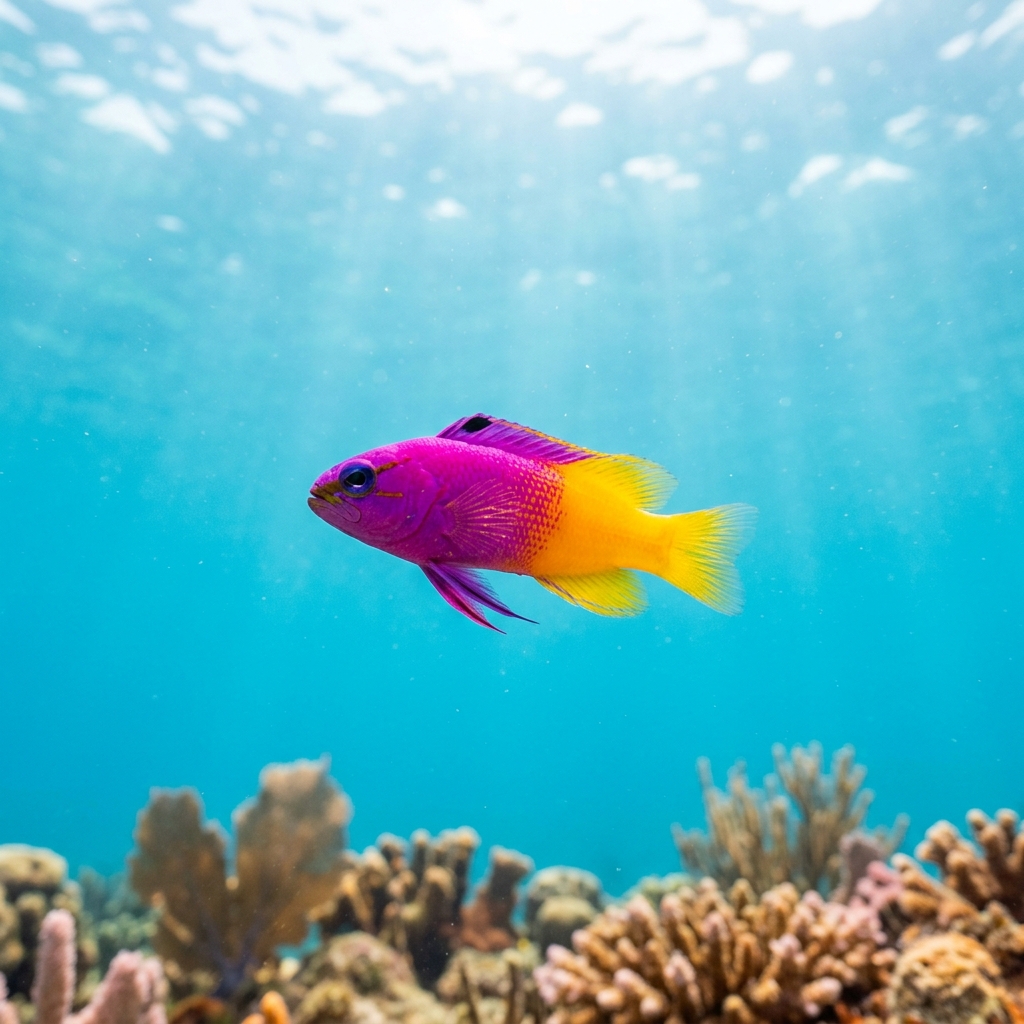
Two colours split the body almost perfectly down the middle: the front half is deep violet-purple, the rear half is bright yellow-orange. It is a small fish, typically just a few centimetres long, with a single dark spot on the front of the dorsal fin. You will almost always see it close to the reef face or overhang, often orientated upside-down relative to the surface, its belly pointing toward the nearest hard substrate rather than downward.
Fairy basslets hover in small groups just off reef walls, overhangs, and the ceilings of coral caverns, often swimming upside-down to keep their bellies close to the substrate, a habit that surprises first-time viewers. They are shy and dart back into crevices quickly when approached, so slow, unhurried movement at their level gives you the best look. They tend to stay within a metre or two of shelter at all times.
Fairy basslets are protogynous hermaphrodites: individuals begin life as females and the dominant fish in a group can transition to male. This means the largest, boldest individual you see hovering near a crevice is almost certainly a male.
Present year-round with no concentrated season. Observed water temperatures run from roughly 26.5 to 29 °C, which matches stable tropical Caribbean conditions, so there is no meaningful off-season for this species.
Fairy basslets are most widely logged across the Caribbean, with the strongest sighting records in the Cayman Islands (particularly Grand Cayman and Little Cayman), Bonaire's west coast and Klein Bonaire, and Roatán in Honduras. The British Virgin Islands, US Virgin Islands, Guadeloupe, the Bahamas, and Belize all show strong populations too, making this effectively a reef-wide Caribbean species.
Mapping where Fairy Basslet is logged…
Fairy basslets are a Caribbean species logged across a wide range of countries. The most reliable sightings come from the Cayman Islands, Bonaire, and Roatán in Honduras. The British Virgin Islands, US Virgin Islands, Guadeloupe, the Bahamas, and Belize are all productive locations too.
Any time of year works. Fairy basslets show no concentrated season across Northern Hemisphere dive sites and are found year-round on Caribbean reefs. The stable tropical water temperatures they favour, around 26 to 29 °C, persist throughout the year at most of their core locations.
Look for a small fish split cleanly into two colours: vivid purple on the front half and bright yellow-orange on the rear. A dark spot on the front of the dorsal fin (the top fin) is another useful mark. They are almost always seen right against a reef wall or overhang, frequently swimming upside-down.
Fairy basslets are small reef fish, typically reaching around 6 to 8 centimetres in length. Their compact size, combined with their habit of staying close to crevices, means you need to look carefully along reef walls rather than out in open water.
Fairy basslets orientate their belly toward the nearest hard surface rather than toward the sea floor. On a vertical reef wall or inside an overhang, that means they appear to be swimming upside-down. It is thought to be a foraging and sheltering behaviour rather than anything unusual about their balance.
Site and sighting data is aggregated from diver logs, iNaturalist and GBIF. For taxonomy and conservation status:
Soldierfish
3,612 sites