Goniodoridella picoensis
A small, uncommon nudibranch most often logged in the French Riviera and Gozo, in water from 14 to 20C, year-round.
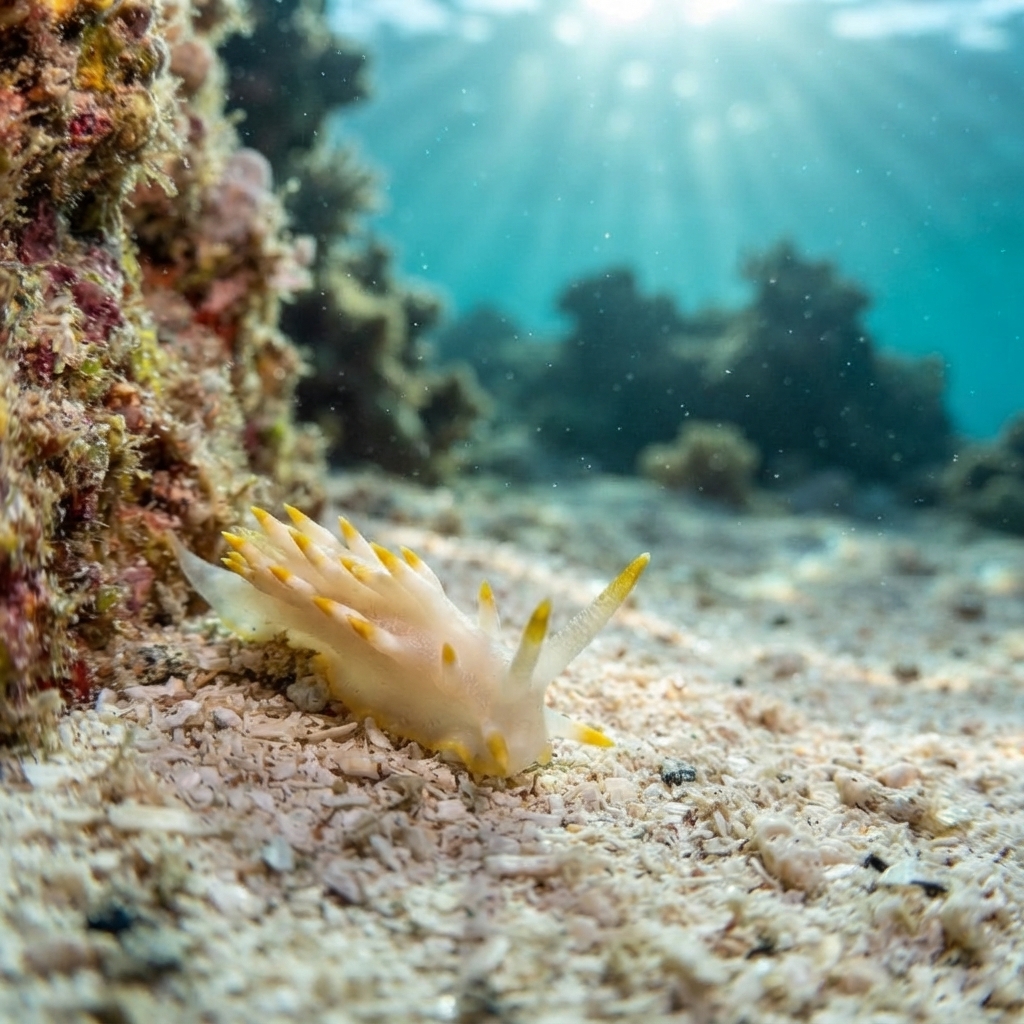
A small nudibranch (sea slug) best picked out by patient reef scanning rather than size or colour drama, since it sits low on encrusting growth and rocky substrate. Look for a compact, soft-bodied form with fine tubercles (small bumps) across the back, in muted tones that blend into the algae and sponge it crawls over. Its rhinophores (the paired sensory stalks on the head) and the small feathery gill cluster near the tail are the features to check against similar dorids once you spot it.
Divers usually find it slow-moving or stationary on rock, sponge or algae-covered surfaces, grazing rather than swimming, which makes it easy to pass right by if you are not looking closely. It shows no reaction to divers beyond the usual slug shrug, so a slow torch-lit scan of ledges and encrusted walls on a muck or reef dive is the way to find one. Most logs describe it as uncommon rather than common, so treat any sighting as a nice find rather than a given.
Like other goniodorid nudibranchs, it almost certainly feeds on specific sessile invertebrates such as bryozoans or sponges, which is why it stays put on the same patch of encrusting growth rather than roaming the reef.
Sightings show no clear seasonal peak, and it turns up across the year in water between roughly 14 and 20C, so any month you are diving the French or Maltese Mediterranean is worth a look.
Reef neighbours a diver could mistake it for. Use the identification notes above to tell them apart.
This one is most reliably found in the Mediterranean, with the strongest logging in France, especially the French Riviera and Provence and Corsica, and a solid second stronghold in Gozo and Comino, Malta. Divers also report it from Catalonia in Spain and, occasionally, the Mediterranean coast of Israel.
Mapping where Pico Goniodoridella is logged…
It is most often logged in the French Riviera and Provence and in Corsica, France, plus Gozo and Comino in Malta. Smaller numbers of sightings come from Catalonia, Spain, and the Mediterranean coast of Israel.
There is no strong seasonal pattern in the sightings, so it is logged across the year in water from about 14 to 20C. Any dive trip to the French or Maltese Mediterranean has a fair shot at turning one up.
Look for a small, low-profile nudibranch with a bumpy (tuberculate) back in muted colours, sitting still on rock, sponge or algae. Check the rhinophores and small tail-end gill cluster against similar dorids to confirm it is not a look-alike species.
Exact size data is not established for this species, but like most goniodorid nudibranchs it stays small, in the centimetre range, and is easy to overlook without a close, slow search of the substrate.
Most divers who log it describe it as uncommon rather than common, with true common sightings limited to a smaller set of sites in France and Malta. Rare reports also come in, so treat any find as a bit of a bonus rather than guaranteed.
Site and sighting data is aggregated from diver logs, iNaturalist and GBIF. For taxonomy and conservation status:
Light-spotted Aegires
3,168 sites