Siganus lineatus
Yellow-striped and reef-bound, goldlined rabbitfish turn up year-round from Raja Ampat to Queensland in 25 to 29 C water.
Safety warning
The dorsal, anal and pelvic fins carry venomous spines that deliver a painful sting if handled or accidentally brushed, so give it space rather than trying to touch or corner it. Sightings are calm from a distance; the risk is almost entirely to divers who grab or crowd the fish.
If you're stung
Venomous fin spinesGeneral first-aid guidance, not a substitute for professional medical care. In an emergency, call your local emergency number.
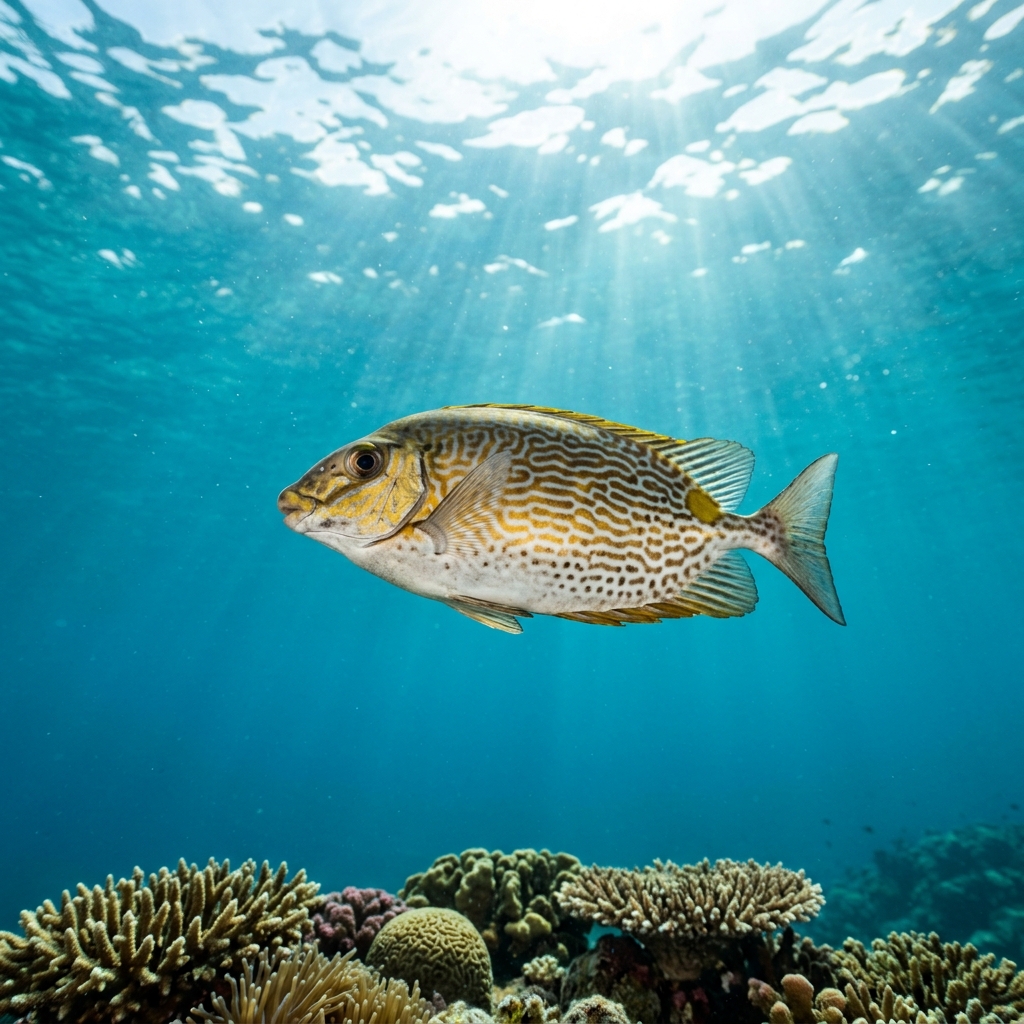
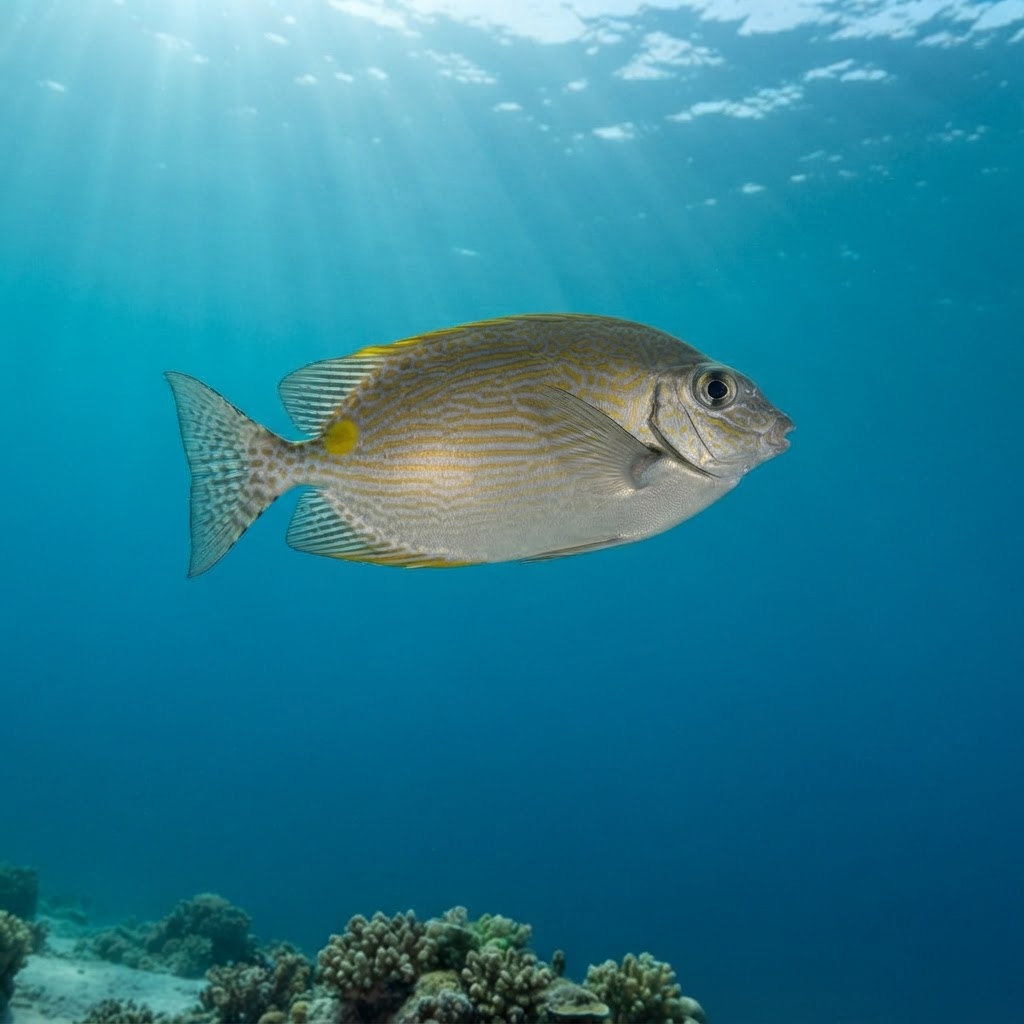
Look for an oval, laterally flattened body about 30 cm long with a pointed snout, patterned in blue-grey with narrow gold-yellow stripes running head to tail. A bright yellow saddle patch sits just behind the head, and the dorsal fin carries a venomous spine that stays raised when the fish feels crowded. It swims in a slow, deliberate glide low over the reef rather than darting, which makes the stripe pattern easy to pick out even at a distance.
Divers most often find it grazing algae over shallow reef flats and rubble patches, usually alone or in loose pairs rather than big schools. It tends to keep a steady distance from divers, drifting off unhurried rather than bolting, and logs as uncommon at more sites than it is common, so a sighting usually means one or two fish rather than a crowd.
Like other rabbitfish, it can pair up and stay close to the same partner over time, which is why divers often see two moving together along the same stretch of reef.
No clear seasonal pattern shows up in the sighting data, and with a comfortable range of roughly 25 to 29 C, these reefs stay within its preferred temperature year-round. Treat it as a year-round sighting rather than something to plan a trip around.
Most reliably logged on reefs around Queensland in Australia, plus strong numbers in Raja Ampat, Indonesia and around Koror and Malakal in Palau. Efate in Vanuatu and Nouméa in New Caledonia also turn up sightings, so the species has a solid spread across the western Pacific rather than being tied to one hotspot.
Mapping where Goldlined Rabbitfish is logged…
Queensland in Australia is the most consistent spot, with good numbers also logged in Raja Ampat, Indonesia and around Koror and Malakal in Palau. Efate in Vanuatu and Nouméa in New Caledonia round out the western Pacific spread.
There's no strong season in the data, and the water it favours, roughly 25 to 29 C, stays warm on these reefs all year. Expect a similar chance of a sighting whenever you dive these regions.
They carry venomous spines in the dorsal, anal and pelvic fins that sting if touched or squeezed, but they don't approach or chase divers. Keep hands off and admire from a short distance and there's no issue.
Look for a blue-grey oval body with fine gold stripes and a yellow patch behind the head, cruising low and slow over the reef. The pointed snout and steady, unhurried swim style help separate it from faster reef fish nearby.
They typically reach around 30 cm in length, a medium-sized reef fish that's easy to spot once you know the stripe pattern.
They're often seen moving in twos, reflecting a tendency in rabbitfish to form lasting pairs rather than travel solo or in large schools.
Site and sighting data is aggregated from diver logs, iNaturalist and GBIF. For taxonomy and conservation status:
Soldierfish
3,612 sites