Siganus guttatus
Yellow-and-blue reef fish common off Phuket, Koh Tao and the Visayas, watch for its venomous dorsal spines when diving 25 to 29 C reef water year-round.
Safety warning
The dorsal, anal and pelvic spines carry venom glands and can deliver a painful sting if the fish is grabbed or accidentally brushed against, so admire it with your hands away from the reef and avoid cornering it in crevices.
If you're stung
Venomous fin spinesGeneral first-aid guidance, not a substitute for professional medical care. In an emergency, call your local emergency number.
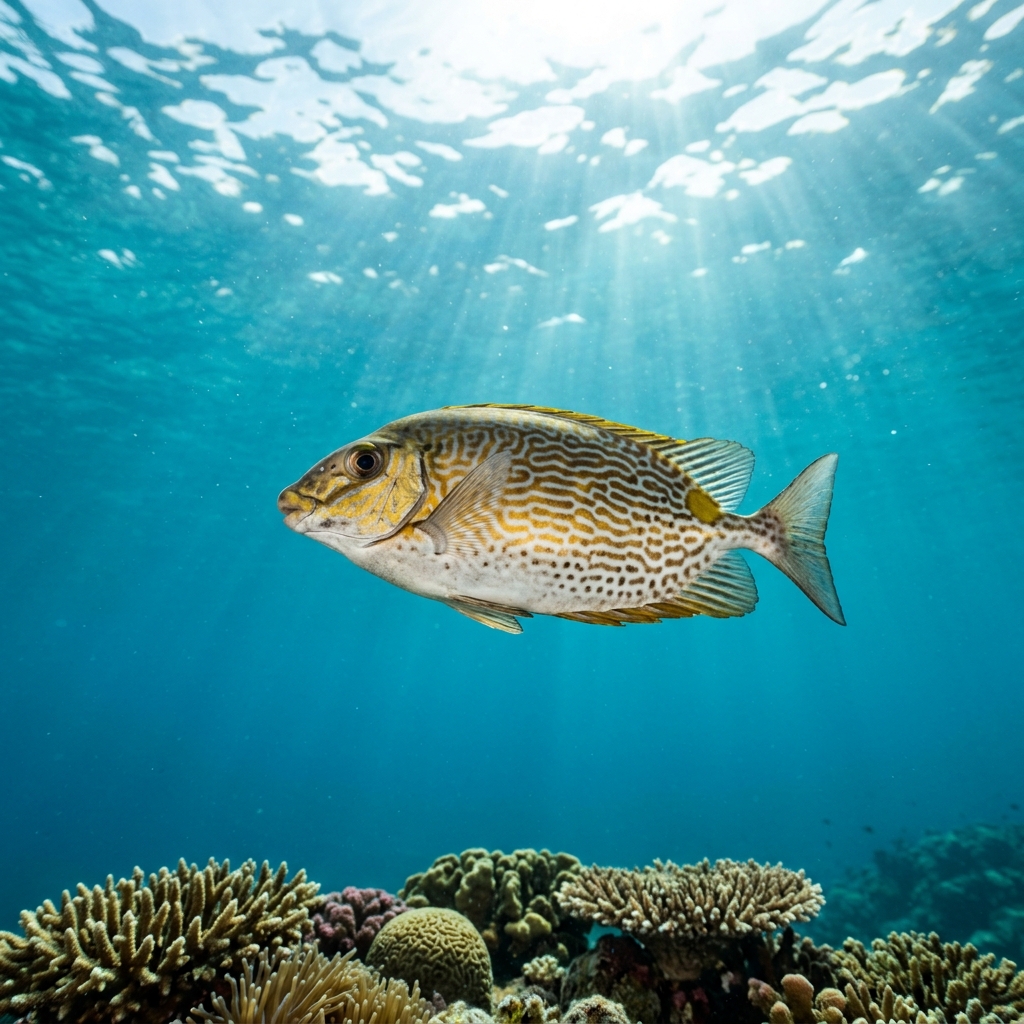
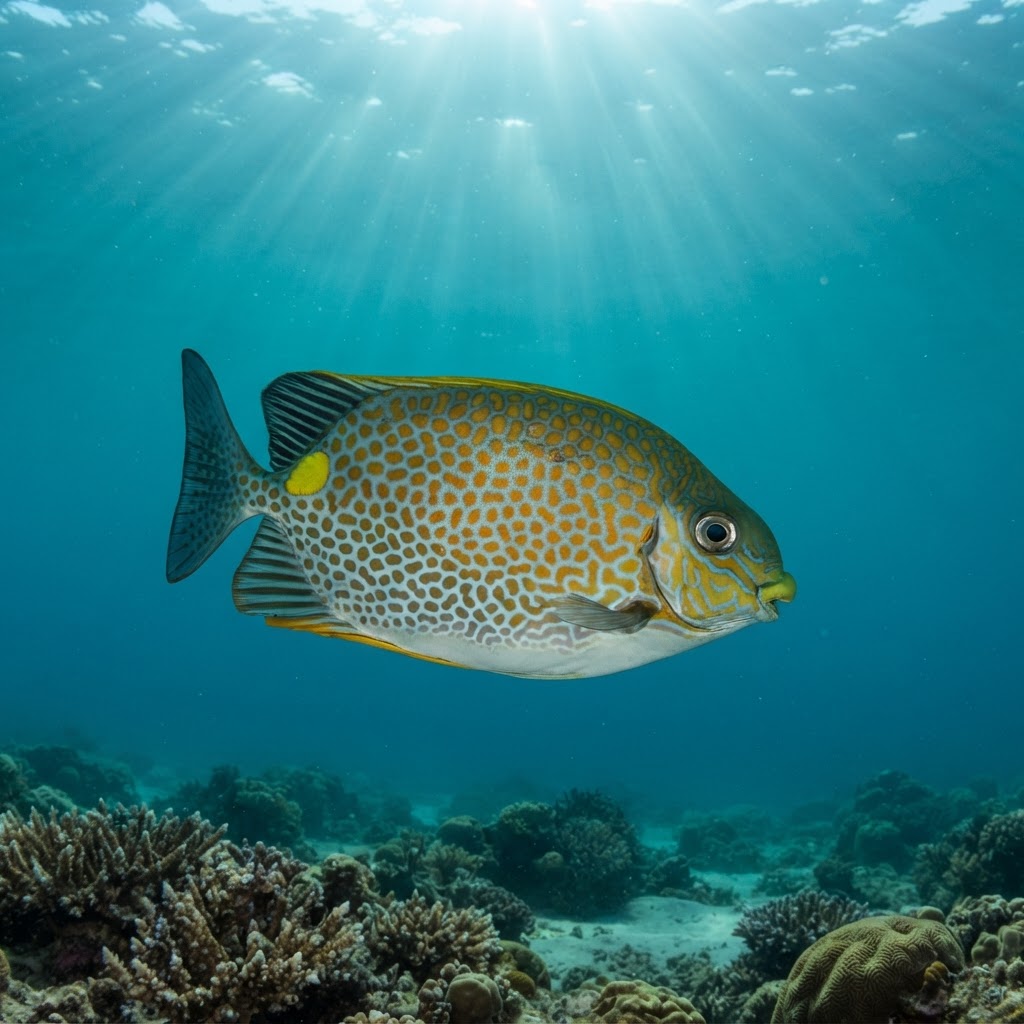
Look for an oval, laterally flattened body in bright yellow to golden-brown, covered in fine blue spots and lines, with a distinctive orange-brown saddle patch across the upper back near the tail. It grows to around 29 cm, usually seen alone or in loose pairs grazing close to the reef, moving with slow, deliberate fin strokes rather than darting. The small, rabbit-like mouth and continuous dorsal spine row running the length of the back are good confirming details.
Divers most often find it browsing algae and small invertebrates on shallow reef flats and rubble patches, moving unhurriedly and tolerating a fairly close approach before drifting off rather than bolting. It tends to stick near cover such as coral heads or seagrass edges, and is logged as uncommon rather than a guaranteed sighting at most sites, though a handful of locations report it consistently.
Like other rabbitfish, it can pair-spawn and release eggs that stick to algae or seagrass rather than drifting freely, giving the next generation a head start close to shelter.
Sighting data shows no strong seasonal pattern, and with a comfortable range of 25.4 to 29.3 C it stays active on reefs through the year, so any month at these sites is workable.
This is a reliable sighting across Thailand, particularly Phuket, Koh Tao and Koh Phi Phi, and it turns up just as often in Malaysia, both on the Peninsular East Coast and in Sabah. The Philippines, especially the Visayas, and Indonesia's Sulawesi region also produce steady logs, with smaller but consistent records from India, Taiwan and Vietnam.
Mapping where Golden Rabbitfish is logged…
It shows up most reliably in Thailand around Phuket, Koh Tao and Koh Phi Phi, and is equally common in Malaysia's Peninsular East Coast and Sabah. The Philippine Visayas and Indonesia's Sulawesi also produce regular sightings.
There's no clear seasonal pattern in the sighting data, and it stays comfortable in warm reef water between roughly 25 and 29 C year-round, so it's a fair bet on any dive trip to its usual regions.
They carry venomous spines on the dorsal, anal and pelvic fins that can cause a painful sting if handled or brushed. They're not aggressive, so simply avoid touching or cornering one.
Check for a yellow to golden body with fine blue speckling and a rusty-orange saddle patch on the upper back near the tail. It has an oval, flattened shape, a small rabbit-like mouth, and moves slowly along the reef rather than darting.
They typically reach around 29 cm in length, making them a medium-sized reef fish comparable to a large angelfish in the water.
They spawn in pairs and lay sticky eggs that adhere to algae or seagrass instead of drifting in open water, which helps keep the next generation close to sheltering habitat.
Site and sighting data is aggregated from diver logs, iNaturalist and GBIF. For taxonomy and conservation status:
Soldierfish
3,612 sites