Genicanthus watanabei
Spot Watanabe's Angelfish in New Caledonia and Vanuatu. Learn how to identify this uncommon reef fish by colour and body shape before your next dive.
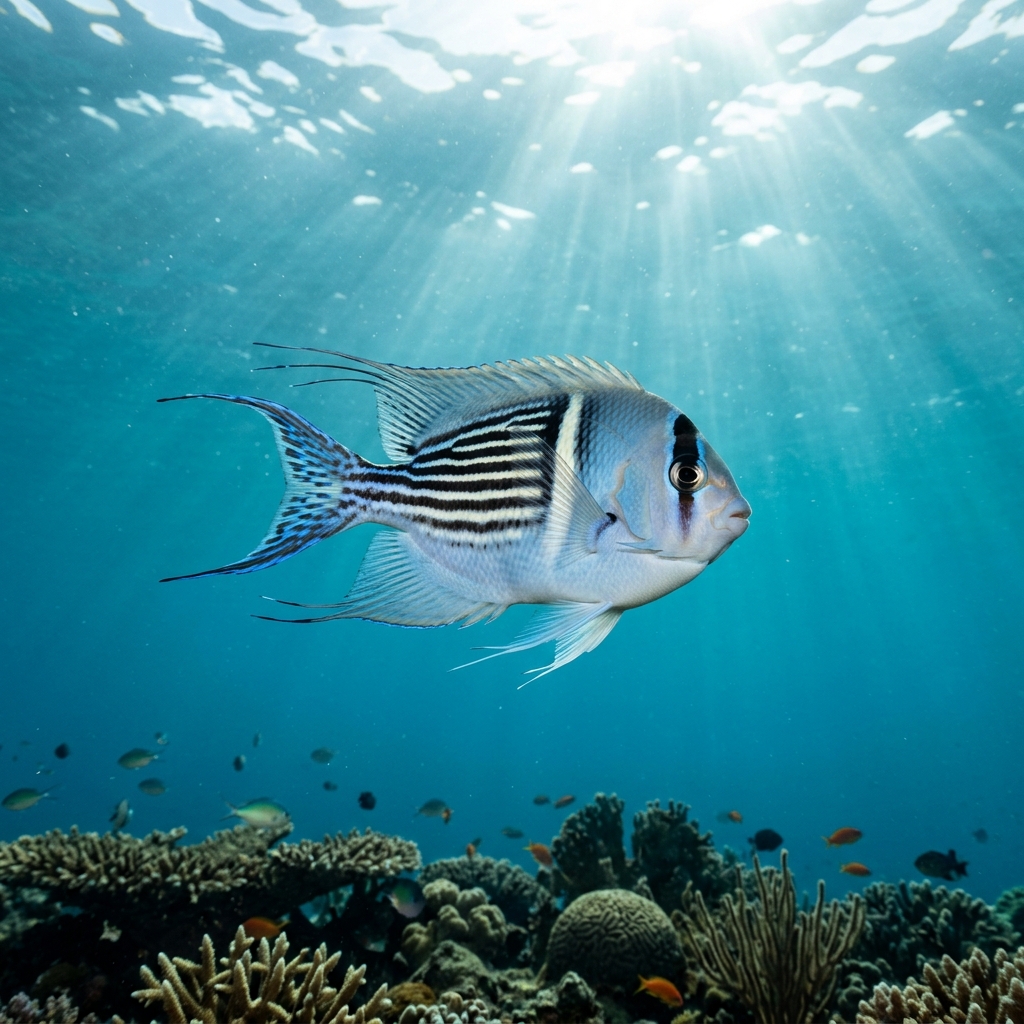
A slender, laterally compressed angelfish with a pale blue or greyish-white body crossed by vivid dark horizontal lines running from head to tail, the key mark to look for underwater. Males show a black facial mask and darker dorsal colouring, while females are noticeably paler overall with less contrast. It is a medium-sized angelfish and moves with the relaxed, undulating glide typical of the Genicanthus genus, which tends to hover higher in the water column than many of its relatives.
Watanabe's Angelfish tends to occupy mid-water above coral slopes and drop-offs rather than sheltering deep in the reef structure, making it easier to spot than many angelfishes. It is typically seen in pairs or small groups, a social pattern common in Genicanthus angelfishes, which form harems with a dominant male. Divers report it as wary rather than bold, it keeps a comfortable distance and will retreat if approached too directly.
Like all Genicanthus angelfishes, Watanabe's Angelfish is a protogynous hermaphrodite: females can transition into males when a dominant male disappears, which explains the striking colour difference between the sexes.
There is not enough seasonal sighting data to point to a peak month, so it is treated as year-round. The observed water-temperature range of around 20 to 28 °C fits the subtropical and tropical reef systems of New Caledonia and Vanuatu through all seasons.
Sightings are clustered around Nouméa and the reefs of New Caledonia, which accounts for most logged encounters. Efate in Vanuatu adds another location in the same broad South Pacific region, so a trip combining both destinations offers the best coverage.
Mapping where Watanabe's Angelfish is logged…
Most logged sightings come from reefs around Nouméa, New Caledonia, with additional records from Efate, Vanuatu. Both destinations sit in the South Pacific and offer subtropical to tropical reef diving where this species has been confirmed by divers.
There is no confirmed seasonal peak in the dive data. It is observed year-round across its recorded sites, which sit within a water-temperature range of roughly 20 to 28 °C, so any dive season in New Caledonia or Vanuatu is a reasonable bet.
Look for a slender angelfish with a pale blue-grey body crossed by bold, dark horizontal lines. Males have a black facial mask; females are paler and lack it. The habit of hovering mid-water above reef slopes rather than hiding in crevices helps distinguish Genicanthus angelfishes as a group.
Precise size data is limited in diver records, but Genicanthus angelfishes typically reach around 15 cm in length. In the water they appear a slender, moderate-sized fish, noticeably more streamlined than the deep-bodied pygmy angelfishes.
Yes. Like all members of the Genicanthus genus, Watanabe's Angelfish is a protogynous hermaphrodite, fish begin life as females and dominant individuals can transition into males. This explains why males and females look so different in colour and patterning.
Site and sighting data is aggregated from diver logs, iNaturalist and GBIF. For taxonomy and conservation status:
Rock Beauty
1,573 sites