Genicanthus melanospilos
Spot the Swallowtail Angelfish in Fiji's Taveuni reefs and Sulawesi, Indonesia. Tips on ID, behaviour, and what to expect in 26-29 °C tropical waters.
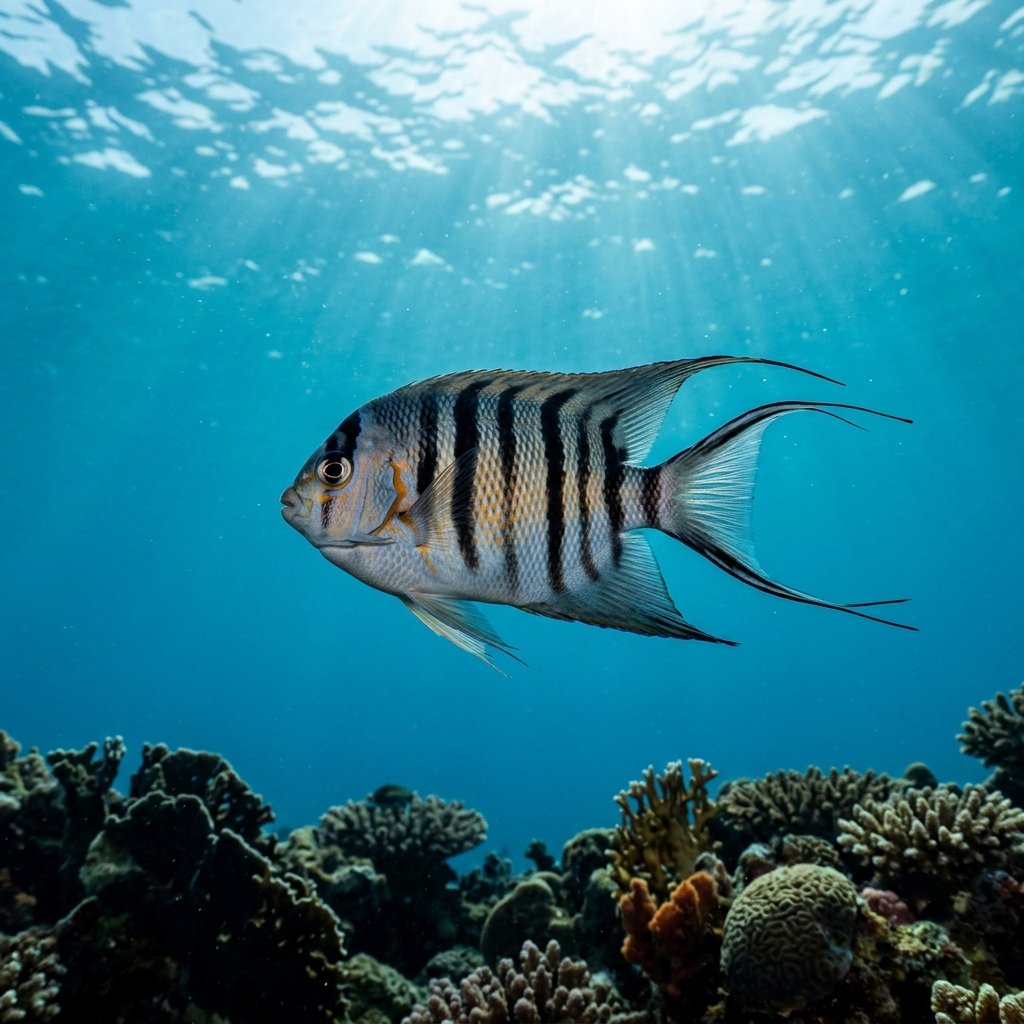
The forked, swallow-like tail is the unmistakable feature that sets this angelfish apart from almost every other reef dweller. Males are pale blue-white on the body with a scattering of black spots along the upper sides and a yellow-orange wash on the back and tail lobes. Females are plainer, with a yellow dorsal surface, blue-white underside, and no spots. Both sexes have a slender, laterally compressed body typical of the Genicanthus genus, giving them a more streamlined look than stockier angelfish.
Swallowtail angelfish tend to cruise the mid-water above coral slopes and drop-offs rather than hugging the reef, which makes them easier to spot but also quicker to retreat into deeper water if approached too directly. They are typically seen in small haremic groups, with a single male accompanying several females, actively feeding on zooplankton in the water column. Slow, non-threatening approaches give the best chance of a close look before they drift down.
Like other Genicanthus angelfish, the swallowtail is a protogynous hermaphrodite (females can transition to males), and dominant males actively control social groups on the reef.
No clear seasonal peak has emerged from the data, so sightings appear possible year-round. The species is consistently logged in warm tropical water between about 26 and 29 °C, which is stable across Fiji and Indonesia throughout the year.
Taveuni in Fiji is by far the strongest location on record, accounting for nearly all logged sightings, making it the go-to destination for encountering this species. A small number of observations also come from Sulawesi and the Nusa Tenggara and Banda Sea region of Indonesia, suggesting a broader but patchier presence across the Coral Triangle.
Mapping where Swallowtail Angelfish is logged…
Taveuni, Fiji, is the standout location, with the large majority of recorded sightings coming from there. Smaller numbers of observations come from Sulawesi and the Nusa Tenggara and Banda Sea area of Indonesia. Fiji is your best bet for a reliable encounter.
There is no defined peak season in the available data. The species occupies warm tropical reefs around 26 to 29 °C year-round, so any time you dive in Fiji or Sulawesi is a reasonable time to look for them.
Look for the deeply forked, swallow-like tail that gives the species its name. Males show black spots on a pale blue body with yellow-orange on the back; females are yellow on top and white-blue below with no spots. Both sexes have a slender, streamlined build and tend to swim in open water above the reef rather than tight against the coral.
Swallowtail angelfish reach around 18 to 20 cm in length. Like other Genicanthus species, they are relatively slender and elongated compared to the chunkier large angelfish, which can make them look a touch smaller than they actually are in the water.
Yes. The swallowtail angelfish is a protogynous hermaphrodite, meaning females can transition into males. Dominant males hold a harem of females, and if a male disappears, the leading female can change sex to take his place. This is a trait shared across the Genicanthus genus.
Site and sighting data is aggregated from diver logs, iNaturalist and GBIF. For taxonomy and conservation status:
Rock Beauty
1,573 sites