Tritonicula hamnerorum
Look for this small nudibranch on reefs in Basse-Terre and Grande-Terre, Guadeloupe, in warm 25-31C water year-round.
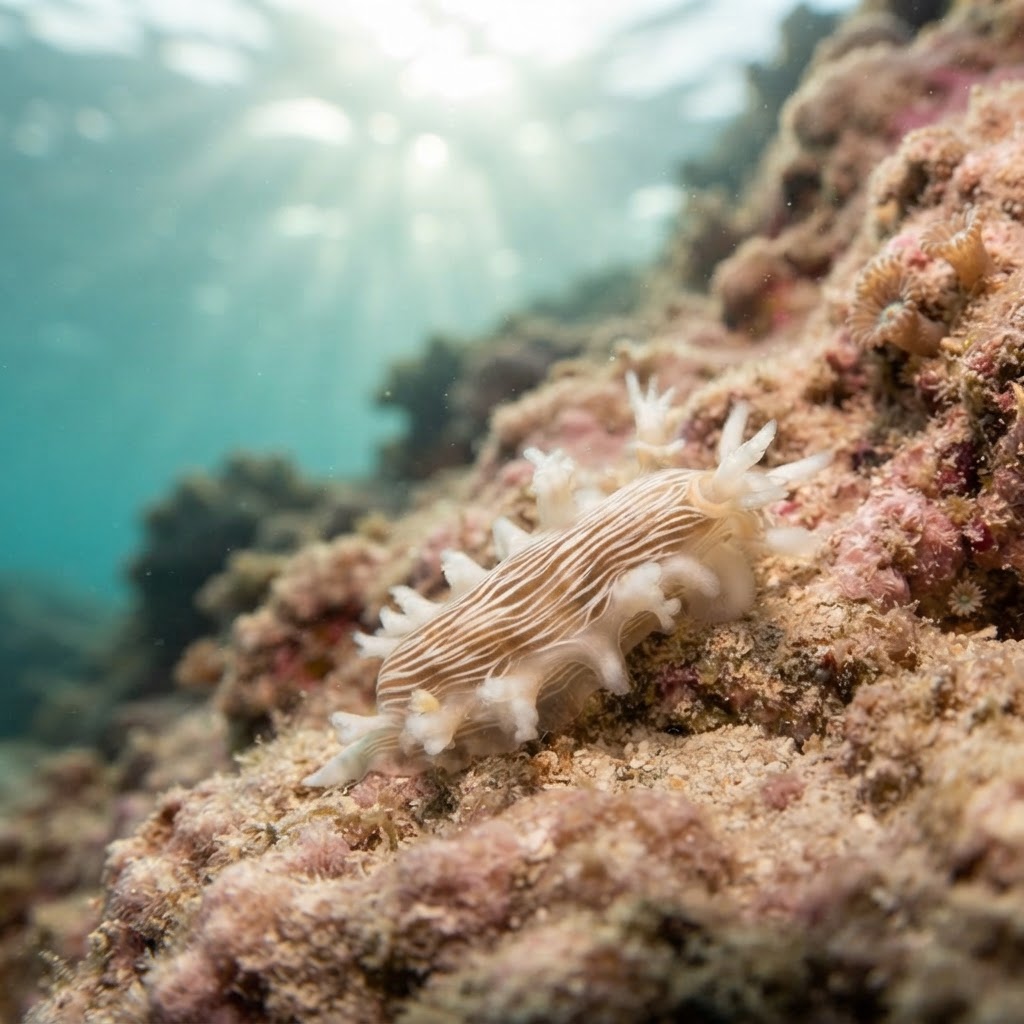
A small, soft-bodied sea slug with a translucent to pale body and a tuft of feathery gills (the exposed breathing organs) on its back, typical of the tritoniid family. It moves slowly across the reef surface and lacks the bold, high-contrast patterning of many of its reef-mate nudibranchs, making it easy to overlook unless you slow down and scan hard substrate and soft coral colonies closely.
Divers find it sitting quietly on the reef or moving slowly across hard substrate, usually near the soft coral and hydroid colonies it feeds on. It shows no reaction to divers beyond continuing its slow crawl, and most sightings come from close, deliberate reef scanning rather than open-water encounters.
Like other tritoniid nudibranchs, it likely feeds on soft corals or gorgonians, using the exposed gill tuft on its back both to breathe and, indirectly, to signal to predators that it has taken on the chemical defences of its prey.
Sightings are spread through the year with no detected season, and the observed water temperature range of roughly 25 to 31C matches typical Caribbean reef conditions year-round, so there is no particular month to target.
Reef neighbours a diver could mistake it for. Use the identification notes above to tell them apart.
Most consistently logged in Guadeloupe, especially around Basse-Terre and Grande-Terre, with a strong secondary population around Grand Cayman in the Cayman Islands. Divers also report it regularly around Portsmouth, Dominica, making the eastern Caribbean the reliable region for a sighting.
Mapping where Hamner's Tritonia is logged…
Guadeloupe is the strongest area, particularly Basse-Terre and Grande-Terre, with good numbers also reported around Grand Cayman in the Cayman Islands and Portsmouth in Dominica.
There is no clear season in the sighting data, and the warm 25 to 31C water it is found in holds steady year-round on these Caribbean reefs, so any month works.
Look for a small, pale, soft-bodied slug with a cluster of feathery gills on its back, moving slowly over hard substrate or soft coral. It lacks bright warning colours, so it is easy to swim past without a close look.
No, they pose no threat to divers. They have no stinging cells that affect humans and simply crawl slowly across the reef.
Exact size data is not available for this species, but tritoniid nudibranchs in general are small, typically a few centimetres long, so expect a modest-sized animal easily missed on a quick reef pass.
It is logged as uncommon at most sites where divers find it, with a smaller number of sites reporting it as common or rare, so it takes a bit of searching rather than being a guaranteed sighting.
Site and sighting data is aggregated from diver logs, iNaturalist and GBIF. For taxonomy and conservation status:
Light-spotted Aegires
3,168 sites