Dichistius capensis
Rare on the reef, native to South Africa: find galjoen in the cool 14-25C waters of the Western Cape year-round.
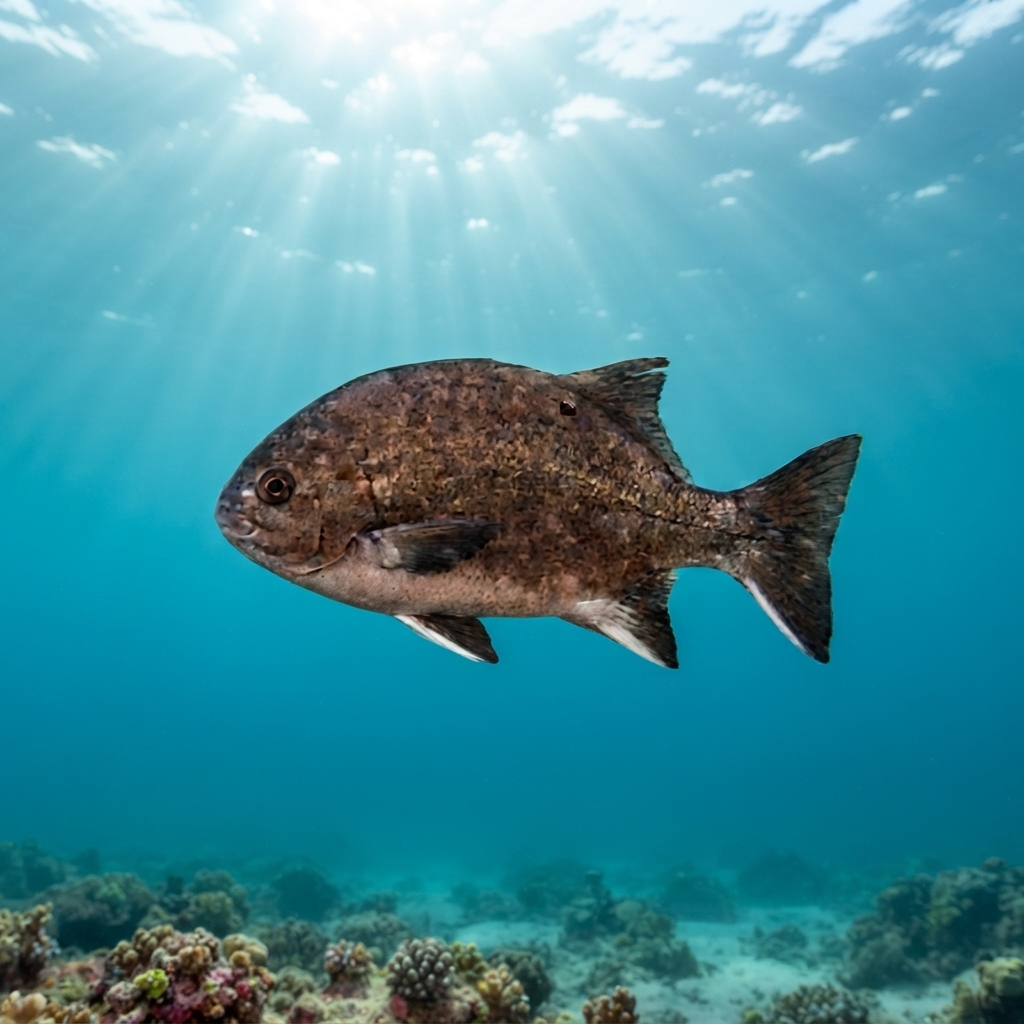
A deep, oval body flattened side-to-side, usually dark grey to near-black, sometimes with faint darker crossbars along the flanks. It has a small, almost puckered mouth built for grazing rather than hunting, and grows to around 56 cm. Look for it holding position tight against rock rather than swimming in open water, using its broad body to shoulder through surge.
Divers typically find it hugging rocky reef and gully structure, holding a fairly fixed position rather than roaming, and it is logged as rare at nearly every site where it has been recorded. It is not a fish that schools up for divers or approaches boats; expect a brief, close-in sighting against rock rather than an open-water encounter.
Its small, tightly muscled mouth is built for grazing red bait and algae off wave-battered rocks, which is why it is almost always seen glued to structure in surge zones rather than cruising open water.
There is no clear seasonal pattern in the sightings, so treat it as a year-round possibility on Western Cape dives. It turns up across a wide temperature range (14.4 to 24.7C), which fits the Cape's cool, current-driven water swinging through the seasons.
This is a South African speciality, and specifically a Western Cape one: every logged sighting in the data comes from dive sites there. If you are diving the cool reefs and rocky gullies around the Cape, keep an eye on structure close to the rock rather than the open water.
Mapping where Galjoen is logged…
Sightings are concentrated in South Africa, specifically the Western Cape, where it is logged at rocky reef dive sites close to shore. It has not been recorded diving anywhere outside this region in the available data.
There is no strong seasonal pattern, so it is best treated as a year-round sighting in the Western Cape. It has been observed across a wide temperature range from about 14 to 25C, reflecting the Cape's variable cool water through the year.
Look for a deep, oval, flattened body in dark grey to near-black, holding tight against rocky structure rather than swimming in open water. Its small mouth and habit of staying close to surge-battered rock are the giveaways, and it grows to around 56 cm.
Galjoen typically reach around 56 cm in length, giving them a noticeably deep-bodied, oval profile compared to slimmer reef fish of similar length.
No, galjoen pose no danger to divers. It is a shy, structure-hugging grazer that keeps its distance rather than approaching or reacting aggressively to divers.
Yes, most dive sites where it has been logged report it as a rare sighting, with only one site reporting it as uncommon. Spotting one is generally a matter of luck on a Western Cape rocky reef dive rather than a reliable encounter.
Site and sighting data is aggregated from diver logs, iNaturalist and GBIF. For taxonomy and conservation status:
Meagre
1,159 sites