Phyllidia alyta
Warty white nudibranch with black lines, most reliably logged across the Central Atolls of the Maldives in 24 to 30C water.
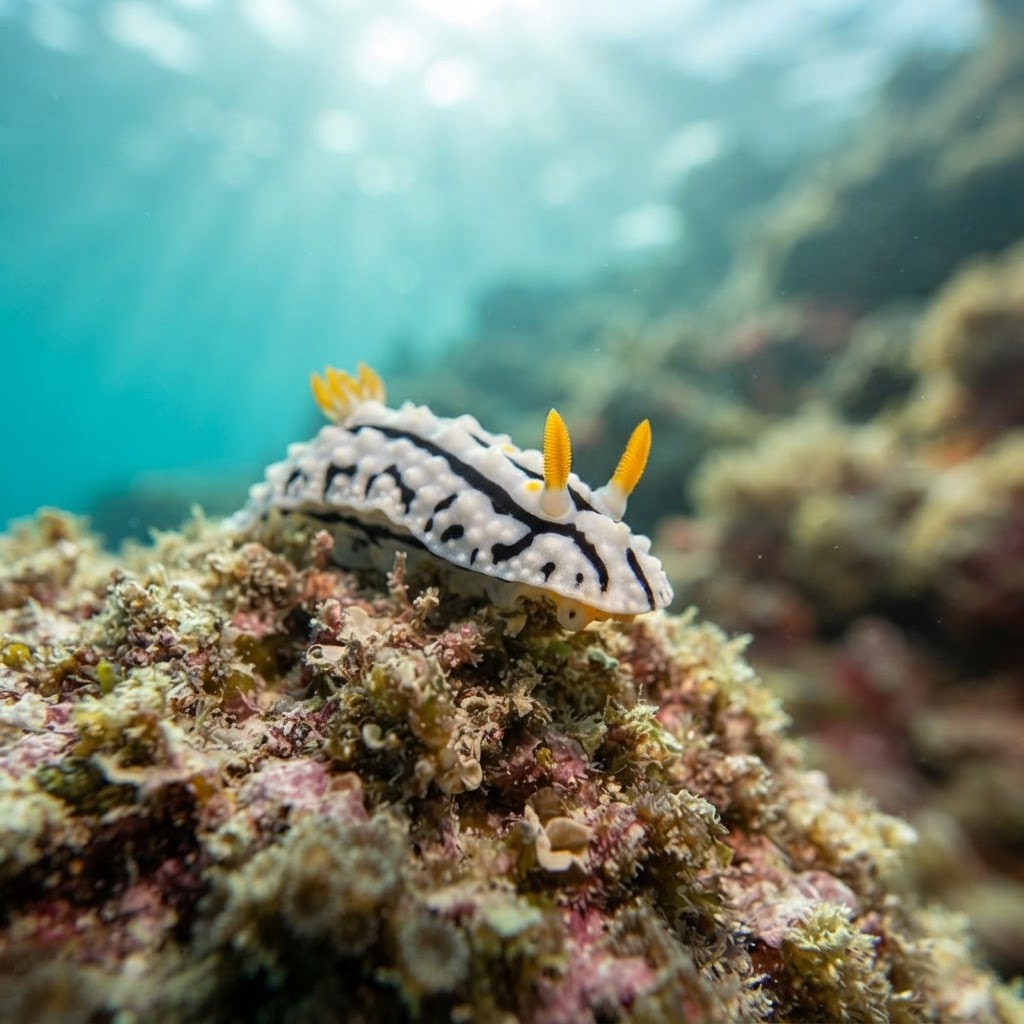
Small, firm-bodied nudibranch covered in raised warty tubercles, with a white or pale grey body marked by four dark longitudinal lines running the length of its back. The texture alone sets it apart from smoother nudibranchs, and the lines stay crisp rather than breaking into spots. It moves slowly across hard substrate and rubble, rarely more than a few centimetres in a single pass.
Divers usually spot it grazing slowly over rubble and low reef structure, often tucked close to the substrate where its warty texture blends in with sponge-covered surfaces. It shows no reaction to divers beyond continuing its slow crawl, making it an easy subject for a macro shot once you have found one. Most logs describe single individuals rather than groups, so a careful scan of the bottom is usually needed to pick it out.
Like other phyllidiid sea slugs, it feeds on sponges and is thought to draw toxic compounds from that diet into its own tissue as a defence, which is part of why its warty skin looks so unappetising to potential predators.
No clear seasonal pattern shows up in the sightings, and its comfort range of 24.4 to 30.4C covers these reefs year-round, so any month is fair game.
Reef neighbours a diver could mistake it for. Use the identification notes above to tell them apart.
Most commonly logged in the Maldives, especially across the Central Atolls and Northern Atolls, where it turns up on reef flats and rubble patches. Outside the Maldives it is a steady find in Reunion, particularly around Saint-Paul and Saint-Leu, with occasional sightings logged in Mayotte.
Mapping where Four-lined Wart Slug is logged…
The strongest sightings come from the Maldives, particularly the Central and Northern Atolls, with a reliable secondary population around Reunion's Saint-Paul and Saint-Leu coasts. It has also been logged at least once in Mayotte.
There is no detected season for this species, and it sits comfortably in 24 to 30C water year-round, so sightings are spread evenly across the calendar rather than clustered in one period.
Look for a small, warty-skinned nudibranch in white or grey with four dark lines running along its back. The rough, tubercle-covered texture combined with those four stripes is the main giveaway.
No, it poses no threat to divers. It has no means of stinging or biting and simply relies on its unpleasant taste to deter predators, so it is completely safe to photograph up close.
Site and sighting data is aggregated from diver logs, iNaturalist and GBIF. For taxonomy and conservation status:
Light-spotted Aegires
3,168 sites