Flabellina ischitana
A small violet-and-orange nudibranch logged across the French Riviera and Costa Brava, in 15 to 21C water, year-round.
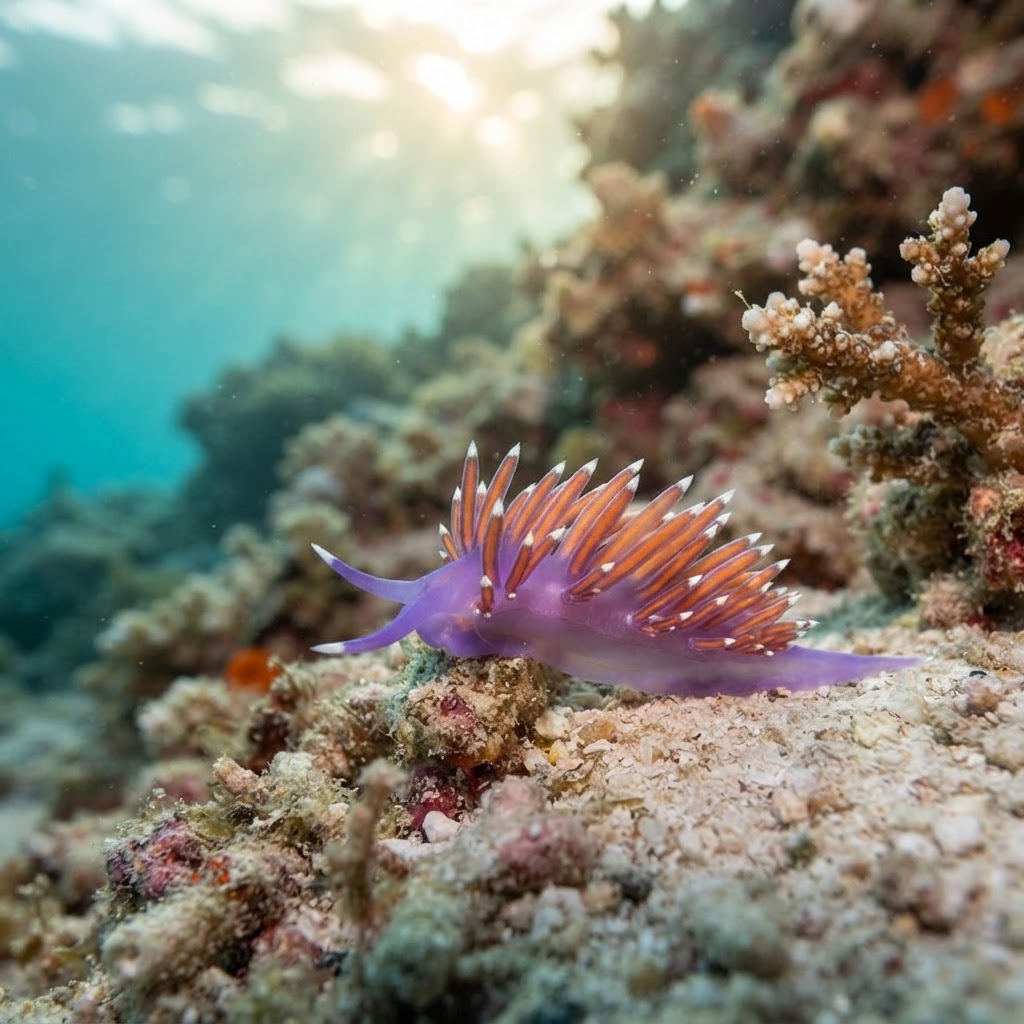
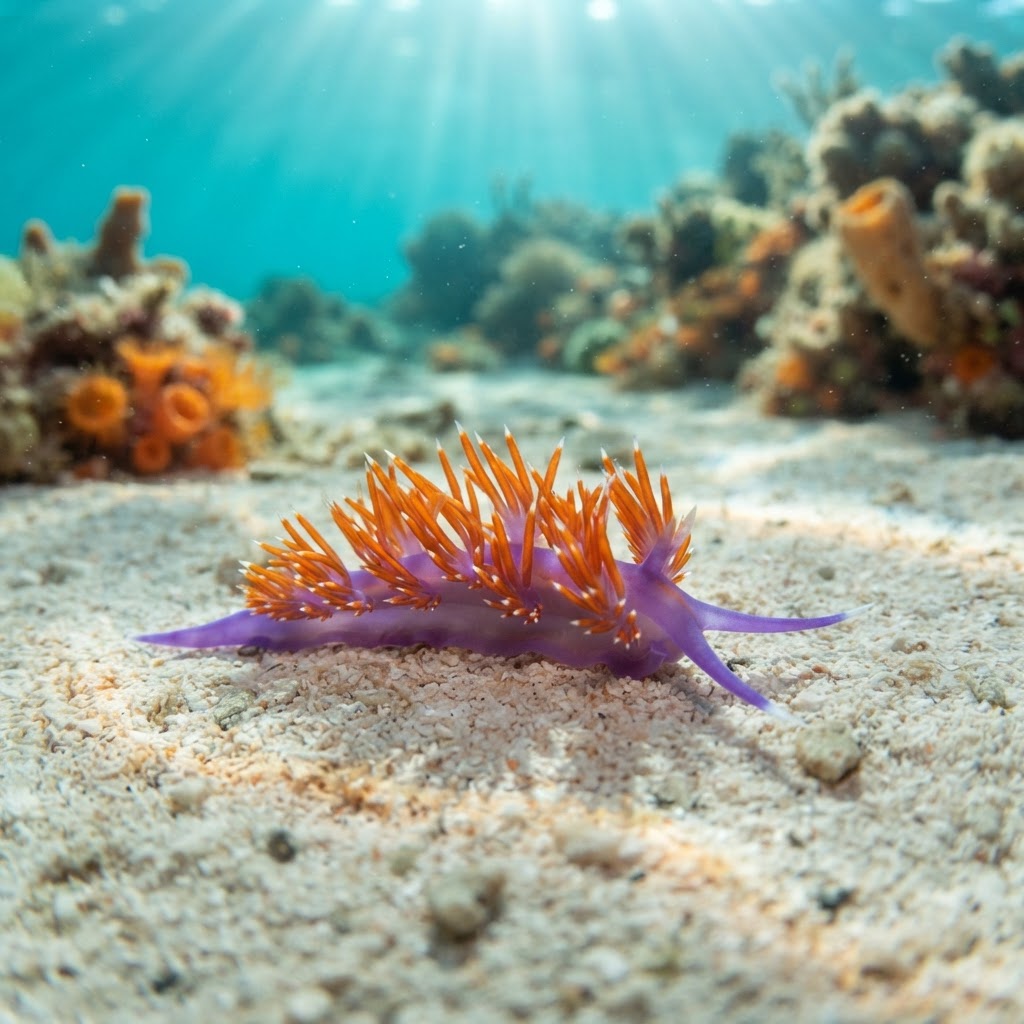
Look for a slender, translucent white to pale body just a centimetre or two long, covered in slim finger-like projections (cerata) that carry violet-purple bands and bright orange tips. The head bears two long, smooth rhinophores (sensory tentacles) that pick up a violet tint matching the cerata. It moves slowly across rock and algae, and the colour contrast against grey Mediterranean rubble is usually what catches a diver's eye first.
Divers usually spot this nudibranch grazing slowly over rock, algae and rubble, often tucked into cracks and low-light corners where its hydroid prey collects. It pays no attention to divers and won't react to a torch or a close look, so it's a patient, macro-focused find rather than something that swims off. Most sightings come from divers working slower, shallower sections of a site rather than mid-water or open sand.
Those orange-tipped cerata aren't just decoration: like other Flabellina species, it feeds on stinging hydroids and repurposes their stinging cells for its own defence, which is part of why the cerata carry such bold colour as a warning.
No clear seasonal pattern shows up in the sighting data, and it's recorded in water from 15 to 21C, so treat it as a year-round find on Mediterranean and nearby Atlantic reefs rather than something tied to a particular month.
Reef neighbours a diver could mistake it for. Use the identification notes above to tell them apart.
This one turns up most reliably along the French Riviera and Provence coast, which accounts for the bulk of logged sightings, with further strong populations in Valencia, the Balearic Islands, Catalonia and Andalusia in Spain. It also shows up with fair regularity in Croatia's Istria and Kvarner regions, and along Portugal's Lisbon Coast, making it a solidly Mediterranean and near-Atlantic find.
Mapping where Ischia Flabellina is logged…
Most sightings cluster along the French Riviera and Provence coast in France, with strong numbers also logged in Valencia, the Balearic Islands, Catalonia and Andalusia in Spain, plus Istria and Kvarner in Croatia.
There's no strong seasonal signal in the data, and it's found in water from 15 to 21C, so it's best treated as a year-round Mediterranean sighting rather than a seasonal one.
Check for a small translucent white body a centimetre or two long, covered in slender cerata banded violet with orange tips, and two smooth violet-tinged rhinophores on the head. It moves slowly over rock and rubble rather than swimming.
Exact size figures aren't well documented for this species, but like most Flabellina nudibranchs it stays small, typically under a couple of centimetres, and needs a close macro look to appreciate.
No. It poses no risk to divers and won't react defensively to a close approach, though its own defence relies on stinging cells borrowed from the hydroids it eats.
Site and sighting data is aggregated from diver logs, iNaturalist and GBIF. For taxonomy and conservation status:
Light-spotted Aegires
3,168 sites