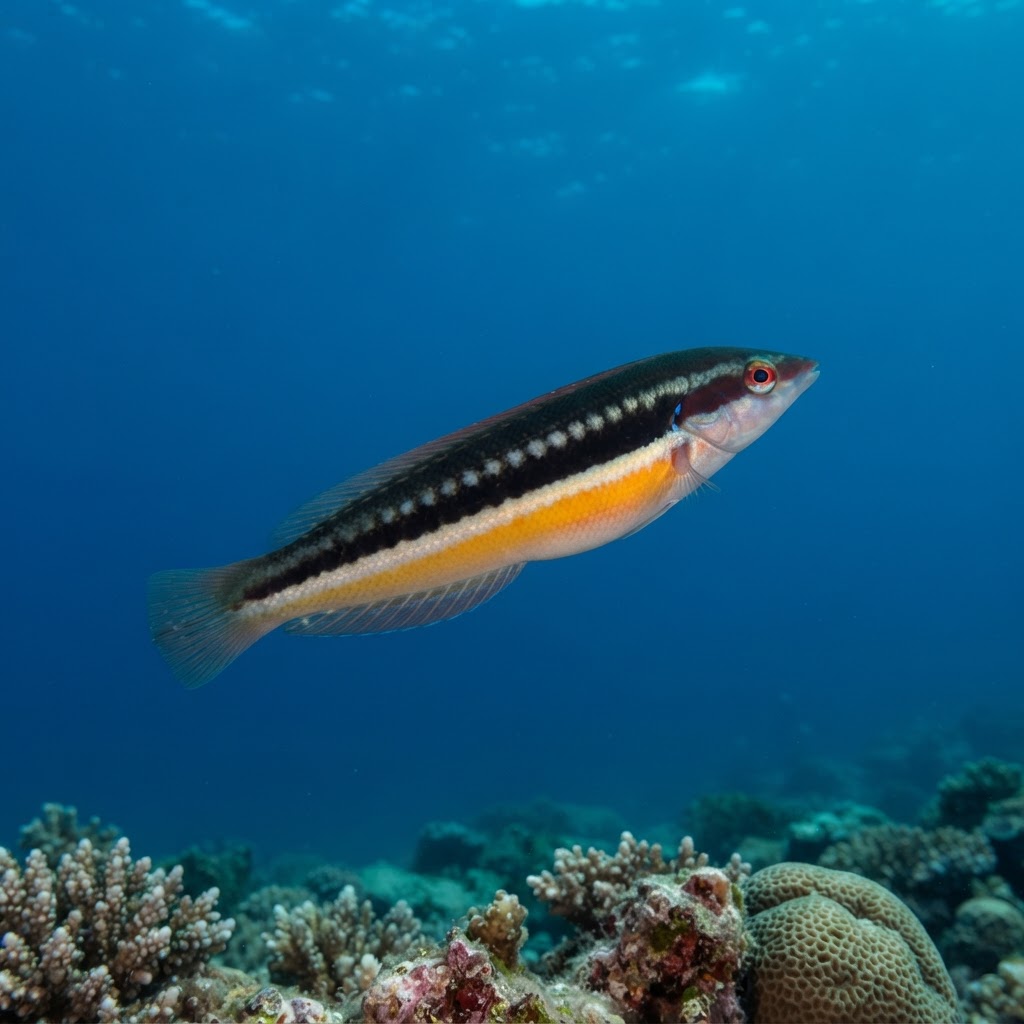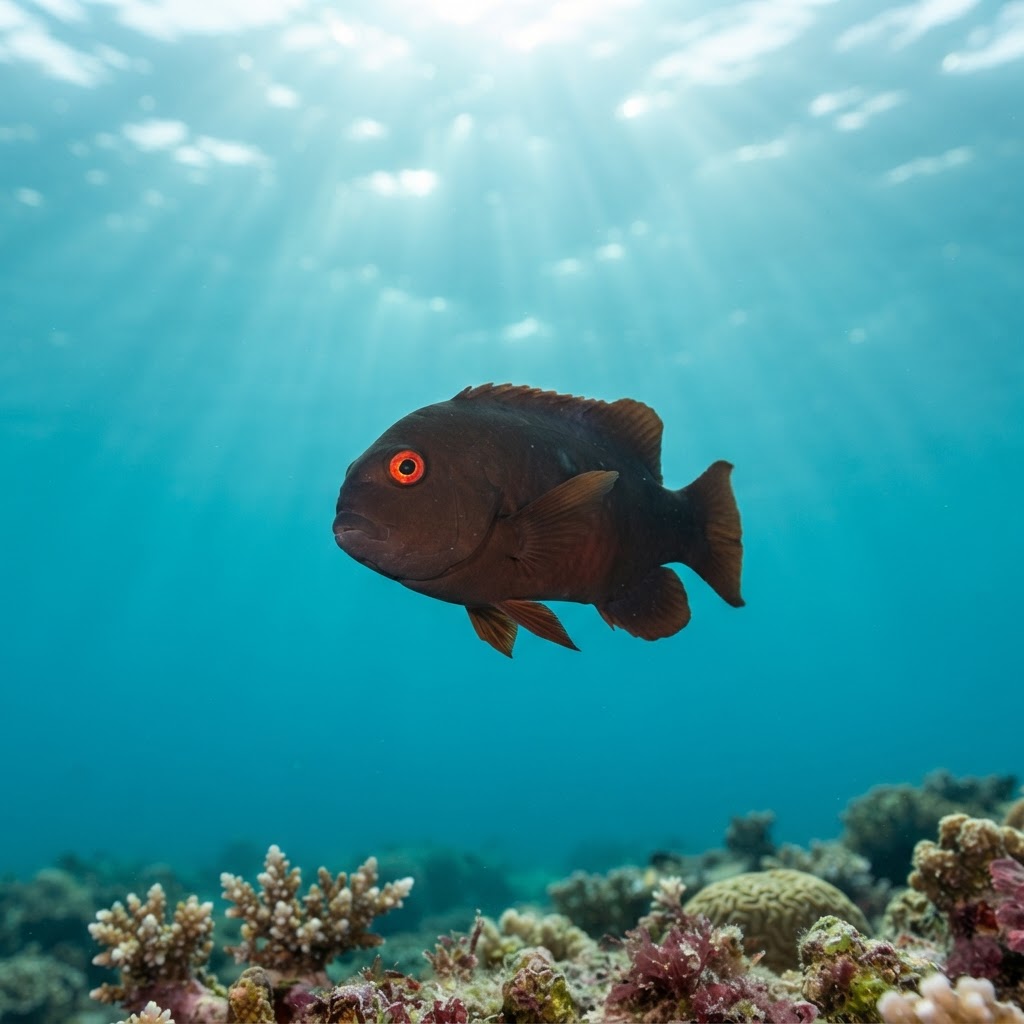
Iniistius pentadactylus
Sandy-bottom sleeper in the Visayas and Bali: spot the fivefinger razorfish's steep head and quick dive-and-vanish act into loose sand.
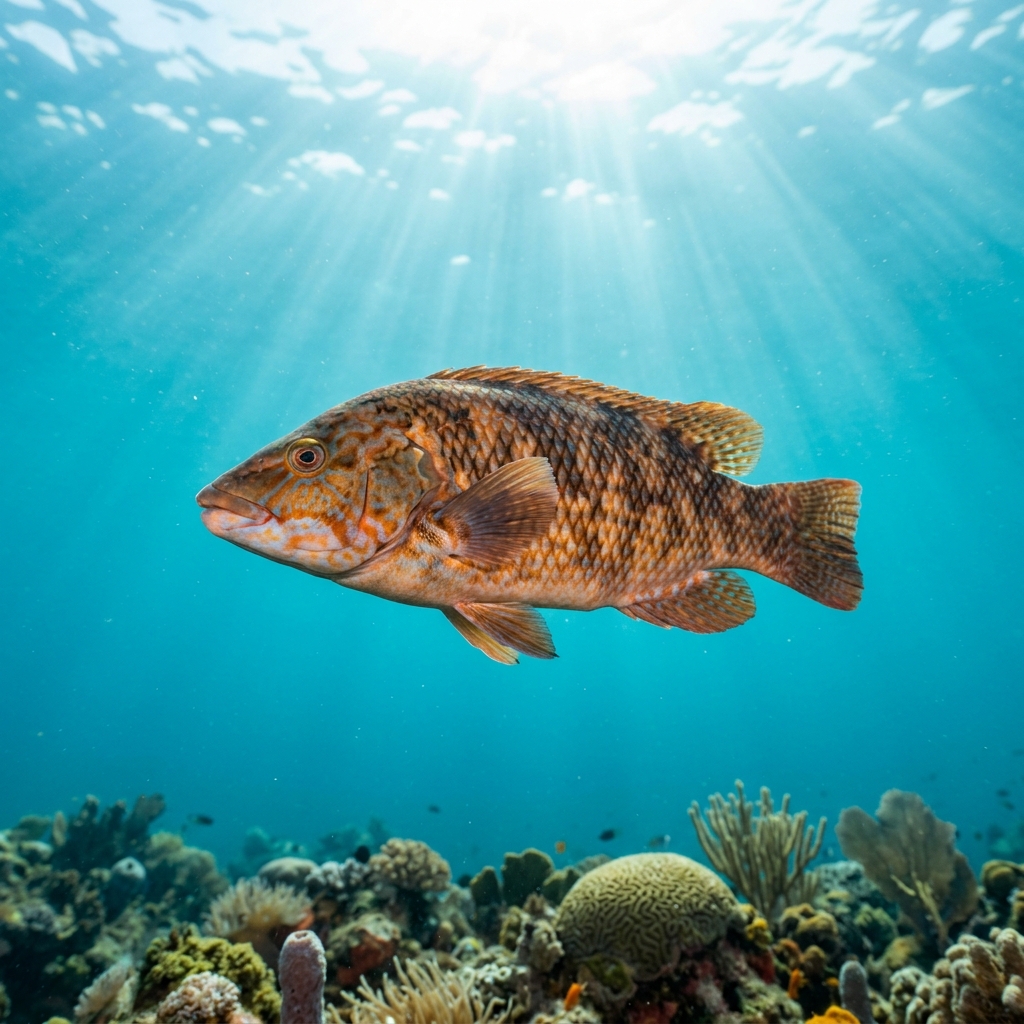
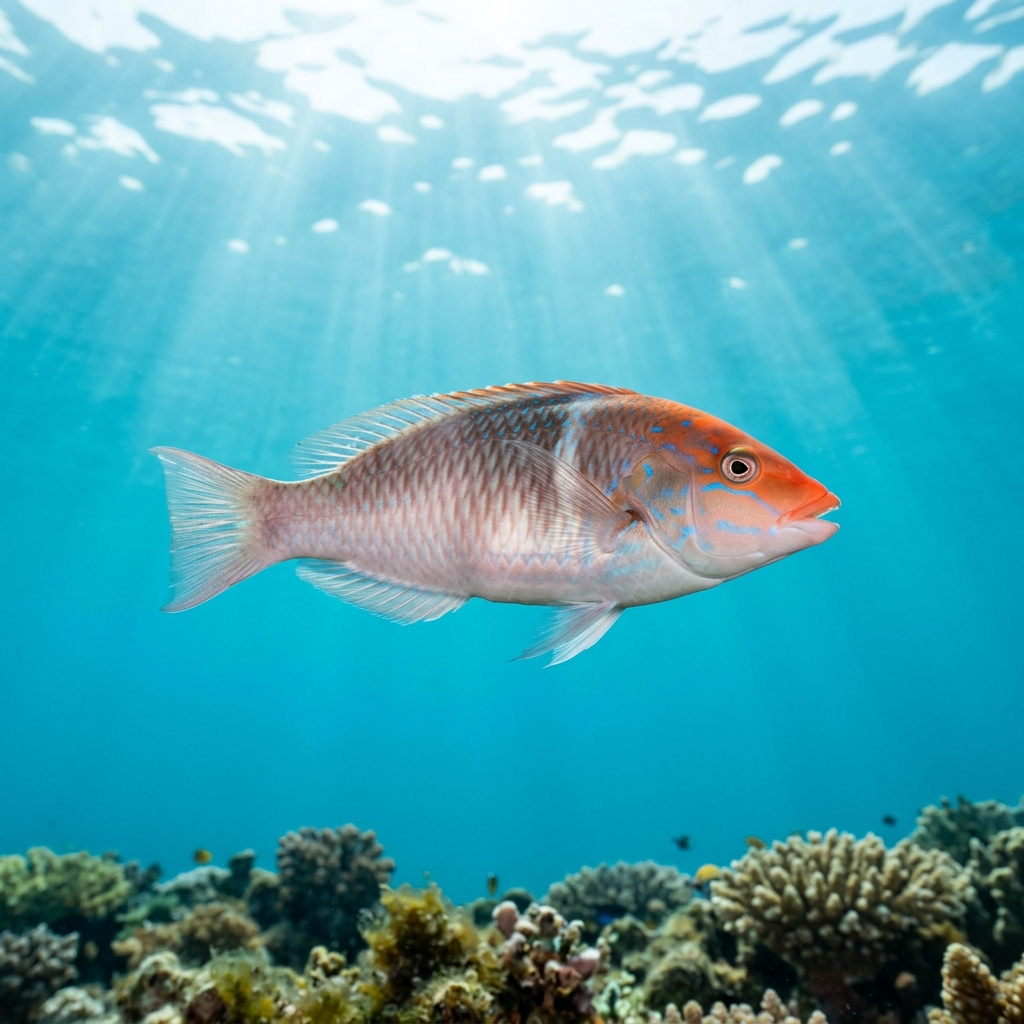
A steep, almost vertical forehead drops to a pointed snout, giving the body a wedge-shaped profile that is the quickest way to pick it out from other wrasses on a sandy bottom. It runs about 18 cm, with a reddish-brown to olive body marked by faint vertical banding that breaks up its outline against rubble and sand. Look for it hovering low or tilted at an angle just above the substrate, ready to dive headfirst into loose sand at the slightest disturbance.
Divers typically find it hovering just off the sand on gentle slopes, often tilted at an angle as it scans the substrate for small invertebrates. It is skittish: approach too fast and it vanishes headfirst into loose sand in an instant, using that dive as its main escape trick rather than fleeing across open water. It is logged as uncommon at the sites where it does occur, so sightings tend to reward slow, low, sand-scanning dives rather than casual reef cruising.
Its habit of diving straight into loose sand to escape threats is a real defence strategy shared by several razorfish species, effectively turning the sea floor into instant cover.
No clear seasonal pattern shows up in the sighting data, and water temperatures where it is found stay in a comfortable 24.4 to 29.3 C range year-round, so any month is fair game in the Visayas or Bali. Treat it as a year-round resident rather than a seasonal target.
Most reliably logged on sand and rubble slopes in the Philippines, especially across the Visayas region, with a strong secondary population around Bali, Indonesia. Outside these two areas, sightings in the dataset are sparse, so divers chasing this species should plan trips around those specific regions rather than assuming it turns up on any tropical reef.
Mapping where Fivefinger Razorfish is logged…
The most consistent sightings come from the Visayas region in the Philippines, with a solid secondary population around Bali, Indonesia. It favours sandy and rubble-strewn slopes rather than hard coral reef.
There is no strong seasonal pattern in the data, and the water it prefers stays warm year-round, so it can be found in the Visayas or Bali at any time of year.
Look for a steep, sloped forehead and pointed snout on a reddish-brown body around 18 cm long, often seen tilted at an angle just above sand or rubble. Its quick headfirst dive into loose sand when startled is a strong confirming clue.
They typically reach around 18 cm in length, making them a small, easily overlooked resident of sandy reef slopes.
When threatened, it dives headfirst straight into loose sand and disappears almost instantly, using the sea floor itself as cover rather than swimming away.
No, they pose no threat to divers and simply retreat into the sand if approached too quickly.
Site and sighting data is aggregated from diver logs, iNaturalist and GBIF. For taxonomy and conservation status:
Bird Wrasse
3,632 sites