Okenia amoenula
A small orange-spotted nudibranch found almost exclusively in the Western Cape, in cool 13 to 19C water, year-round.
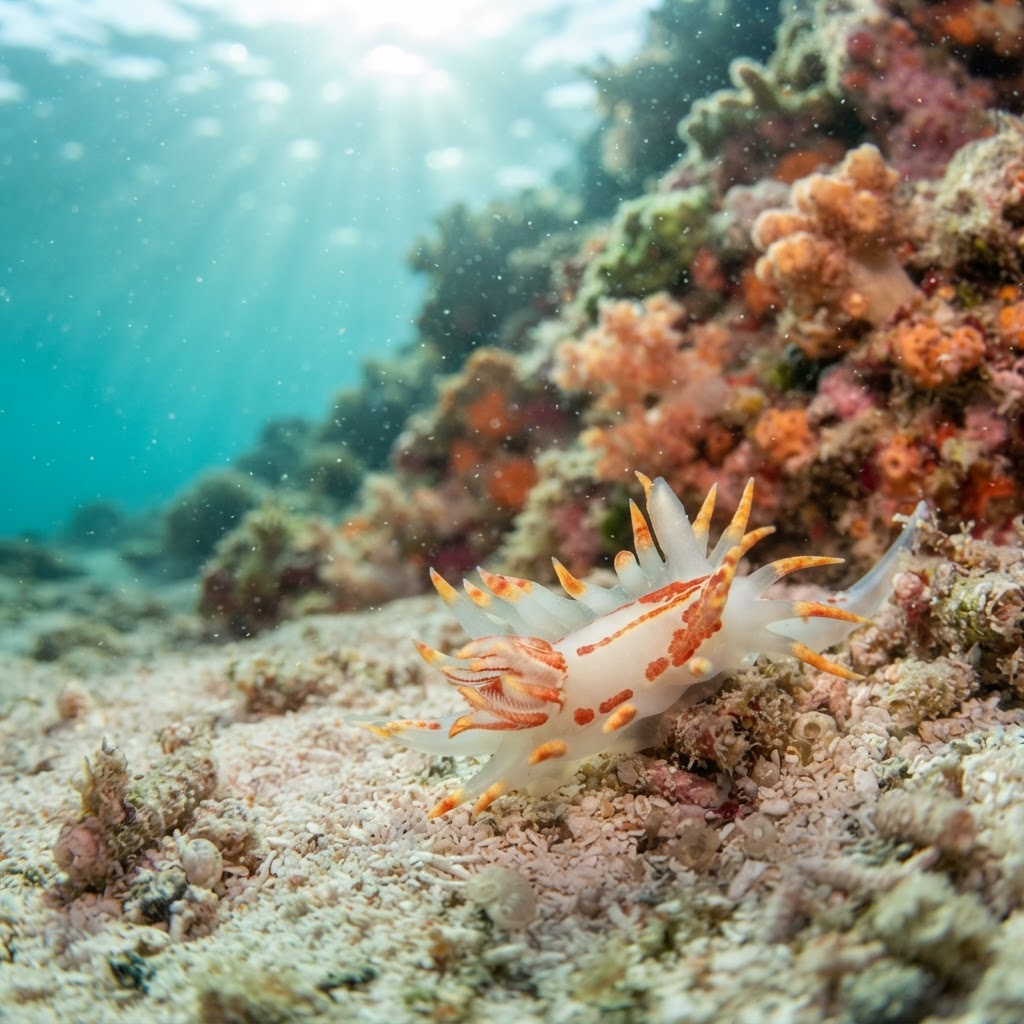
A tiny nudibranch (sea slug) best spotted by scanning rubble and sponge-covered rock closely rather than swimming past. It carries fiery orange-red patches or spots across a pale, semi-translucent body, with the soft feathery gills (rhinophores and gill tuft) visible on its back if you look closely. Size isn't well documented for this species, so expect to search at centimetre scale rather than spot it from a distance.
Found grazing slowly over rock, rubble and sponge-encrusted surfaces, doing what most dorid nudibranchs do: feeding on sponges and barely reacting to a diver's presence. It's not a species you chase; it's one you find by slowing down and checking ledges and crevices closely with a torch or macro lens. Most reports describe it as uncommon rather than common, so patient, close-focus searching pays off more than open-water scanning.
Like other goniodorid nudibranchs, it almost certainly feeds on specific sponge species, and its bright colouring is a warning signal rather than camouflage, telling predators its body carries sponge-derived chemical defences.
Sightings don't show a clear seasonal pattern, so it's logged year-round in the Western Cape's characteristically cool water, from about 13.4 to 19.4C. Any time you're diving these cold Cape reefs is a fair time to look for it.
Reef neighbours a diver could mistake it for. Use the identification notes above to tell them apart.
This one is essentially a Western Cape speciality: every logged sighting comes from South Africa, concentrated in the Western Cape region. If you're diving the cool, nutrient-rich reefs around Cape Town and nearby sites, this is one of the small nudibranchs local divers keep an eye out for on slow, macro-focused dives.
Mapping where Fiery Pump Dorid is logged…
Almost all logged sightings are from South Africa's Western Cape, making it a regional specialty rather than a species you'll find on tropical reefs elsewhere.
There's no strong seasonal pattern in the data, so it's considered a year-round find on Western Cape reefs, where water temperature typically sits between 13.4 and 19.4C.
Look for a small, pale-bodied nudibranch marked with fiery orange-red patches, usually resting on rubble or sponge-covered rock. Its size is small enough that divers often need a macro lens or close look to spot it at all.
Exact size isn't well documented for this species, but like most Okenia nudibranchs it's a small, centimetre-scale animal best found by close, slow searching rather than spotted from a distance.
No, it poses no danger to divers. It has no means of harming a diver and simply grazes on sponges, ignoring anything nearby.
Like other dorid nudibranchs, it likely absorbs chemical defences from the specific sponges it feeds on, using its bright orange colouring to warn predators rather than to hide.
Site and sighting data is aggregated from diver logs, iNaturalist and GBIF. For taxonomy and conservation status:
Light-spotted Aegires
3,168 sites