Gambusia holbrooki
Tiny live-bearer seen in Florida canals and Gibraltar shallows, active year-round in 19-25C water. Here's where to look.
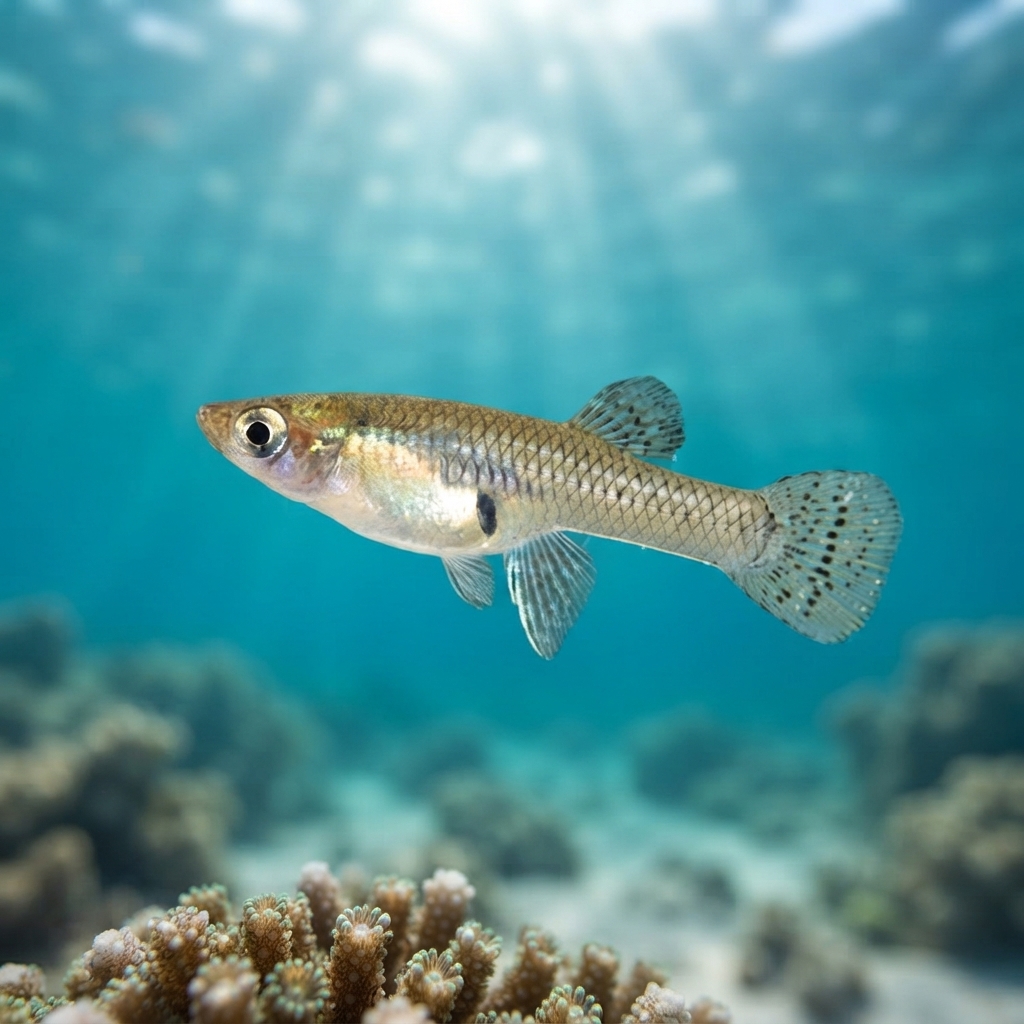
A tiny, torpedo-shaped fish rarely more than 4 cm long, with a flattened top to its head and an upturned mouth built for feeding at the surface. Colouring is a plain silvery-grey to olive, often with faint dark speckling along the flanks and a translucent, rounded tail fin. Males are noticeably smaller and slimmer than females, and females often show a darker patch near the base of the anal fin, a trait tied to how they give birth to live young rather than laying eggs.
Look for small groups picking at the surface film or hovering just under it in still, weedy shallows, canals and drainage ditches rather than out on open reef. They're quick and skittish, darting for cover among plants or debris the moment a diver or snorkeller gets close, and most sightings happen in calm, low-visibility freshwater or brackish margins rather than mid-water. Activity seems steady through the day, with fish often clustering wherever there's shade or vegetation to hide in.
Named for its appetite for mosquito larvae, this species was deliberately introduced far outside its native range as a biological control agent, which is part of why divers now log it in places like Gibraltar and Spain that are nowhere near its original US range.
No clear seasonal pattern shows up in the data, and with a comfort range of 19 to 25 C it stays active across most of the year at the sites where it's found. Treat it as a year-round sighting rather than something tied to a particular month.
Most consistently logged in Florida, where it turns up in freshwater canals, springs and drainage systems, and in Gibraltar, where it has become a regular find in shallow coastal and brackish spots. Smaller numbers are logged in Catalonia and Andalusia in Spain and along the Slovenian coast, usually in still or slow-moving shallows rather than open water.
Mapping where Eastern Mosquitofish is logged…
Florida is the most reliable place to find them, in canals, springs and still freshwater. Gibraltar also has a strong record of sightings, with smaller numbers logged in Catalonia, Andalusia and along the Slovenian coast.
There's no strong season in the sightings data. They're comfortable in 19 to 25 C water and tend to be seen year-round wherever they're established.
Look for a plain silvery-grey fish under 4 cm with a flat-topped head, upturned mouth and rounded tail. Females are visibly larger and rounder than males, with a dark mark near the anal fin.
They're small, typically around 4 cm long, making them one of the smallest fish a diver or snorkeller is likely to log.
No. They pose no threat to divers or snorkellers and simply dart away when approached.
They give birth to live young instead of laying eggs, and were widely introduced outside their native range specifically to eat mosquito larvae, which explains their odd, scattered global distribution.
Site and sighting data is aggregated from diver logs, iNaturalist and GBIF. For taxonomy and conservation status:
Sun Perch
2,182 sites