Epinephelus marginatus
Spot dusky grouper across the Mediterranean and Canary Islands, where sightings peak July to December in water from 13 to 26 °C.
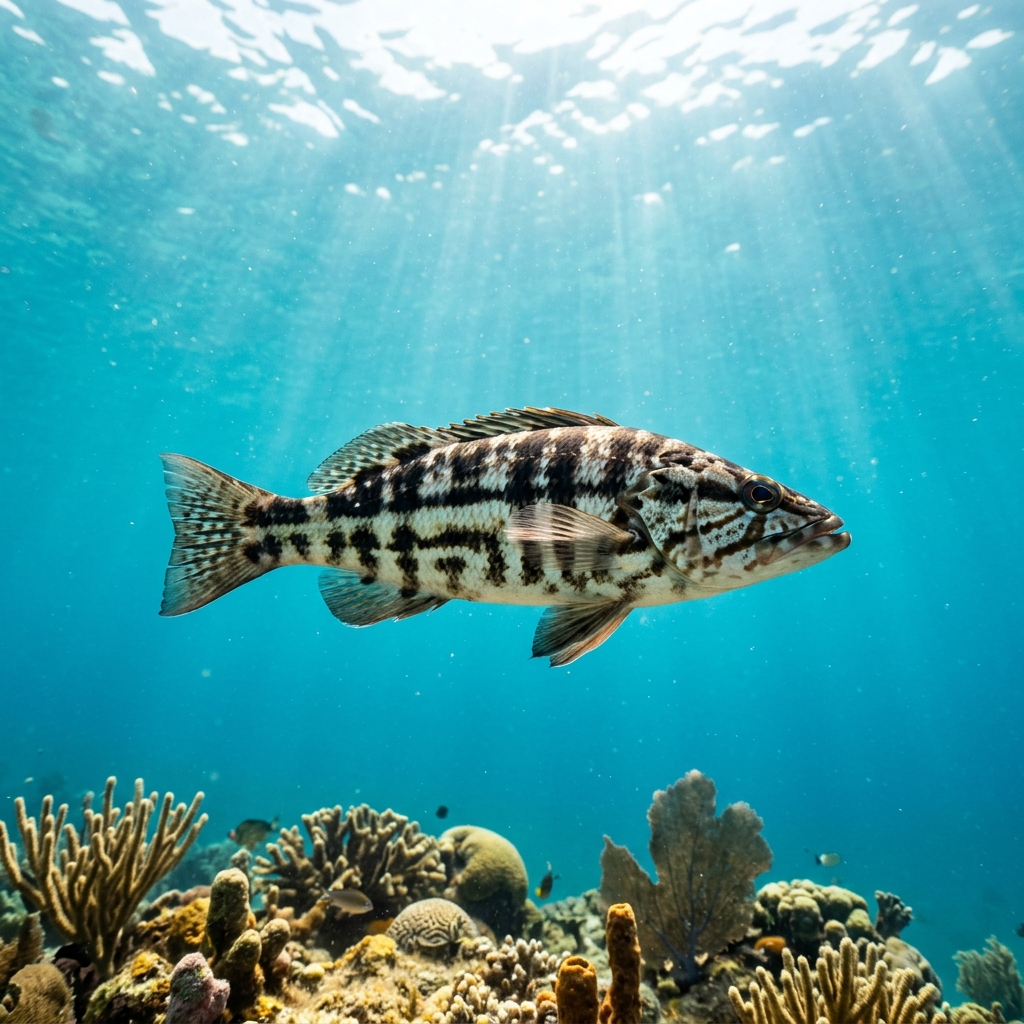
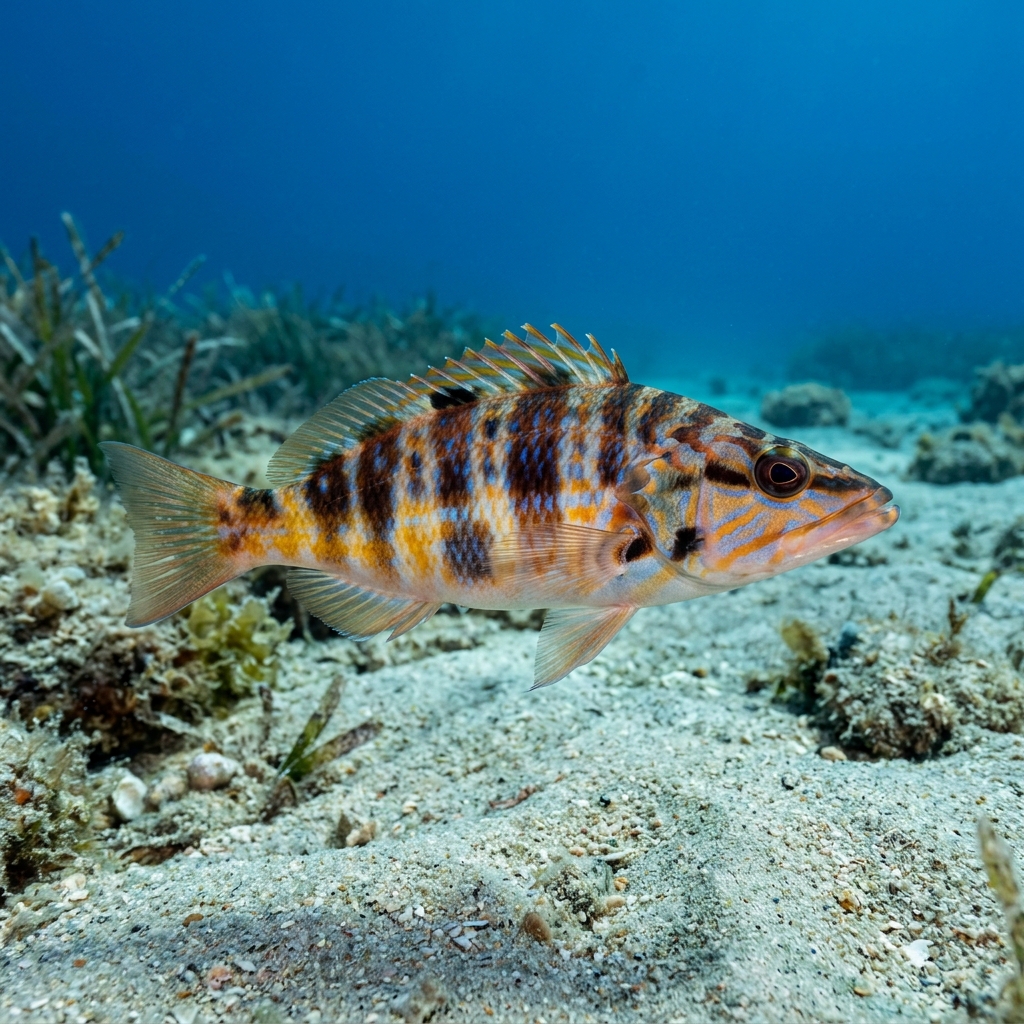
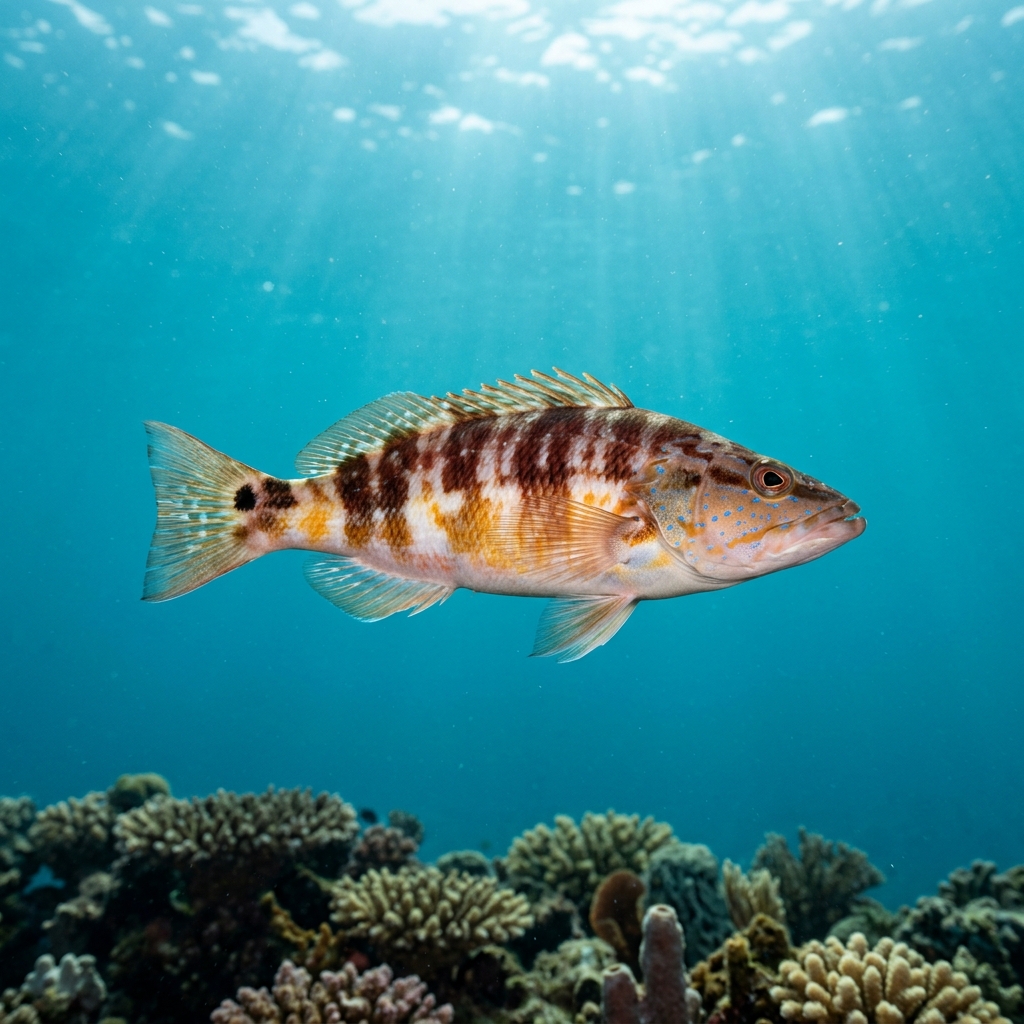
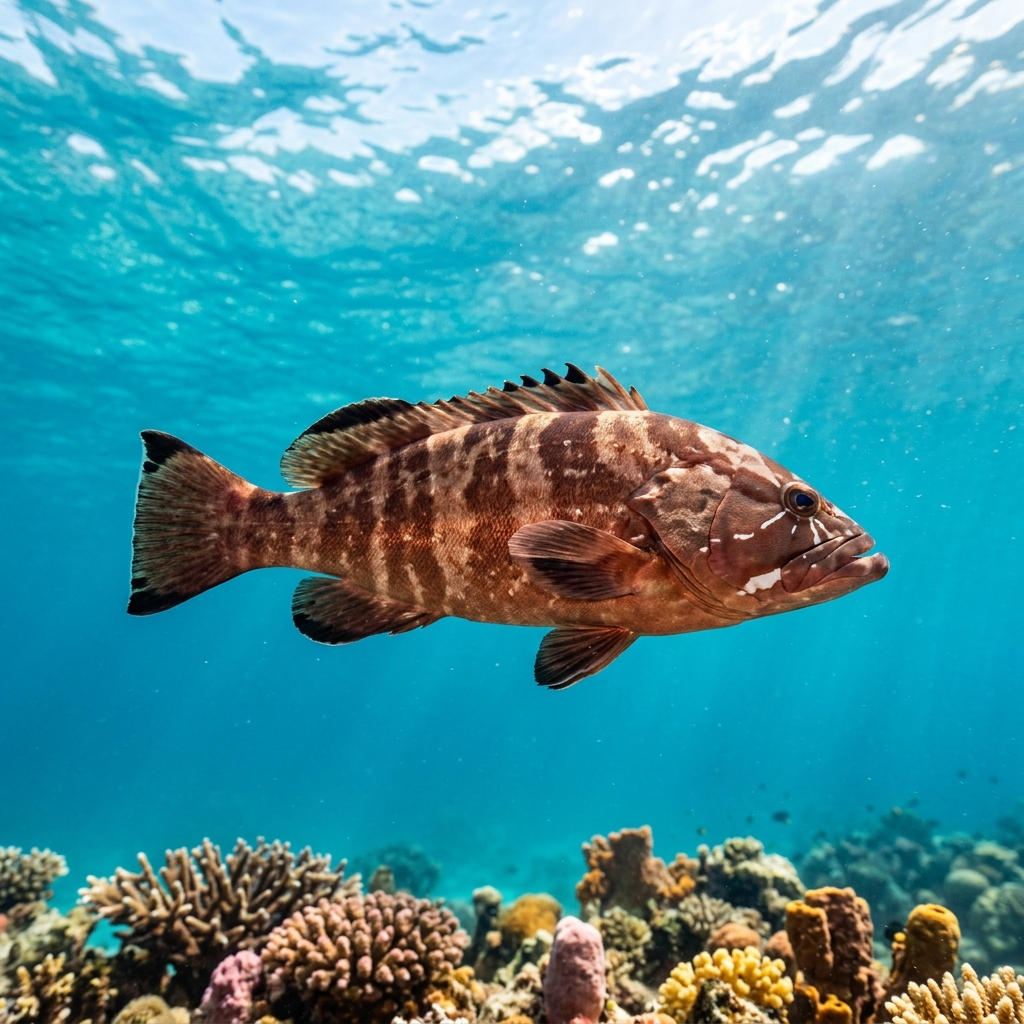
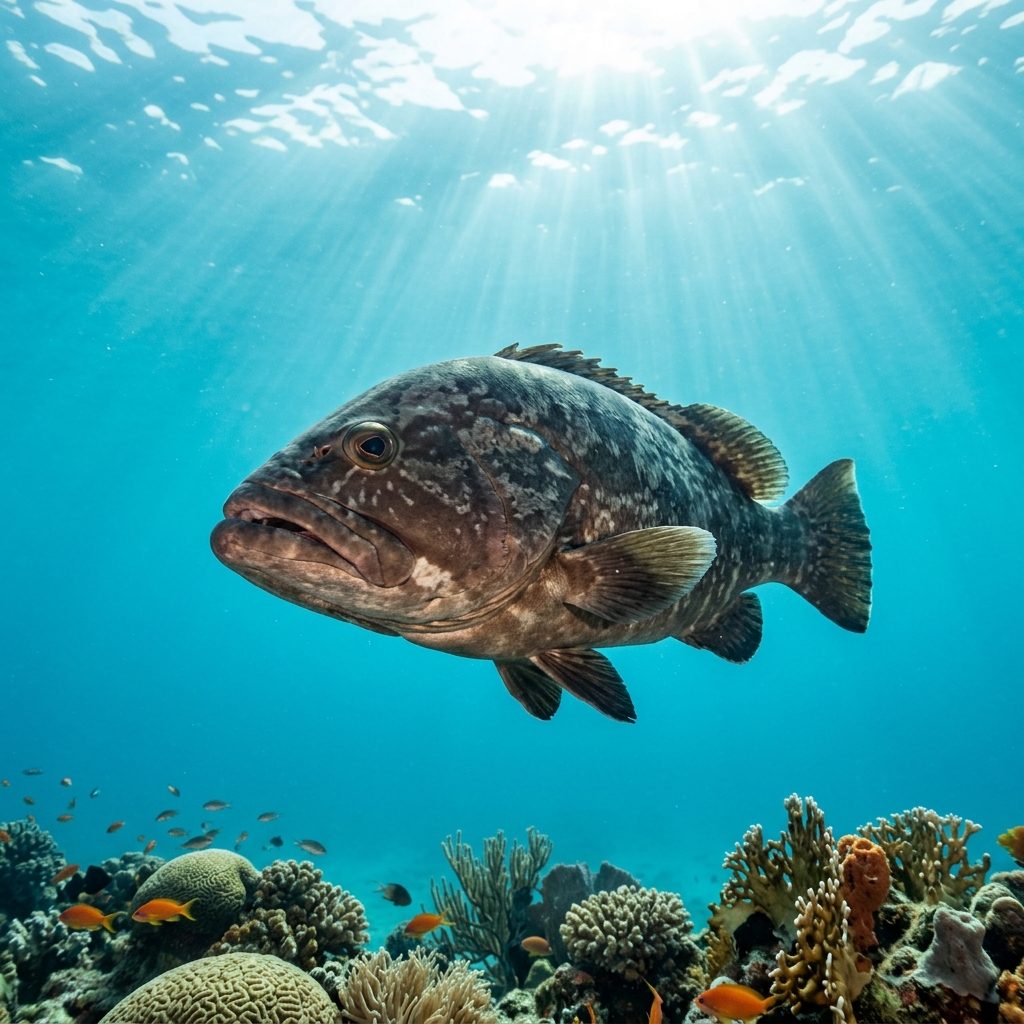
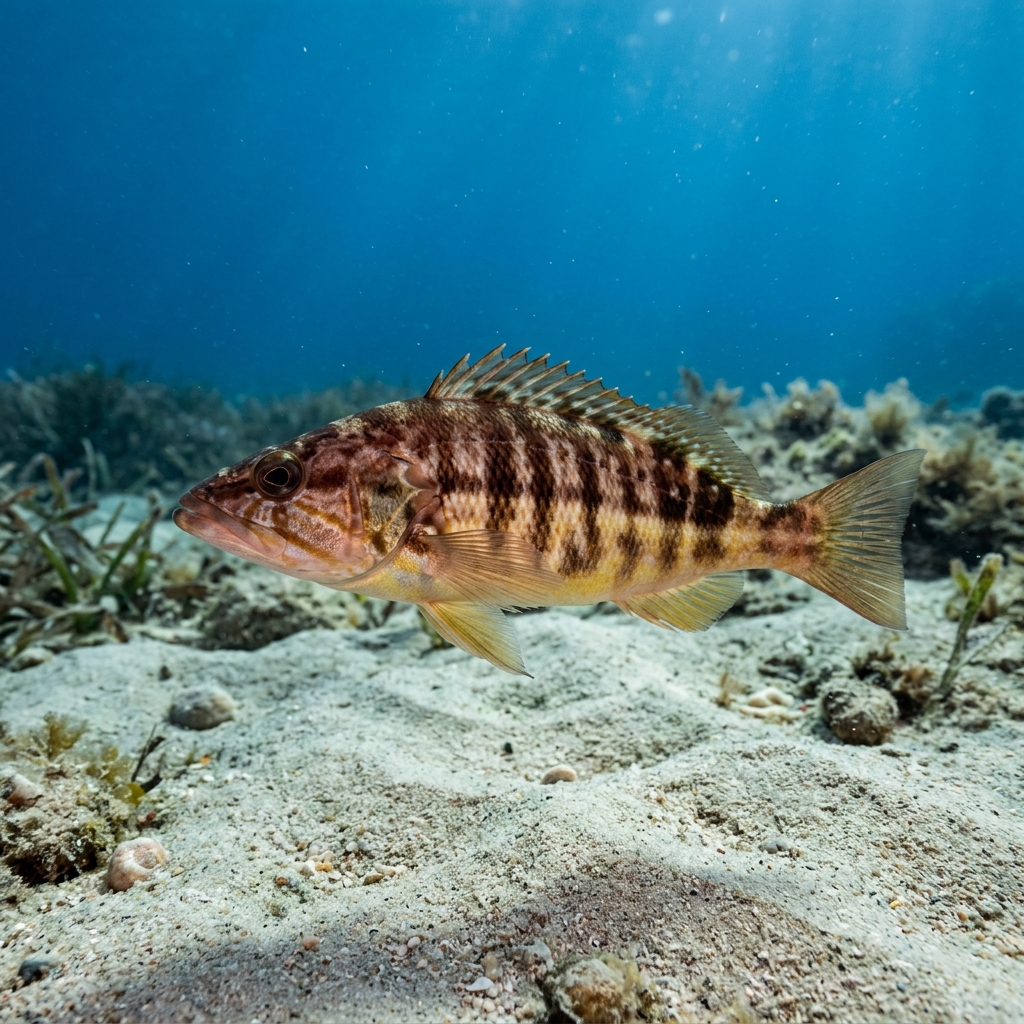
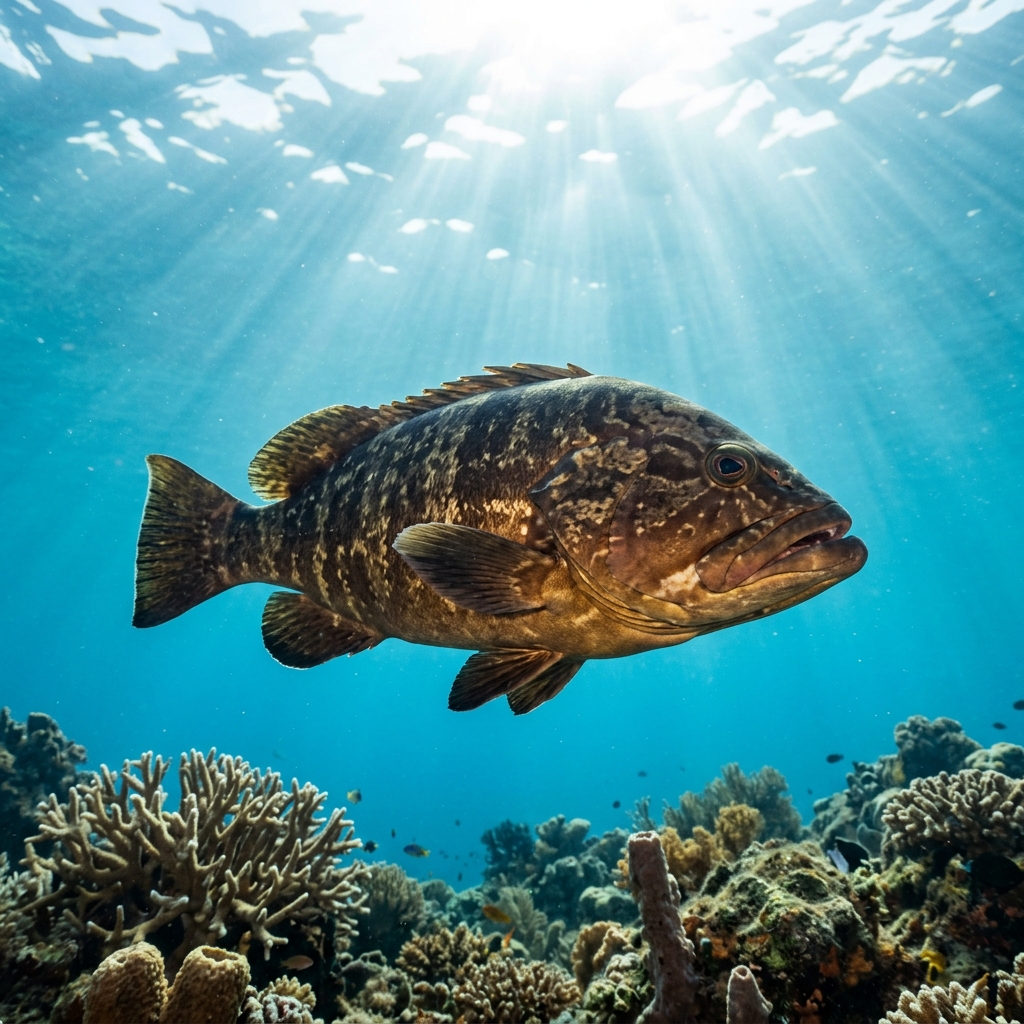
A chunky, broad-headed grouper with mottled brown, olive, and russet colouring broken by irregular pale blotches across the flanks, the pattern looks almost marbled in the water. The tail is rounded, the mouth is wide and slightly protruding, and adults carry a distinctly heavy, almost bulldog-like profile compared with slimmer reef fish. Juveniles are much more strikingly marked, showing vivid orange-yellow with dark-edged white blotches that fade as the fish matures. Because this species is a protogynous hermaphrodite (females can transition to males with age), larger, scarred individuals are often males.
Dusky groupers are largely solitary and territorial, typically encountered resting on or hovering just above rocky reefs and boulder fields. They tend to be curious rather than skittish, individuals in lightly fished marine reserves will often hold position and regard divers calmly from a short distance. Ambush hunters by nature, they spend much of their time motionless, which is exactly why they are relatively straightforward to approach and observe.
Like other groupers, dusky groupers are protogynous hermaphrodites: all individuals begin life as females and the largest, most dominant fish in a territory eventually transition into males. This life-history quirk means that removing large individuals, whether by fishing or disturbance, disproportionately impacts reproduction.
In the Northern Hemisphere, sightings concentrate from July through December, so late summer and autumn are the most productive months to look. Water temperatures across its range run from roughly 13 to 26 °C, suggesting the fish remains resident year-round but may be more active and visible during the warmer half of the year.
Most commonly logged across the Mediterranean, with the strongest showings in Greece (particularly Attica), Italy (Sicilia, Lampedusa, and Sardinia), Spain's Costa Blanca, Croatia's Central Dalmatia, and Turkey's Aegean Coast. The Canary Islands, especially Gran Canaria, are another reliable area, and the species also appears along the Brazilian coast around Rio de Janeiro and São Paulo.
Mapping where Dusky Grouper is logged…
The Mediterranean is the core range for divers, with strong populations in Greece, Italy, Spain, Croatia, and Turkey. The Canary Islands and the Brazilian coast around Rio de Janeiro and São Paulo also offer regular sightings. Marine reserves in all these areas tend to produce the most reliable encounters.
Northern Hemisphere sightings peak between July and December, making late summer and autumn the most productive window. The species tolerates a wide temperature range, so it is resident year-round, but encounters are more frequent during the warmer months.
Look for a stocky, broad-headed fish with mottled brown and olive blotching, a rounded tail, and a characteristically heavy, bulldog-like profile. Adults lack bold markings but the marbled pattern and sheer bulk set them apart from most other Mediterranean reef fish.
Dusky groupers can reach around 150 cm in length and weights exceeding 60 kg, though most divers encounter fish well below this maximum. Large individuals are uncommon outside well-protected marine reserves where the fish have had decades to grow.
No. Dusky groupers pose no meaningful risk to divers. Larger individuals in protected areas can be bold and will approach closely out of curiosity, but they are not aggressive. Give them space and avoid cornering them on the reef.
They are classified as Vulnerable by the IUCN. Their slow growth, late maturity, and sex-change biology make populations slow to recover from fishing pressure. Numbers are visibly higher inside Mediterranean marine protected areas, which is one reason these reserves are worth supporting.
The Dusky Grouper is listed as vulnerable by the IUCN. Observe from a distance, avoid touching or feeding it, and report sightings to local marine research organisations.
Dusky grouper is listed as Vulnerable on the IUCN Red List, largely due to overfishing and slow recovery linked to its late sexual maturity and sex-change biology. If you encounter one, keep your distance, avoid chasing it off its territory, and support marine protected areas where populations are visibly recovering.
Site and sighting data is aggregated from diver logs, iNaturalist and GBIF. For taxonomy and conservation status:
Blacktip Grouper
2,726 sites