Dorosoma cepedianum
Spot gizzard shad in the Great Lakes region of Canada and the US. Common at dive sites in cold water down to 1.3 °C. Here's what to look for.
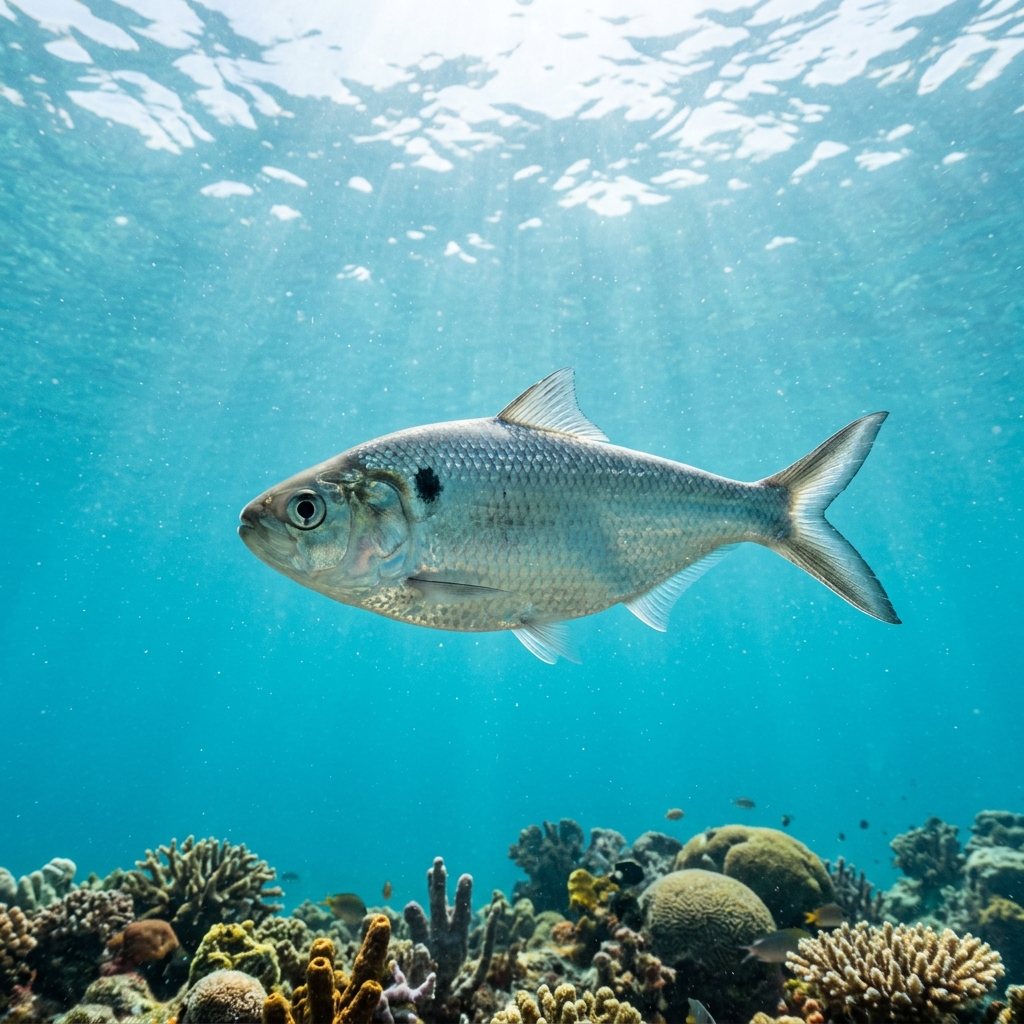
A deep-bodied, strongly compressed (flattened side-to-side) silvery fish with a noticeably rounded belly and a blunt, overhanging snout. The most useful field mark is a single dark spot just behind the gill cover, which fades with age but is usually visible on adults. The last ray of the dorsal fin is extended into a long trailing filament, a feature you won't find on most other schooling fish sharing the same water. Coloration is blue-grey on the back shading to bright silver on the sides.
Gizzard shad are schooling fish, so when you find one you are typically looking at a large group moving together through open or mid-water. They are filter feeders, drawing in suspended organic matter, and are often seen near the surface or in the water column rather than hugging the bottom. They tend to ignore divers and will continue feeding or schooling as long as you move calmly.
The common name comes from their unusually muscular, gizzard-like stomach, which grinds up sediment and organic particles in a way more like a bird's digestive system than a typical fish's. This adaptation lets them exploit food sources most other fish cannot access.
There is not enough monthly data to identify a peak season, so treat it as a year-round possibility. Observed water temperatures range from 1.3 to 22.5 °C, confirming it tolerates very cold conditions and remains active through Great Lakes winters.
Almost all logged sightings come from the Great Lakes and Ontario region of Canada, making that the go-to area for any diver hoping to encounter this species. There is also a single logged site in the Great Lakes and Northeast United States, so the broader Great Lakes basin is the place to focus. Sightings are rated common at the majority of sites where it has been recorded.
Mapping where Gizzard Shad is logged…
The vast majority of logged dive sightings are from the Great Lakes and Ontario region of Canada, with one additional site in the Great Lakes and Northeast United States. If you are diving freshwater sites in the Great Lakes basin, you have a good chance of an encounter.
There is no clear seasonal peak in the available data, so they can be encountered year-round. Their tolerance for water temperatures as low as 1.3 °C means cold-water winter dives in the Great Lakes region are still viable.
Look for a deep, strongly compressed silvery body with a blunt overhanging snout and a single dark spot just behind the gill cover. The extended filament trailing from the last dorsal fin ray is a reliable distinguishing mark. They typically appear in schools in open water.
The data on typical underwater size is limited, but gizzard shad commonly reach around 30 to 40 cm in length, with larger individuals reported up to roughly 50 cm in well-established populations.
The name refers to their highly muscular, thick-walled stomach that functions similarly to a bird's gizzard. It grinds up sediment, algae, and organic debris, allowing the fish to digest food sources that most other freshwater fish cannot process.
Site and sighting data is aggregated from diver logs, iNaturalist and GBIF. For taxonomy and conservation status:
Soldierfish
3,621 sites