Doriopsilla areolata
A small yellow-brown nudibranch turning up year-round along the Lisbon Coast and Bay of Biscay in 14 to 20C water.
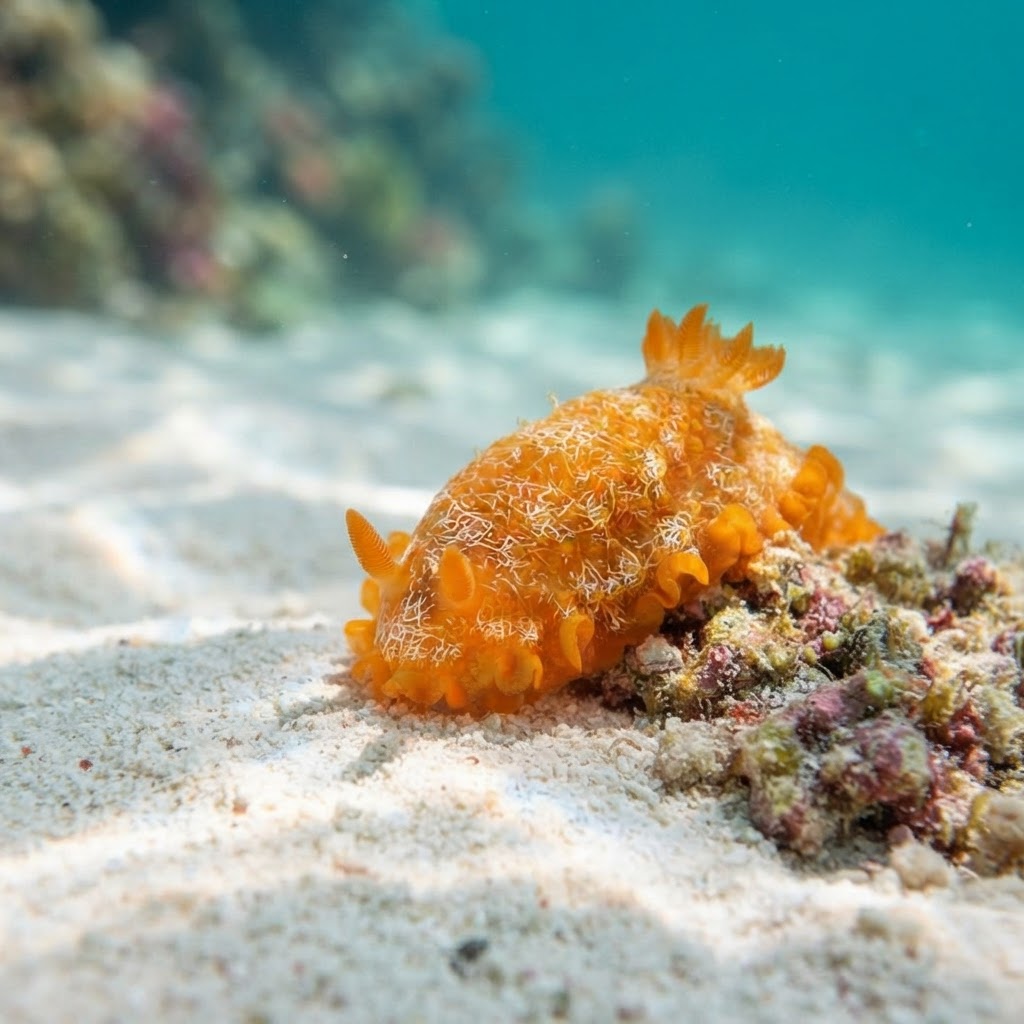
A small, soft-bodied nudibranch with a granular, warty-looking mantle in shades of yellow, tan or olive-brown, usually without the bold contrasting spots seen on many reef nudibranchs. The body is oval and low-profile, tapering gently, with a smooth outline rather than frilly gill plumes standing tall off the back. Divers key on the muted, slightly translucent colour and the finely textured skin rather than any single bright marking.
Typically found moving slowly over rock and encrusting growth on the seabed rather than out in open water, consistent with its demersal (bottom-dwelling) habits. Divers usually spot it during slow, methodical macro-hunting passes rather than mid-water, and it shows no reaction to a diver's presence beyond its usual unhurried crawl.
Like other dendrodorid nudibranchs, it likely feeds on sponges, using the encrusting growth on rock and reef structure as both its food source and its camouflage.
Sightings show no detected seasonal peak, so treat it as a year-round find. It sits comfortably in the 14.4 to 20.4C range typical of these Atlantic coasts, which stays fairly stable across the diving calendar.
Reef neighbours a diver could mistake it for. Use the identification notes above to tell them apart.
Most reliably logged along Portugal's Lisbon Coast and Algarve, with strong numbers also in Andalusia and the Cantabrian Coast and Galicia in Spain, plus the Bay of Biscay in France. This is very much an Iberian Atlantic and Bay of Biscay species on current logs, rather than one spread across warm tropical reefs.
Mapping where Scribbled Nudibranch is logged…
It turns up most often on the Lisbon Coast and Algarve in Portugal, and across Andalusia, the Cantabrian Coast and Galicia in Spain, with further sightings in France's Bay of Biscay. It is an Iberian Atlantic and Bay of Biscay find rather than a tropical one.
There is no strong seasonal pattern in the logs, so it is considered a year-round sighting. Water temperatures where it is found stay in a fairly narrow 14.4 to 20.4C band across the year.
Look for a small, low-profile nudibranch with a warty, granular mantle in muted yellow, tan or olive-brown tones and no bold contrasting spots. The texture and understated colouring are the main giveaway on Atlantic rock and reef.
Exact size data is not confirmed for this entry, but like most Doriopsilla species it stays in the small, easy-to-miss size range typical of macro nudibranch finds.
No. It poses no danger to divers and can be observed and photographed up close without any risk.
Across the sites where it has been logged, most divers rate it as uncommon, with a smaller number of sites reporting it as common. It is a find for divers who take the time to look closely at rock and reef surfaces rather than a species you stumble across constantly.
Site and sighting data is aggregated from diver logs, iNaturalist and GBIF. For taxonomy and conservation status:
Light-spotted Aegires
3,168 sites