Dondice freddiemercuryi
An uncommon nudibranch logged almost entirely in Guadeloupe's Grande-Terre, in warm 25 to 31C water year-round.
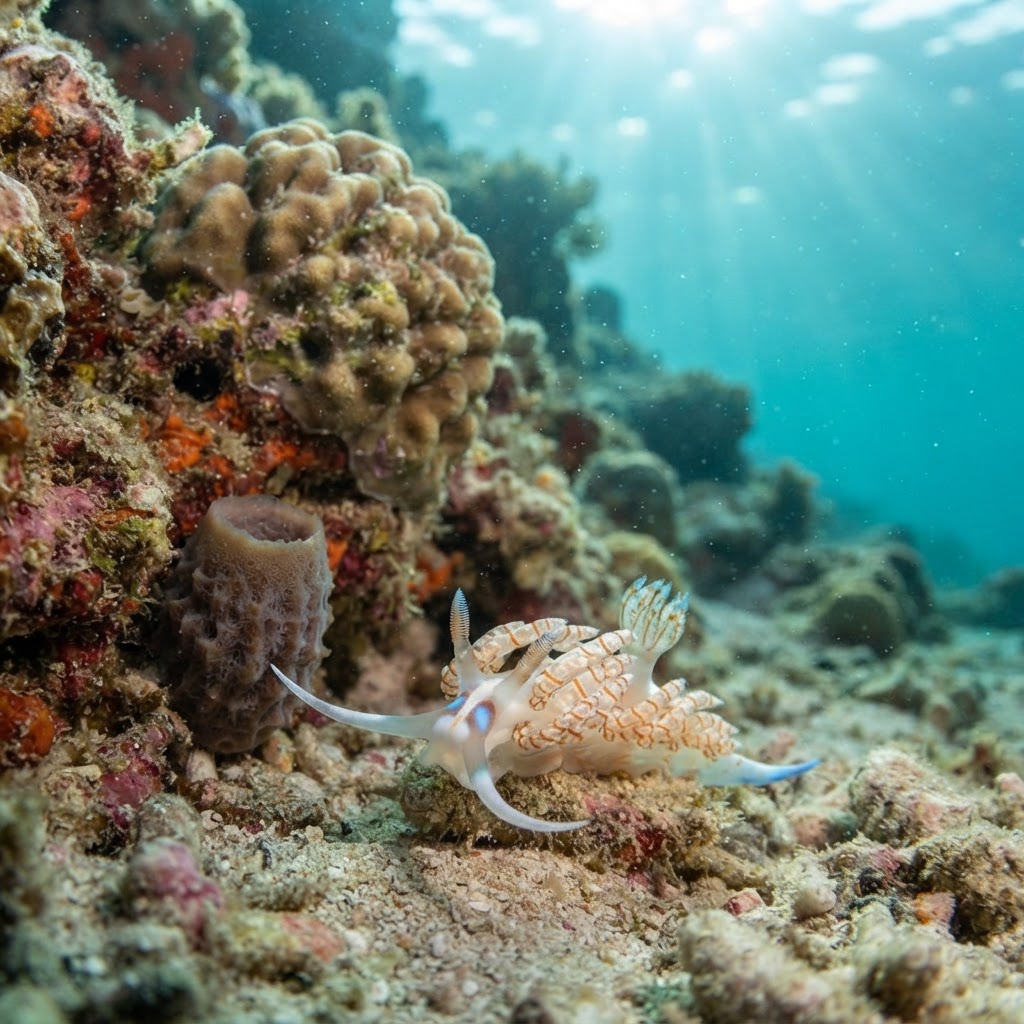
A small aeolid-type nudibranch (a group carrying feathery finger-like cerata on its back) with a slender translucent body and clusters of cerata tipped in orange or reddish colour running down each side. The head bears two rhinophores (sensory tentacles) that stand up like small horns, and the overall look underwater is a slim, almost fuzzy-backed slug rather than the smooth-mantled dorids divers often see nearby. Size is not well documented, so expect to search close to the substrate rather than spot it from a distance.
Divers find it slow-crawling over reef rubble and hard substrate, usually tucked low where hydroid growth (its likely food source, based on related Dondice species) collects in cracks and crevices. It shows no reaction to divers beyond continuing its unhurried grazing, so a slow approach and a macro lens are all you need. Most logs come from daytime dives, and it turns up as a solo find rather than in groups.
Like other Dondice species, it almost certainly feeds on hydroids and may retain stinging cells from its prey in those orange-tipped cerata as a defence, though this has not been specifically confirmed for this species.
Sightings show no detectable season, and the observed water temperature of 24.7 to 30.7C is warm enough that it likely stays active year-round on Guadeloupe's reefs. Plan around good visibility and calm conditions rather than a particular month.
Reef neighbours a diver could mistake it for. Use the identification notes above to tell them apart.
Grande-Terre in Guadeloupe is by far the strongest area for this species, with sightings logged across a wide spread of local sites there. A single record from Florida in the United States shows it turns up outside the Caribbean too, but Guadeloupe is where divers actually go looking for it.
Mapping where Freddie Mercury's Dondice is logged…
Grande-Terre in Guadeloupe accounts for almost every logged sighting, making it the place to search. A lone record from Florida shows it is not exclusive to the Caribbean, but Guadeloupe is by far the more reliable option.
There is no clear seasonal pattern in the sightings, and the warm 24.7 to 30.7C water it is found in suggests it is present year-round rather than tied to a particular month.
Look for a slender, translucent-bodied nudibranch with clusters of orange-tipped cerata lining its back and two upright rhinophores on its head. It is a fuzzy-backed aeolid type rather than a smooth dorid, and it moves slowly over rubble and hard substrate.
Exact size data has not been recorded for this species, so expect a small slug best spotted at close range on rubble or hard substrate, in line with other members of the Dondice genus.
No, it poses no danger to divers. It has no way to harm a person and simply continues grazing if you get close for a photo.
Its orange-tipped cerata likely store defensive stinging cells borrowed from the hydroids it feeds on, a trick common across the Dondice genus. That gives it a bristly, colourful look quite different from the smooth-bodied dorid nudibranchs divers commonly see alongside it.
Site and sighting data is aggregated from diver logs, iNaturalist and GBIF. For taxonomy and conservation status:
Light-spotted Aegires
3,168 sites