Placida dendritica
A speck-sized nudibranch turning up on rocky reefs from the Balearic Islands to Norway's Østlandet coast, year-round in cool water.
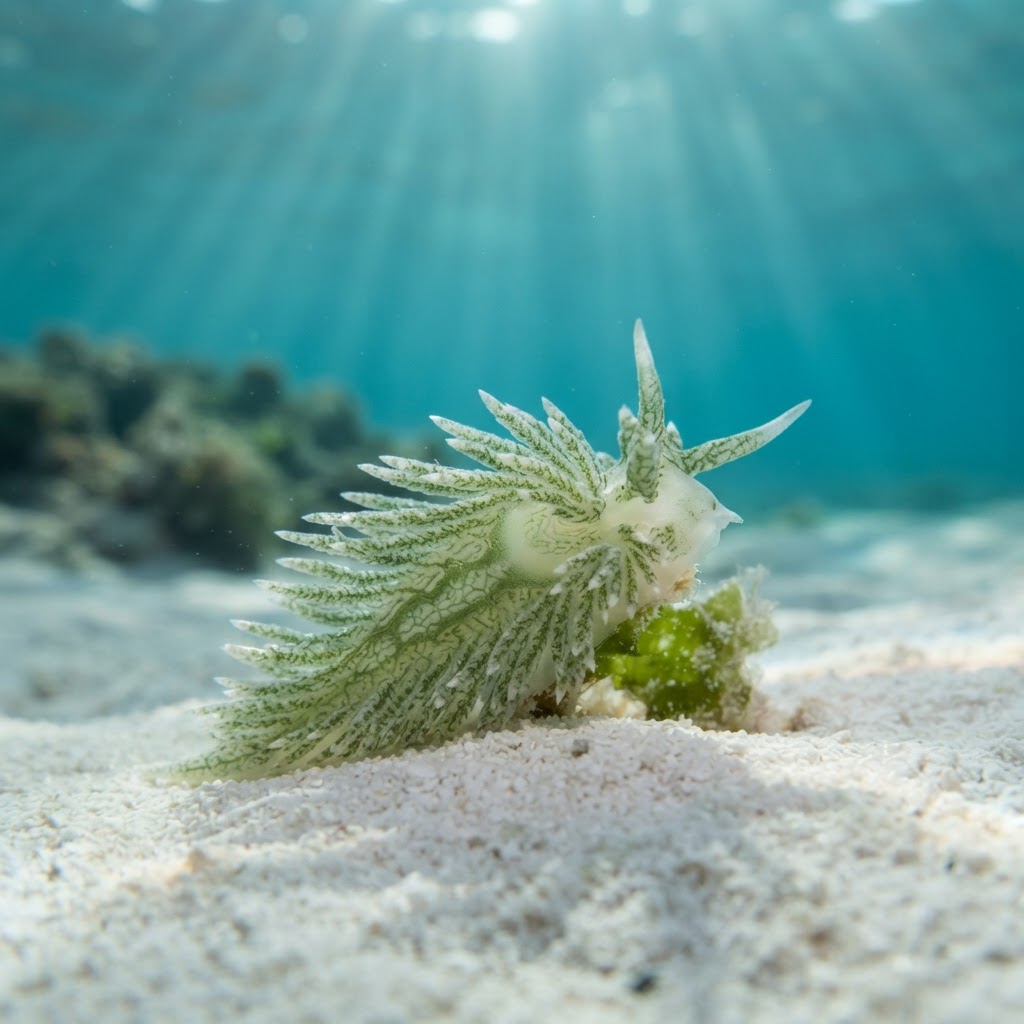
Small and slender, rarely bigger than a fingernail, with a translucent green to olive body that takes on the colour of whatever algae it has just eaten. The back is covered in slim, finger-like projections (cerata) arranged in rows, giving it a slightly furry or branched silhouette rather than a smooth slug body. Look closely at the tips of the cerata, which often carry a darker or iridescent spot that helps separate it from plain algae debris on the rock.
Divers usually find it grazing slowly over algae-covered rock and stones, often tucked in among filamentous green algae that it feeds on and visually matches. It moves little when approached, relying on camouflage rather than fleeing, so a slow scan of algal turf in shallow water is the best way to pick one out. Most logs come from depths under 10 metres, so it is a species for the shallow, well-lit fringe of the reef rather than deeper ground.
It steals chloroplasts from the algae it eats and keeps them working in its own tissue for a while, a trick called kleptoplasty that lets the slug's body photosynthesise slightly and helps explain why its colour tracks its most recent meal so closely.
Sightings are spread across the year with no clear seasonal peak in the data, which fits its comfort range of roughly 12 to 18 C, a band that persists for long stretches on temperate rocky reefs. Treat it as a year-round find rather than a seasonal target.
Reef neighbours a diver could mistake it for. Use the identification notes above to tell them apart.
Most reliably logged on rocky reef sites in Spain's Balearic Islands and Norway's Østlandet coast, with strong showings too in France's French Riviera and Provence and Canada's Nova Scotia. Northern Ireland adds another dependable pocket, and smaller numbers turn up across Occitanie, Wales and England.
Mapping where Dendritic Nudibranch is logged…
It is most commonly logged on rocky reef sites in Spain's Balearic Islands and Norway's Østlandet region, with reliable sightings also in France's French Riviera and Provence, Canada's Nova Scotia, and Northern Ireland.
There is no strong seasonal pattern in the sighting data, so it can turn up any month. It favours cooler water in the 12 to 18 C range, which holds for much of the year on the rocky reefs where it lives.
Look for a small, slender slug with a translucent green to olive body and rows of thin, branch-like projections along its back. Its colour often blends with the algae it is grazing on, so check closely for the darker tips on those projections.
They are a small species, typically only a centimetre or two long, easy to overlook against algae-covered rock unless you are looking closely.
It absorbs functioning chloroplasts from the algae it eats and retains them in its own tissue for a time, effectively borrowing photosynthesis. This also explains why individuals often match the exact shade of green of their recent meal.
No, they pose no threat to divers. They have no means of harming a diver and simply graze quietly on algae when approached.
Site and sighting data is aggregated from diver logs, iNaturalist and GBIF. For taxonomy and conservation status:
Light-spotted Aegires
3,168 sites