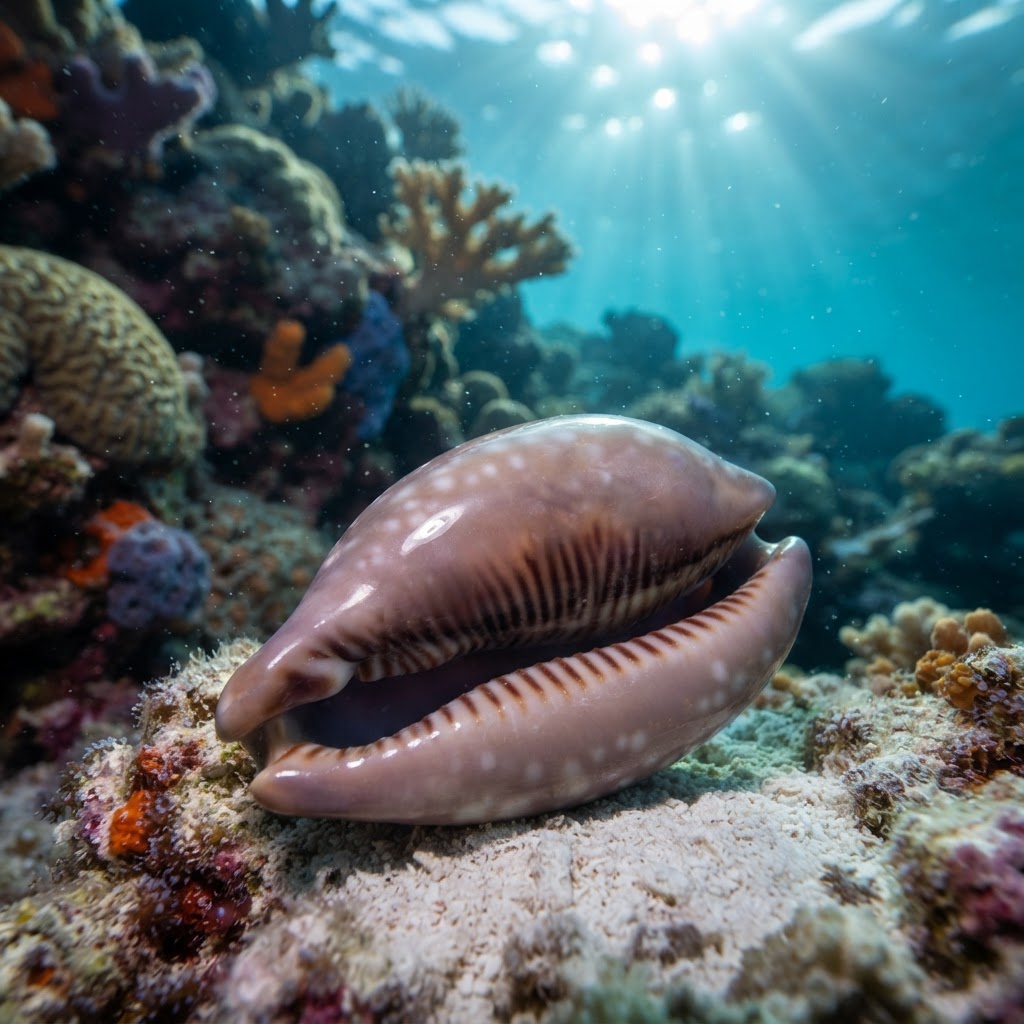
Macrocypraea cervinetta
A rare find on rocky reefs from the Galápagos Islands to Costa Rica's Central Pacific, in water 23 to 30C year-round.
Look for a glossy, oval shell around 6 cm long, tan to reddish-brown with a scatter of small pale spots that echo a fawn's coat, hence the name. The shell has a smooth, high-gloss surface and a narrow slit-like opening on the underside lined with fine teeth. When active at night the mantle (soft tissue) may partially wrap over the shell, giving it a mottled, fleshy look rather than the bare polished shell you see in a dead specimen.
Turns up tucked into rocky crevices and under ledges by day, usually solo, and is easy to swim straight past given how rare it is at most sites. It is most active after dark, when it emerges to graze, so night dives on rocky reef give better odds than daytime drift dives. Divers who do spot one report it holding still and retracting into its shell when approached rather than fleeing.
Like other cowries, it feeds mostly at night, rasping algae and encrusting organisms off rock surfaces with a file-like tongue (radula), then withdraws into crevices by day where its glossy shell is easy to overlook against wet rock.
No clear seasonal pattern shows up in sightings, and its comfort range of 23 to 29.7C spans the tropical eastern Pacific year-round, so any month is worth a look. Plan the dive around the site's usual visibility and current conditions rather than a calendar month.
Most reliably found on rocky reefs in Ecuador, especially around the Galápagos Islands and the mainland Pacific Coast, and along Costa Rica's Central Pacific. Smaller but real populations turn up on Mexico's Pacific Coast and in Panama.
Mapping where Deer Cowrie is logged…
Best chances are on rocky reef in Ecuador, particularly the Galápagos Islands and the Ecuadorian mainland Pacific Coast, and in Costa Rica's Central Pacific. It also turns up occasionally in Mexico's Pacific Coast and Panama.
There is no strong season in the sightings data, and its 23 to 29.7C temperature range holds year-round across the eastern Pacific, so it can be found on any dive trip. Night dives improve your odds more than any particular month.
Look for a smooth, glossy tan to reddish-brown shell about 6 cm long with scattered pale spots, tucked into rocky crevices. The high shine and oval shape are the giveaways, especially compared to the duller, softer-bodied slugs sharing the same reef.
They reach around 6 cm in shell length, making them a small, easy-to-miss find on a rocky reef.
No. They are harmless, slow-moving snails that retract into their shell rather than react to divers.
It feeds mainly at night, using a file-like tongue called a radula to graze algae off rock surfaces, then hides in crevices during the day where its polished shell blends into wet rock.
Site and sighting data is aggregated from diver logs, iNaturalist and GBIF. For taxonomy and conservation status:
Triton Shell
2,297 sites