Polycera hedgpethi
A translucent white nudibranch with dark-tipped tentacles, most reliably found on temperate reefs in Victoria, Australia.
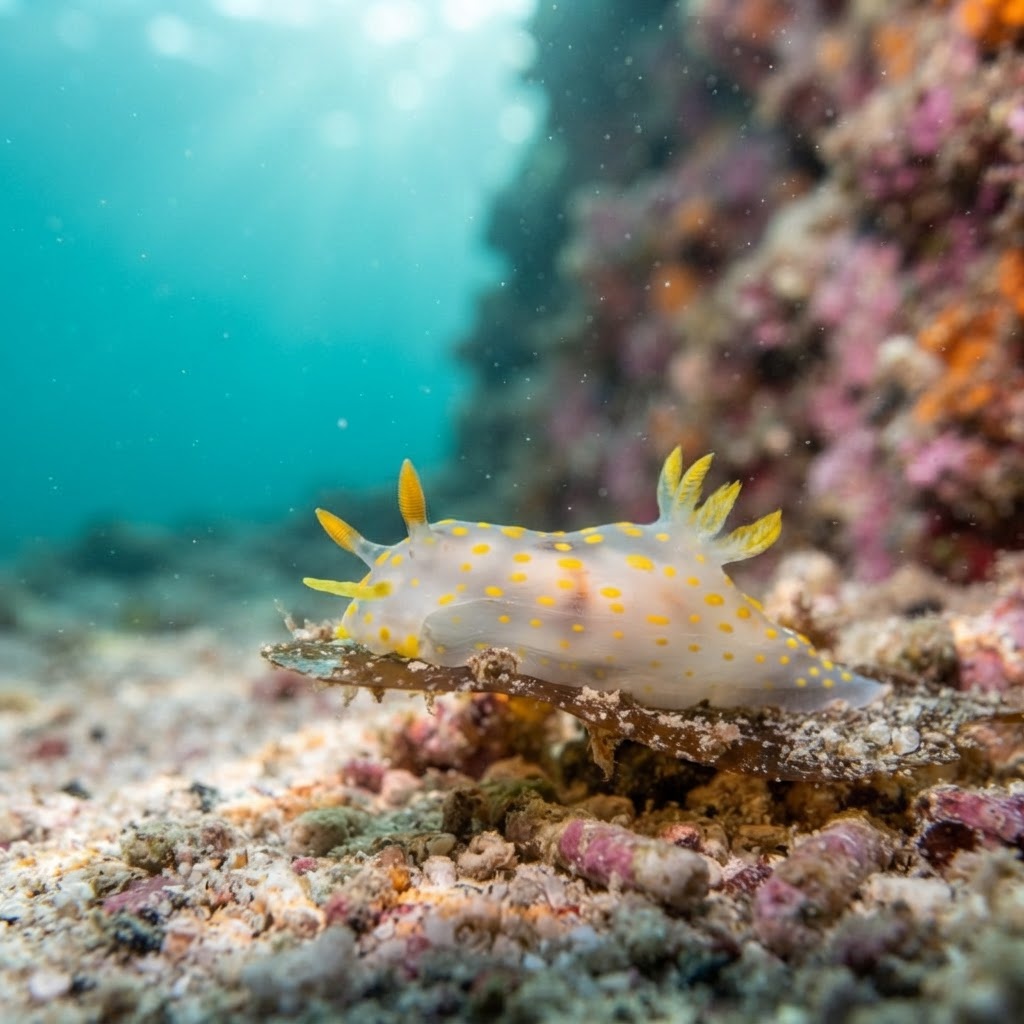
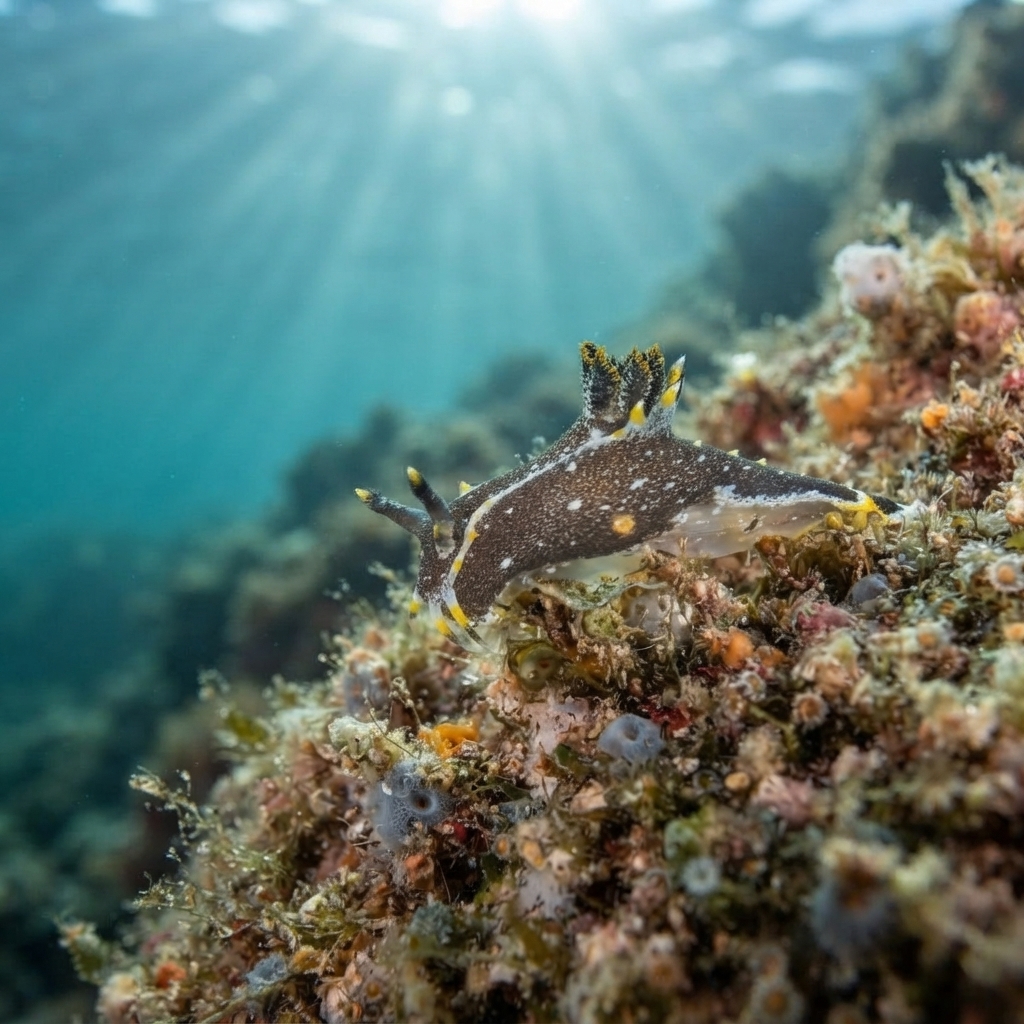
Tiny at around 2 cm, with a translucent white to pale yellowish body that lets it disappear against sponge and algae cover. The giveaway is the dark tips on the frontal tentacles and the gill tufts near the tail, which look almost inked against the pale body. It has a slender, elongated shape typical of dorid nudibranchs rather than a rounded slug-like profile, and you will usually need a close look or a macro lens to pick out the tentacle markings.
Found creeping slowly over rock, algae, and sponge-encrusted surfaces in shallow water, usually within the top 10 metres where light still reaches the substrate. It pays divers no attention at all, being far too busy grazing on its sponge or bryozoan prey to react to a torch or a close approach. Look for it tucked into crevices and under ledges on rocky reef rather than out on open sand.
Like other dorid nudibranchs it feeds by rasping at encrusting sponges and bryozoans with a file-like tongue (radula), and the toxins or spicules it absorbs from that diet likely contribute to the bold tentacle and gill colouring that warns off predators.
Sightings don't show a clear seasonal pattern, and its temperature range of 12.3 to 21.5 C spans cooler temperate conditions found across much of the year in its range, so treat it as a year-round find rather than a seasonal target.
Reef neighbours a diver could mistake it for. Use the identification notes above to tell them apart.
Most reliably logged in Victoria, Australia, which accounts for the bulk of recorded sightings, with further records from New South Wales and Western Australia. Outside Australia it turns up in California, United States, and along the Occitanie coast of France, so it has a real foothold on both sides of the Pacific and in the Mediterranean.
Mapping where Dark Crowned Dorid is logged…
Victoria, Australia is the strongest area for sightings, with more records from New South Wales and Western Australia. It's also found in California, United States, and along the Occitanie coast of France.
There's no strong seasonal pattern in the sightings data, so it's considered a year-round find in the temperate waters where it lives.
Look for a translucent white to pale yellow body only about 2 cm long, with dark-tipped frontal tentacles and dark-tipped gill tufts near the tail. It moves slowly over sponge-covered rock in shallow water.
They stay small, typically around 2 cm long, which makes them an easy species to overlook without a close look at the reef surface.
No, they pose no danger to divers. They are small, slow-moving, and entirely focused on grazing sponges and bryozoans.
They feed on encrusting sponges and bryozoans, scraping food off the substrate with a radula, a tongue-like structure covered in tiny teeth typical of nudibranchs.
Site and sighting data is aggregated from diver logs, iNaturalist and GBIF. For taxonomy and conservation status:
Light-spotted Aegires
3,168 sites