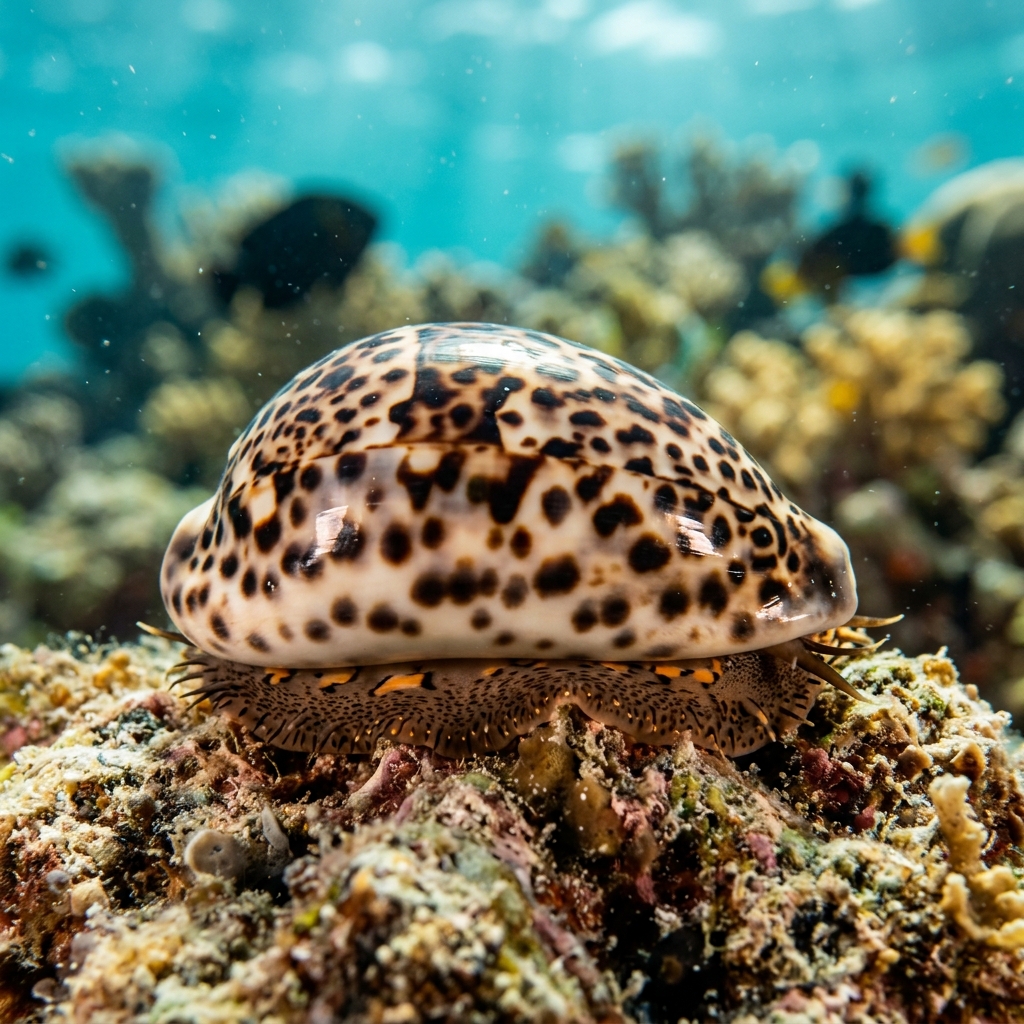
Cypraea tigris
Spot tiger cowrie on Indo-Pacific reefs from Malaysia to Zanzibar. Most sightings fall between 25-29 °C in Perhentian, Visayas, and Bali.
That polished, egg-shaped shell is the giveaway: creamy white to pale tan on top, densely freckled with dark brown and black spots of varying sizes, and a flat, toothed underside that's typically orange-brown. Adults can grow to roughly 10-15 cm, making them one of the larger cowries you'll encounter on a reef. When active, the fleshy mantle (the soft tissue that wraps over and protects the shell) extends up over the sides, dark and speckled to match the shell. Pull back and the shell sits alone, instantly recognisable.
Tiger cowrie is largely nocturnal, so your best chance of seeing one active and moving is on a night dive, when it crawls across rubble, sandy patches, and reef slopes grazing on algae and sponges. During the day it tends to shelter in crevices, under coral heads, or wedged beneath ledges, often with the shell partially or fully retracted and the mantle withdrawn. Approached slowly, it generally stays put rather than retreating, making it an easy subject to observe.
The living animal polishes its own shell. The mantle that wraps over the exterior deposits fresh layers of enamel continuously, which is why tiger cowrie shells have that distinctive high gloss you won't see on any dead or beached specimen.
In the Northern Hemisphere, sightings concentrate from October through May, which covers the calmer diving seasons across Malaysia, the Philippines, and the Pacific islands. In the Southern Hemisphere, April to October is the more productive window for destinations like Bali and Zanzibar.
Tiger cowrie turns up across the Indo-Pacific, and the strongest concentration of logged sightings is in Malaysia, particularly the reefs around Perhentian and Redang islands, and Pulau Tioman. The Philippines, especially Central Visayas, and Bali with the broader Lombok and Java region in Indonesia are the next most reliable destinations. It also appears regularly in Hawaii, Sipadan and East Sabah, Zanzibar, and throughout Guam and the Marshall Islands.
Mapping where Tiger Cowrie is logged…
The most reliable diving for tiger cowrie is in Malaysia (Perhentian and Redang islands, Pulau Tioman, and Sipadan), the Philippines (Central Visayas), and Indonesia (Bali, Lombok, and Java). It also turns up in Hawaii, Zanzibar, Guam, and the Marshall Islands.
In the Northern Hemisphere, October to May covers the peak window across Malaysia, the Philippines, and the Pacific. In Southern Hemisphere destinations like Bali and Zanzibar, April through October tends to produce the most sightings.
Look for a large, oval, highly polished shell with dense dark brown and black spots on a creamy background and a flat toothed underside. When active, the dark spotted mantle folds up over the shell. No other common reef cowrie combines that size, gloss, and bold spot pattern.
Tiger cowrie is one of the largest cowrie species, typically reaching around 10 to 15 cm in shell length. On the reef it feels substantial in the hand, noticeably bigger than most other cowries you will encounter.
The gloss is produced by the living animal itself. The soft mantle tissue wraps over the outside of the shell and continuously deposits fresh layers of enamel. Shells found washed up on a beach lose that polish quickly once the animal dies.
Site and sighting data is aggregated from diver logs, iNaturalist and GBIF. For taxonomy and conservation status:
Triton Shell
2,297 sites