Cymbacephalus beauforti
Spot crocodile fish on sandy reef flats in Sipadan, Palawan and the Banda Sea. Year-round in warm Indo-Pacific waters from 23-29 °C.
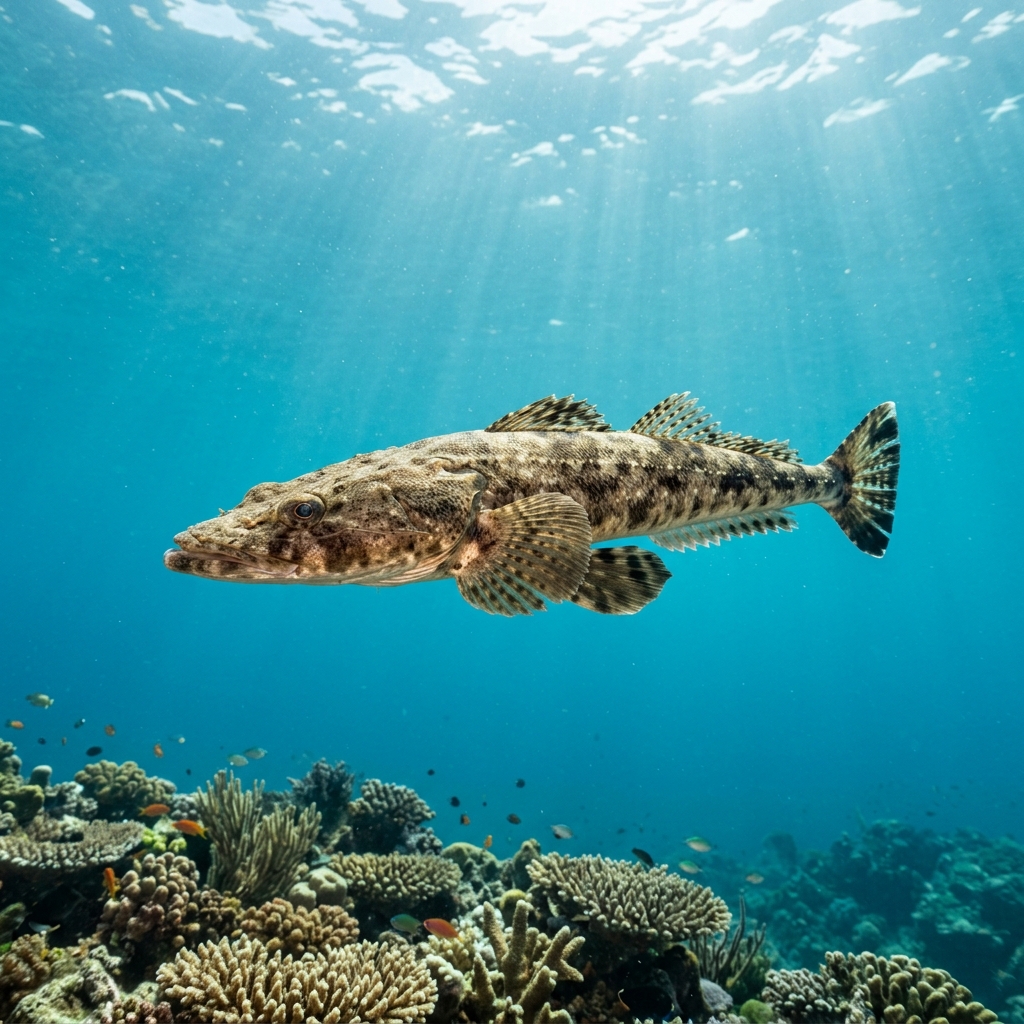
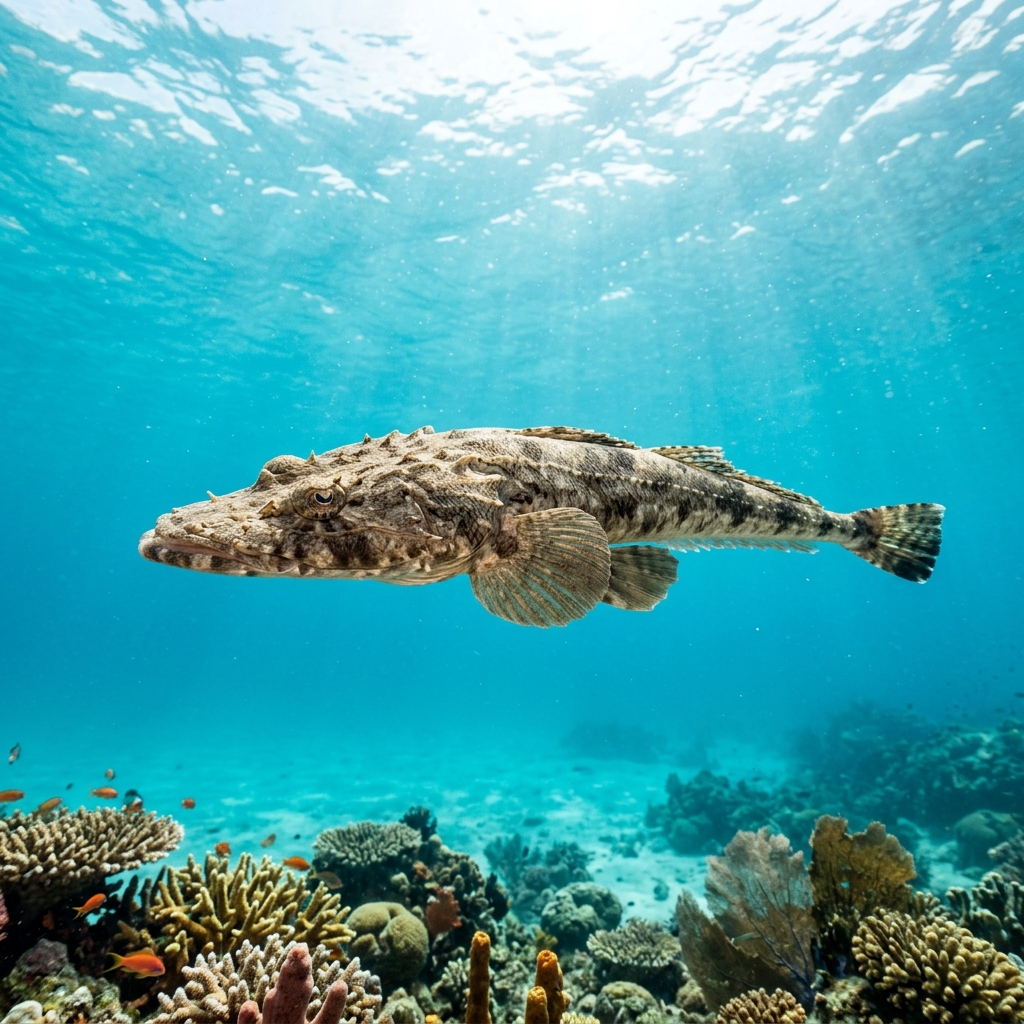
Flat as a dinner plate and built like a crocodile's head, this is one of the most distinctive bottom-dwellers on the Indo-Pacific reef. The body is heavily mottled in browns, greys and tans, blending almost perfectly with sand, rubble and seagrass. The give-away is the enormous, wide-set eyes equipped with elaborate iris lappets (fringed skin flaps around the pupil) that break up the eye's outline to maintain the camouflage. Reaching well over half a metre in large individuals, it lies completely motionless, usually on open sandy substrate or rubble rather than on coral.
Almost everything about this fish is about staying still, you will typically find it lying motionless on the sand or rubble, relying entirely on camouflage rather than retreat. Divers who approach slowly and look closely are often rewarded with a fish that simply refuses to move, occasionally shifting only its eyes. They are ambush predators, so patient observation sometimes reveals a lightning-fast lunge at a passing fish.
Those extraordinary iris lappets are not just decorative, they are one of the few documented cases of a vertebrate evolving active disruption of its own eye to preserve camouflage, a trick studied by vision researchers.
No strong seasonal pattern emerges from the data, so it is treated as a year-round resident. Its observed temperature range of roughly 23 to 29 °C matches stable tropical and subtropical reef conditions throughout the Indo-Pacific.
Most frequently logged across Malaysia, Indonesia and the Philippines, with Sipadan and East Sabah dominating the sighting records by a wide margin. Palawan and Apo Reef in the Philippines, Nusa Tenggara and the Banda Sea in Indonesia, and Efate in Vanuatu are all solid places to search. Smaller but consistent records also come from the Andaman Islands in India and Nouméa, New Caledonia.
Mapping where Beaufort's Crocodilefish is logged…
The strongest concentration of sightings is in Malaysia's Sipadan and East Sabah area, followed closely by Palawan and Apo Reef in the Philippines and various sites across Indonesian Nusa Tenggara and the Banda Sea. Vanuatu, New Caledonia, and the Andaman Islands also produce reliable records.
There is no defined season in the sighting data, so any time of year is valid. Water temperatures between roughly 23 and 29 °C suit them well, which describes most tropical Indo-Pacific reefs year-round.
Look for a very flat, elongated fish lying completely still on sand or rubble. The wide, laterally positioned eyes with fringed lappets around the iris are the key feature, no other common reef fish has them. The mottled brown and grey body can be over half a metre long and looks almost like a piece of sandy substrate until you spot the outline.
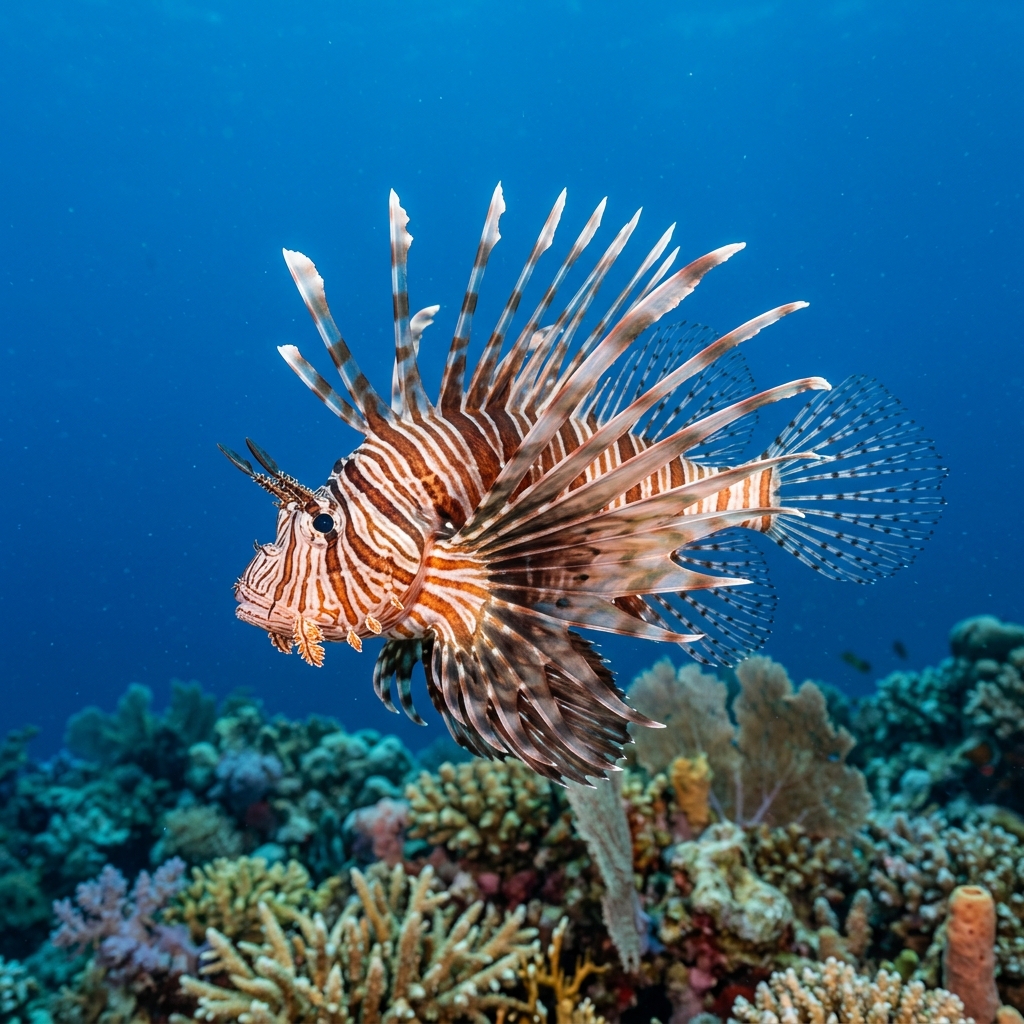
No. Unlike some other bottom-dwellers such as stonefish or lionfish, crocodile fish pose no venom risk and are not aggressive. They rely on camouflage, not defence, so the main risk is accidentally placing a hand on one, worth avoiding simply to avoid disturbing the animal.
Cymbacephalus beauforti is one of the larger platycephalids (flatheads), commonly reaching 50 to 70 cm in length. In the water they read as a substantial, elongated form, which makes spotting them satisfying once you train your eye for the outline.
The fringed flaps around the pupil, called iris lappets, break up the circular outline of the eye, the one part of a camouflaged fish that is hardest to hide. It is a rare and well-studied adaptation that makes the crocodile fish's disguise remarkably complete even at close range.
Site and sighting data is aggregated from diver logs, iNaturalist and GBIF. For taxonomy and conservation status:
Madeira Rockfish
2,773 sites