Allogalathea elegans
Colour-matched to its host crinoid, this tiny lobster hides in plain sight across Bali's reefs at 25-31C, year-round.
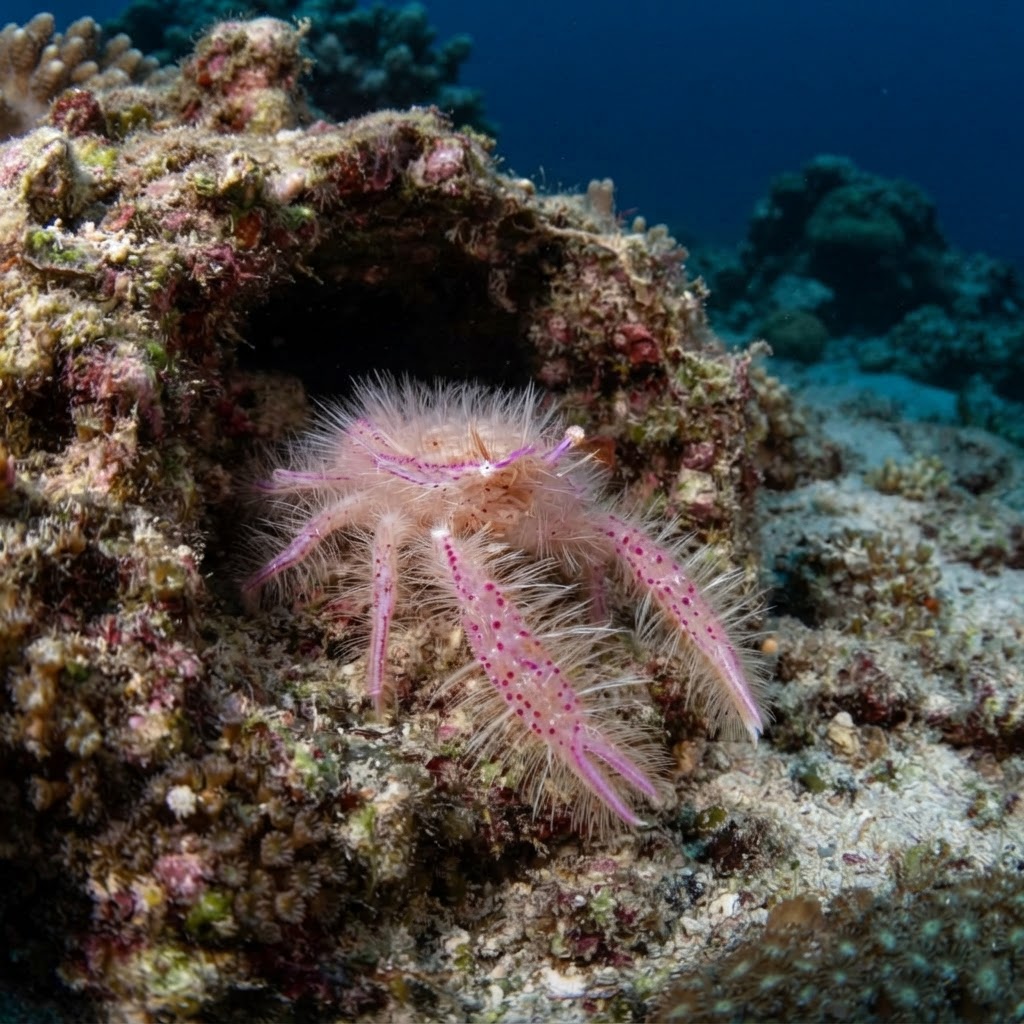
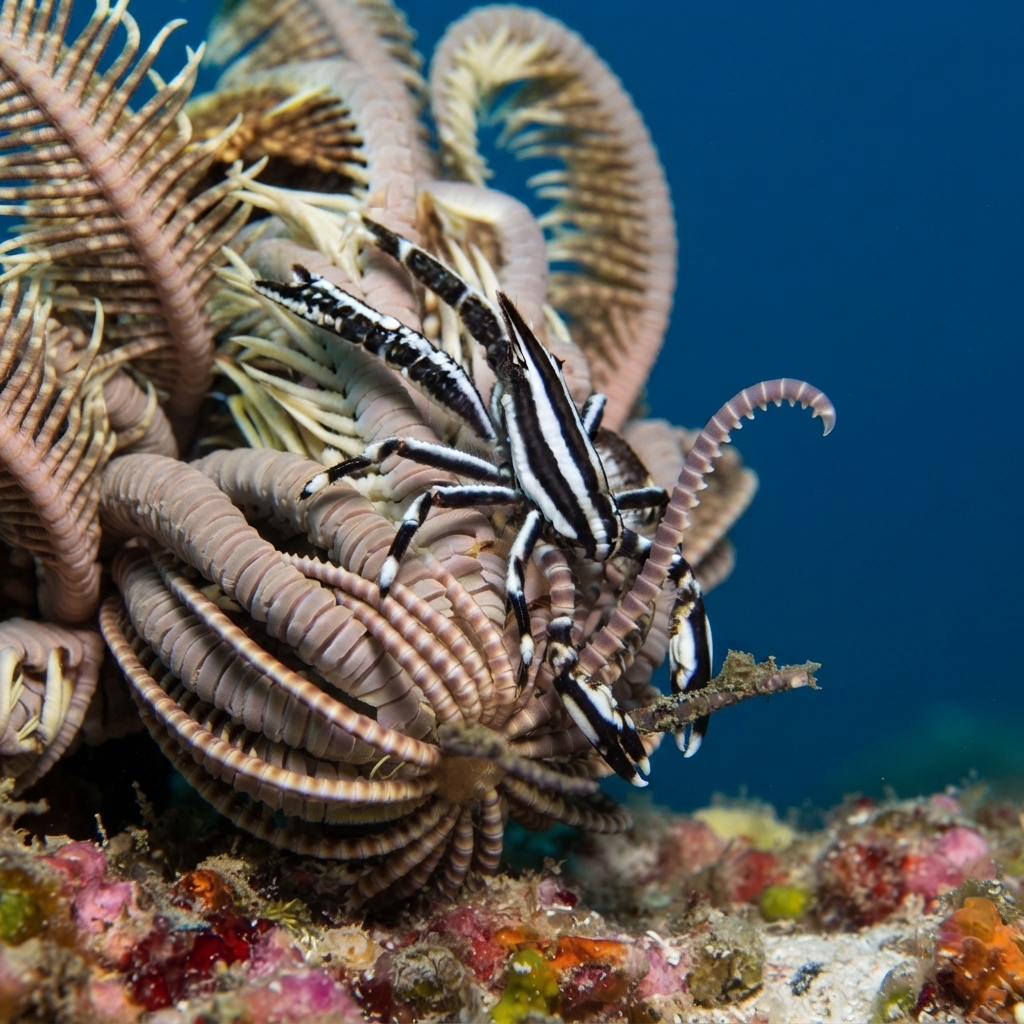
A small, slender lobster-like body that tucks itself among the arms of a feather star (crinoid), matching its host's colour so closely it can be almost invisible until it moves. Look for long, thin walking legs and a pair of slim claws held forward, with a body that curls to hug the crinoid's arms rather than sitting exposed on the reef. Colour varies from purple and yellow to red and white depending on which crinoid it is riding, so the shape and posture are better ID cues than the colour itself.
Spends its time riding a single feather star, gripping the crinoid's arms and picking at passing plankton and detritus with its claws rather than roaming the reef. It rarely bolts when divers approach, relying instead on colour-matching to stay unnoticed, so a slow careful look over a crinoid's arms is usually how divers spot one. Most sightings happen on daytime reef dives where crinoids are perched on top of coral or rubble in current.
It lives its entire adult life on one host crinoid, matching that individual's colour so precisely that divers often need a torch or macro lens to separate the lobster's outline from the feather star's arms.
Comfortable across a narrow warm-water band of roughly 25 to 31C, which matches tropical reef temperatures year-round, so there is no strong seasonal pattern in the data. Any month works as long as you are diving reefs with plenty of feather stars to check.
Reef neighbours a diver could mistake it for. Use the identification notes above to tell them apart.
Most reliably logged in Indonesia, especially around Bali, which accounts for the bulk of sightings, with further records from Sulawesi. Outside Indonesia it turns up in the Visayas region of the Philippines, and single logged sites in Queensland, Australia and Dili, Timor-Leste.
Mapping where Crinoid Squat Lobster is logged…
Bali in Indonesia is the strongest area for sightings, with more records from Sulawesi. The Visayas in the Philippines, Queensland in Australia, and Dili in Timor-Leste also have logged sightings.
There is no strong season in the sighting data. It lives in water between roughly 25 and 31C, which describes tropical reefs all year, so any month of diving is fair game as long as feather stars are present.
Check any feather star closely for a slender lobster-shaped animal gripping its arms, coloured to match the host. Long thin legs, forward-held claws, and a curled posture against the crinoid's arms are the giveaways rather than a fixed colour.
They stay small, easily overlooked against a feather star's arms unless you look closely. Exact size figures are not well documented, but divers should expect a body that fits comfortably within a single crinoid's span.
It commits to a single feather star as a lifelong home, adjusting its colour to blend with that individual host. This makes it one of the better examples on the reef of an animal that camouflages itself against a living partner rather than the seafloor.
Site and sighting data is aggregated from diver logs, iNaturalist and GBIF. For taxonomy and conservation status:
Caribbean Spiny Lobster
2,209 sites