Nembrotha cristata
Black, green and orange nudibranch logged across the Visayas and Sabah, reliable year-round in 25.5 to 31.5 C reef water.
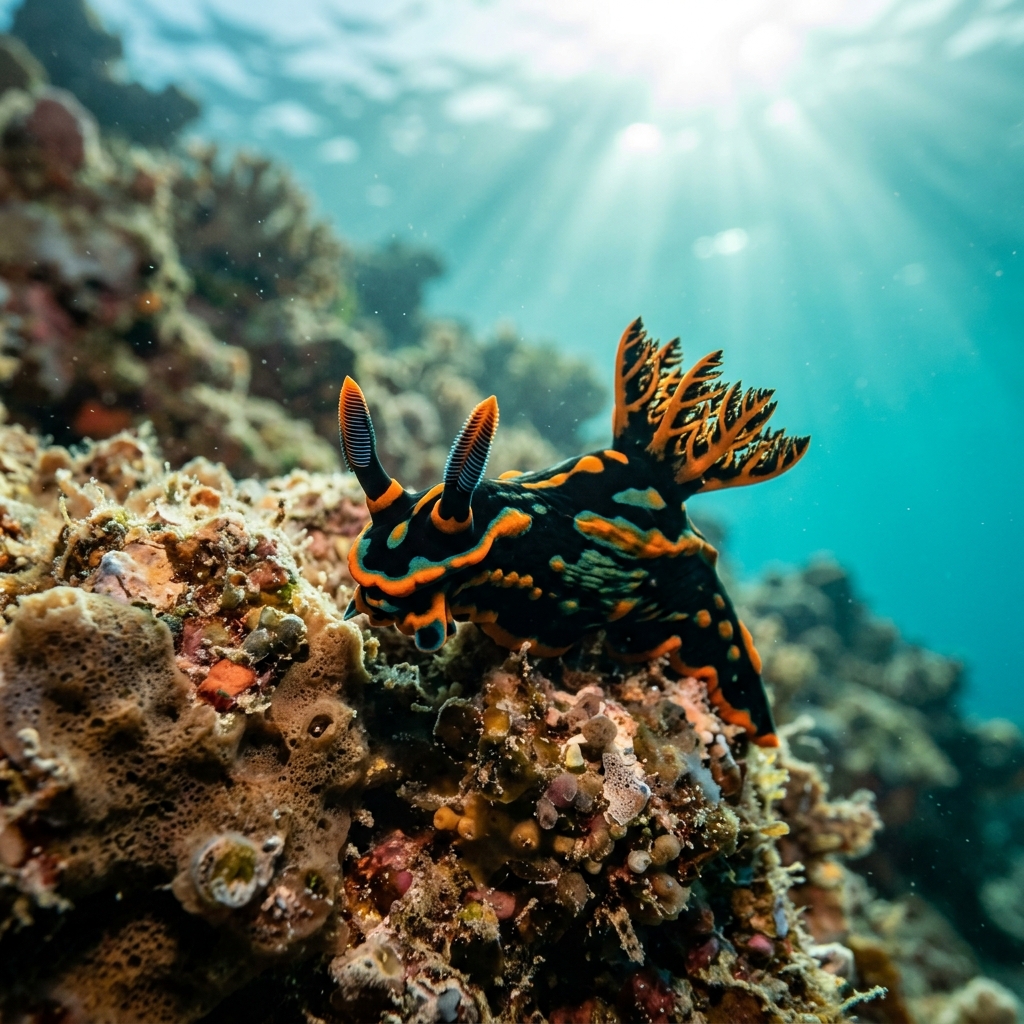
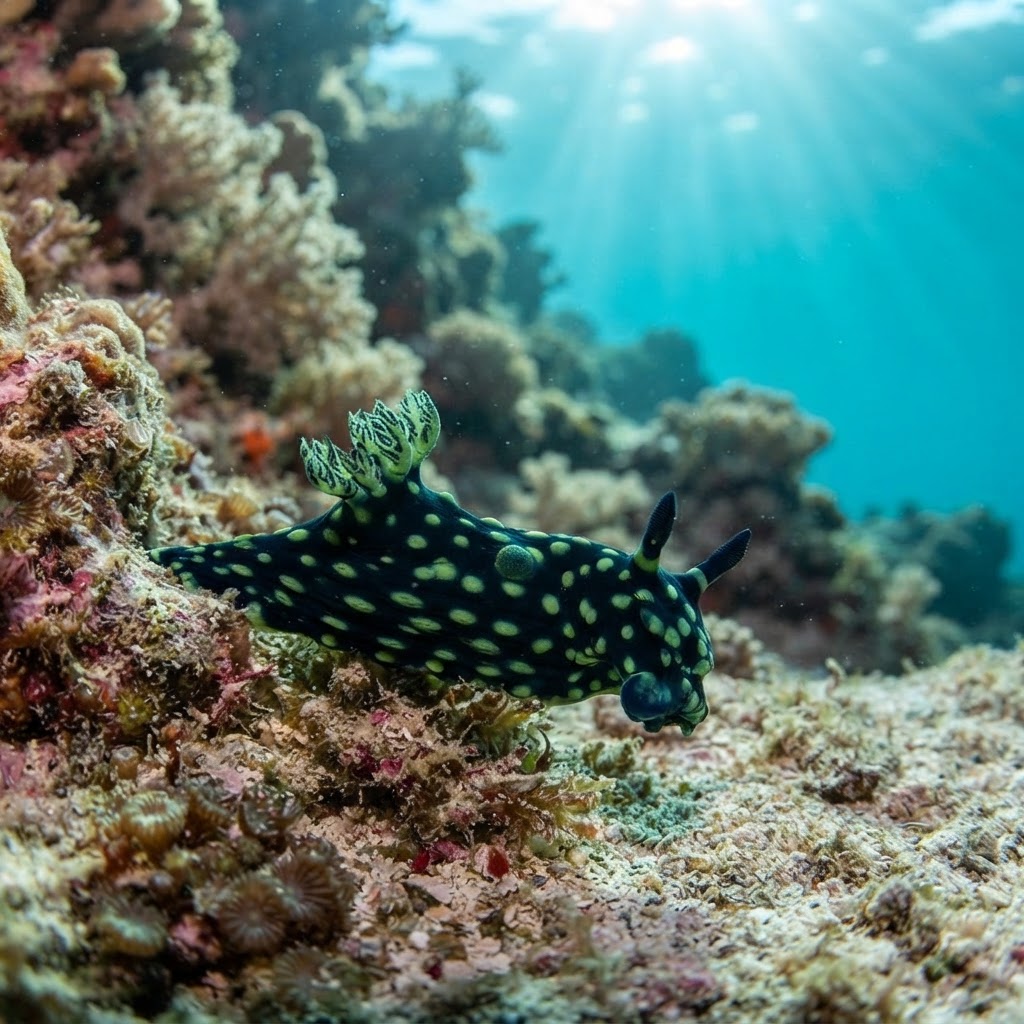
Small slug around 8 cm long with a black or dark green body carrying bold green stripes or blotches down its back. Look for the orange-tipped rhinophores (the paired sensory horns on the head) and the orange gill cluster near the tail, both of which stand out sharply against the dark body. It moves slowly across the reef surface, unmistakably a nudibranch rather than a flatworm once you spot the raised gill plume.
Divers usually find it parked on the reef surface at a crawl, working over sponges and tunicates rather than darting for cover, which makes it an easy subject for macro photographers. It shows no reaction to a diver's presence beyond continuing its slow grazing pace, and it turns up on both day and night dives on rubble slopes and coral rubble patches. Look low on the reef among sponge-encrusted rock rather than up in open water.
Its bold black, green and orange colouring is a warning signal rather than decoration, likely linked to toxins it picks up from the ascidians (sea squirts) and sponges it feeds on, which most reef predators leave well alone.
No clear seasonal pattern shows in the sightings, and with a comfortable range of 25.5 to 31.5 C it is present on Coral Triangle reefs all year round. Plan around good visibility and macro conditions at your chosen site rather than a particular month.
Reef neighbours a diver could mistake it for. Use the identification notes above to tell them apart.
This is a Coral Triangle regular, most consistently logged in the Visayas and Luzon regions of the Philippines, with strong numbers also in Sabah, Malaysia. It turns up reliably in Bali and Sulawesi in Indonesia too, and shows up in smaller numbers on reefs in Western Australia and Timor-Leste.
Mapping where Crested Nembrotha is logged…
It's most reliably seen in the Visayas and Luzon regions of the Philippines, plus Sabah in Malaysia. Bali and Sulawesi in Indonesia are also solid bets, with occasional sightings in Western Australia.
There's no strong seasonal pattern in the data, and its warm-water niche of 25.5 to 31.5 C means it's present on tropical reefs year-round. Any month works if the site itself has good conditions.
Look for a dark, black or deep green body with green ridges or blotches, orange-tipped rhinophores on the head, and an orange gill cluster near the tail. It moves slowly across sponges and rubble rather than swimming.
It grows to around 8 cm, a typical size for reef-dwelling nudibranchs, so most sightings are of adults close to that length.
No. It has no sting or bite of concern to divers and simply crawls over the reef surface, safe to observe and photograph up close without disturbing it.
It feeds on toxic sponges and tunicates and appears to store their chemical defences in its own tissue, which is likely why its colouring is so bold. Most reef predators avoid it as a result.
Site and sighting data is aggregated from diver logs, iNaturalist and GBIF. For taxonomy and conservation status:
Light-spotted Aegires
3,168 sites