Cratena peregrina
Spot the Cratena Slug across the French Riviera, Costa Brava and Gozo from March to December in water as cool as 13°C.
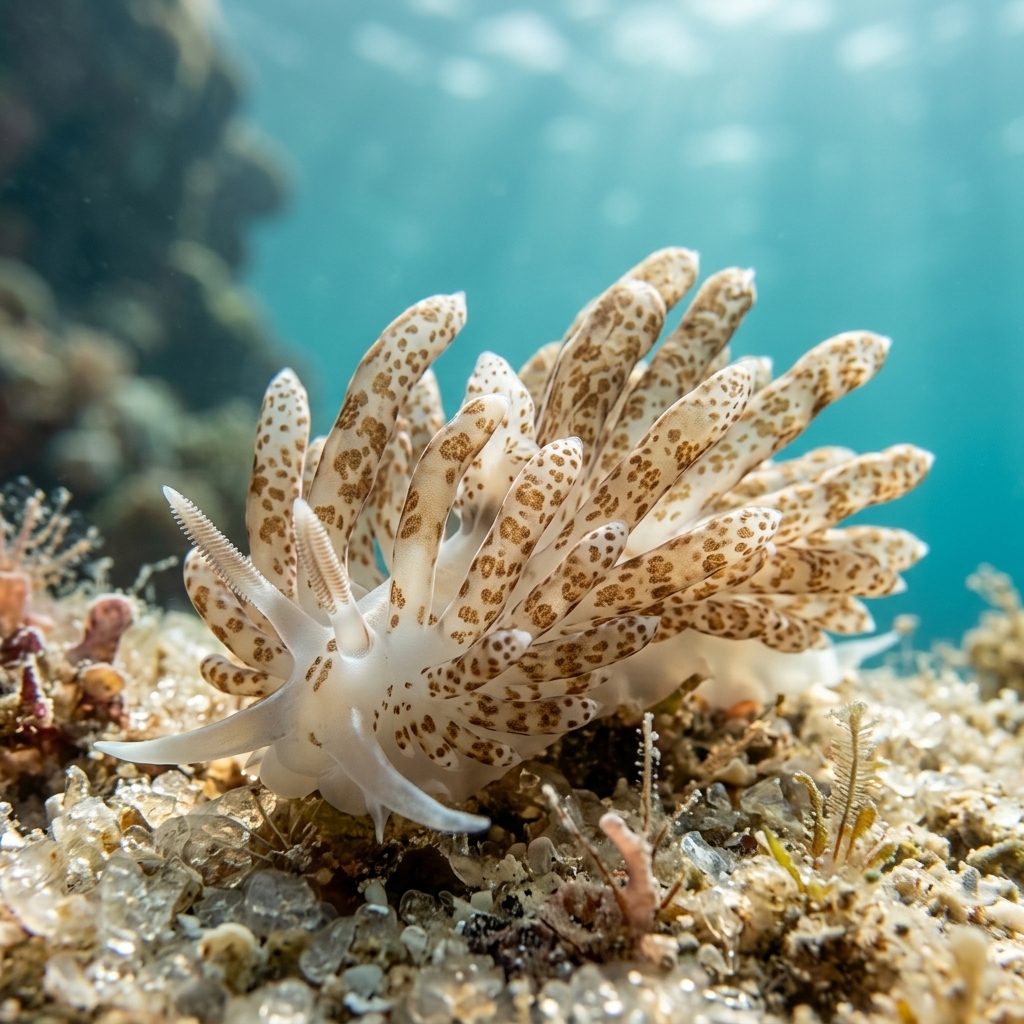
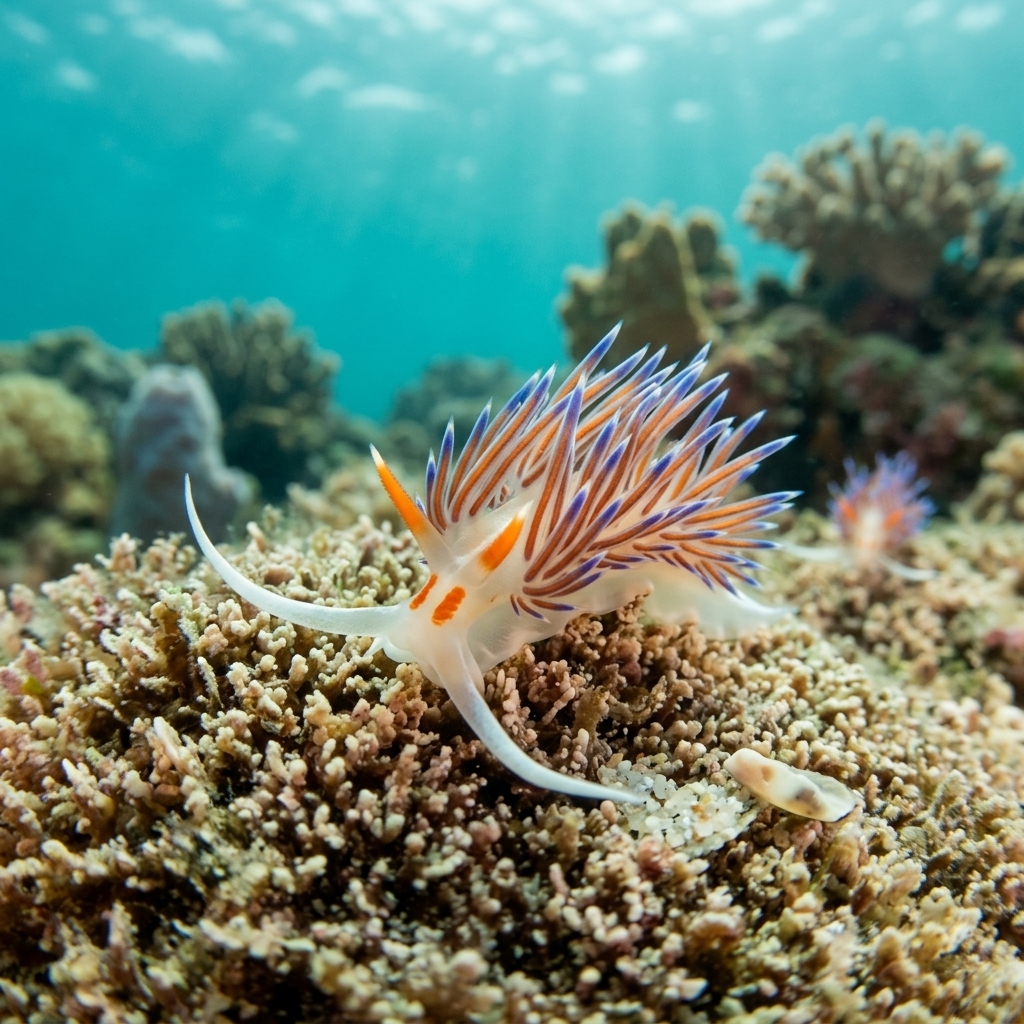
A slim, elongated nudibranch whose white or translucent body is packed with upright finger-like projections called cerata, each tipped with a bright orange or red cap and banded in violet near the base. The head carries long white or pale rhinophores (scent organs used to detect prey) and similarly pale oral tentacles, making the front end look distinctly antennae-heavy. Against a rocky Mediterranean wall it tends to stand out because of that repeated orange-tipped pattern running the full length of the back.
You will almost always find one foraging slowly over rocky or algae-covered surfaces at shallow to moderate depths, hunting the hydroid colonies it feeds on. It tends to ignore divers entirely, continuing to move and feed even when approached closely, which makes for unhurried photography. Look on shaded vertical walls and beneath ledges where hydroids thrive.
Cratena peregrina stores stinging cells (nematocysts) from the hydroids it eats and transfers them to the tips of its own cerata, using them as a borrowed chemical defence against predators.
Sightings concentrate from March through to December across northern Mediterranean sites, so spring through autumn is the window to aim for. The species is recorded in water temperatures between roughly 13 and 22°C, which fits that Mediterranean seasonal pattern well.
Reef neighbours a diver could mistake it for. Use the identification notes above to tell them apart.
By far the most consistently logged records come from Spain, France, Croatia, and Italy, with the French Riviera and Provence, the Costa Brava, and the Balearic Islands representing the strongest concentrations of sightings. Gozo in Malta and Croatia's Kvarner Gulf and Istria coast are also reliable hunting grounds. Portugal and Gibraltar contribute a smaller number of records at the western edge of its range.
Mapping where Cratena Slug is logged…
The strongest populations are in the western and central Mediterranean. The French Riviera, Costa Brava, Balearic Islands, and Gozo in Malta see the most consistent sightings, with Croatia's Istria and Kvarner Gulf also very productive. Scattered records exist along the Portuguese coast and at Gibraltar.
March through December covers the bulk of logged sightings in the northern Mediterranean. Peak activity aligns with the warmer months, but the species tolerates quite cool water, so spring and autumn dives are productive too.
Look for a slender nudibranch whose back is covered in rows of cerata tipped bright orange or red with a violet band underneath. The pale, antenna-like rhinophores at the front are also distinctive. That repeating orange-tipped pattern along the whole dorsal surface is the quickest field mark on a rocky Mediterranean reef.
Exact size data for this species in the field is limited, but like most aeolid nudibranchs it is a small animal, typically in the range of a few centimetres in length. You will need to look carefully on hydroid-covered rock to spot one.
It feeds almost exclusively on hydroids, small colonial animals that look like fuzzy growths on rock or algae. More remarkably, it recycles the hydroids' own stinging cells into its cerata tips, giving itself a ready-made defence without producing any venom of its own.
Site and sighting data is aggregated from diver logs, iNaturalist and GBIF. For taxonomy and conservation status:
Light-spotted Aegires
3,168 sites