
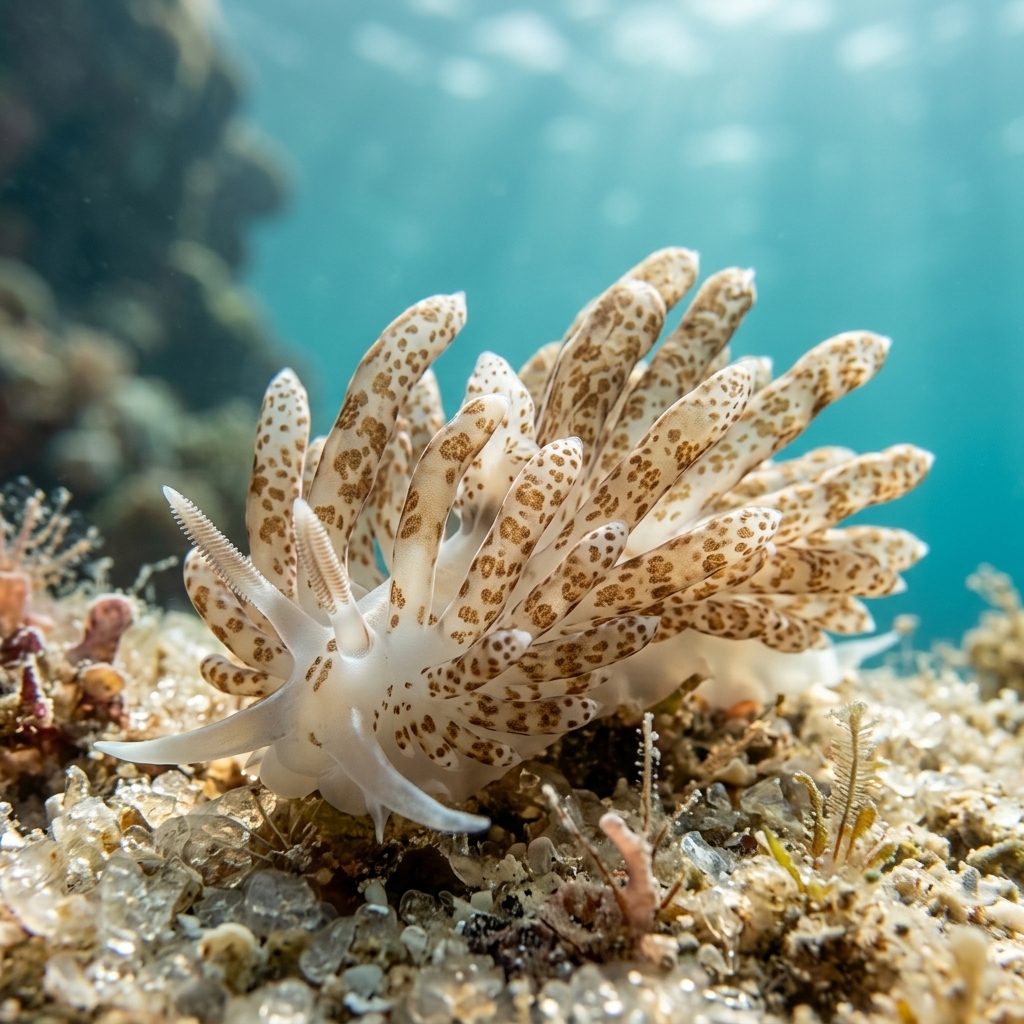
Phyllodesmium longicirrum
Rare but unmistakable in Indonesia, Japan and Timor-Leste. Learn how to spot Phyllodesmium longicirrum in warm Indo-Pacific waters around 27-29 °C.
Pale, almost translucent body with long, finger-like cerata (the branching projections along its back) that are swollen and packed with brown zooxanthellae, symbiotic algae that give the tips a warm tan or brownish hue. That combination of inflated, light-gathering cerata and a near-colourless body is the key field mark; no other nudibranch in its range quite matches it. Individuals tend to be found on or very close to soft corals of the genus Sarcophyton, which is their host.
When encountered, it is almost always sitting directly on or alongside its host soft coral, moving slowly as it feeds. It shows little fear of divers and tends to stay put when approached carefully. Because it relies on zooxanthellae in its cerata to supplement energy from sunlight, it is most likely to be found in shallower, well-lit reef zones rather than deep rubble slopes.
It is one of the few animals that farms solar energy: the cerata house living zooxanthellae harvested from its soft coral prey, and the nudibranch then keeps those algae alive and photosynthesising inside its own body, effectively running on sunshine between meals.
No clear seasonal pattern has emerged from the data, so it is treated as a year-round target. Its observed temperature range of 27 to 29 °C points firmly to shallow tropical reef conditions, which remain consistent across its Indo-Pacific range throughout the year.
Most sightings come from Indonesia, particularly Sulawesi and the Maluku and Papua regions, making those areas your best bet. Okinawa in Japan and the north coast of Timor-Leste also have verified observations, and there is at least one record from Queensland, Australia.
Mapping where Solar-powered Nudibranch is logged…
Verified diver sightings place it in Indonesia (especially Sulawesi and Maluku and Papua), Okinawa in Japan, the north coast of Timor-Leste, and Queensland in Australia. Indonesia holds the greatest spread of sites, so a trip to Sulawesi or the Banda Sea gives you the widest net to cast.
There is no defined season from the available data, so it can appear any time of year. Its comfort zone of 27 to 29 °C means it sticks to warm tropical reefs, which maintain those temperatures year-round across its Indo-Pacific range.
Look for a pale, near-translucent body lined with long, distinctly swollen cerata tipped in brown or tan. That brownish tint comes from zooxanthellae living inside the cerata, a feature unique to Phyllodesmium longicirrum among similar nudibranchs. Finding it on or right next to a Sarcophyton soft coral is a strong supporting clue.
Reliable size data for this species is limited, but members of the Phyllodesmium genus are generally small nudibranch, typically a few centimetres in length. Underwater, they can look larger because of the long, outstretched cerata.
It earns the name by sequestering zooxanthellae (photosynthetic algae) from its soft coral prey and keeping them alive inside its cerata. Those algae continue to photosynthesise, passing sugars back to the nudibranch, essentially letting it harvest solar energy directly. It is one of only a handful of animals known to use this solar-farming trick.
Site and sighting data is aggregated from diver logs, iNaturalist and GBIF. For taxonomy and conservation status:
Light-spotted Aegires
3,168 sites





