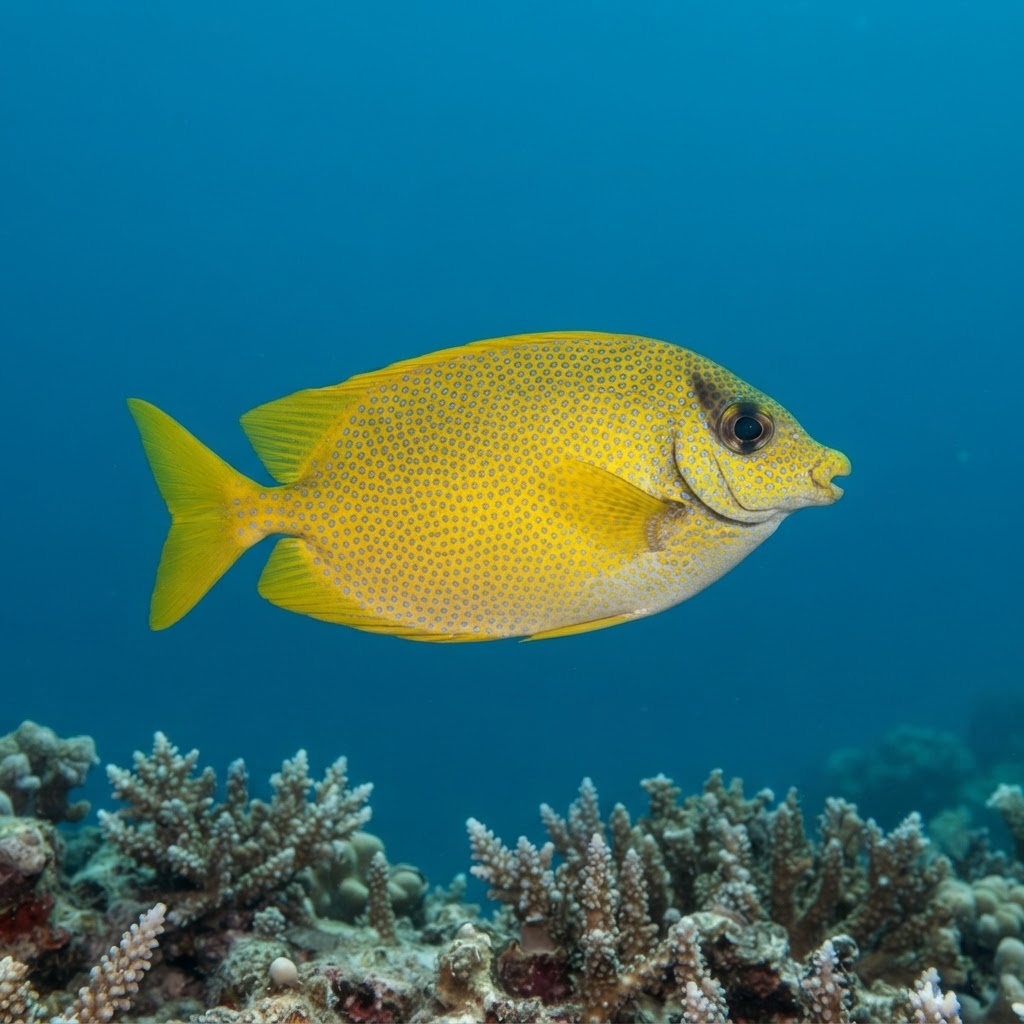
Siganus corallinus
Yellow-blue reef fish grazing in Queensland, Raja Ampat and the Inner Islands of Seychelles, 24.7-29C year-round.
Safety warning
The spines along its fins deliver a painful, venomous sting if grabbed or accidentally pressed against, so admire it without touching and keep hands and gear clear of the reef where it's feeding.
If you're stung
Venomous fin spinesGeneral first-aid guidance, not a substitute for professional medical care. In an emergency, call your local emergency number.
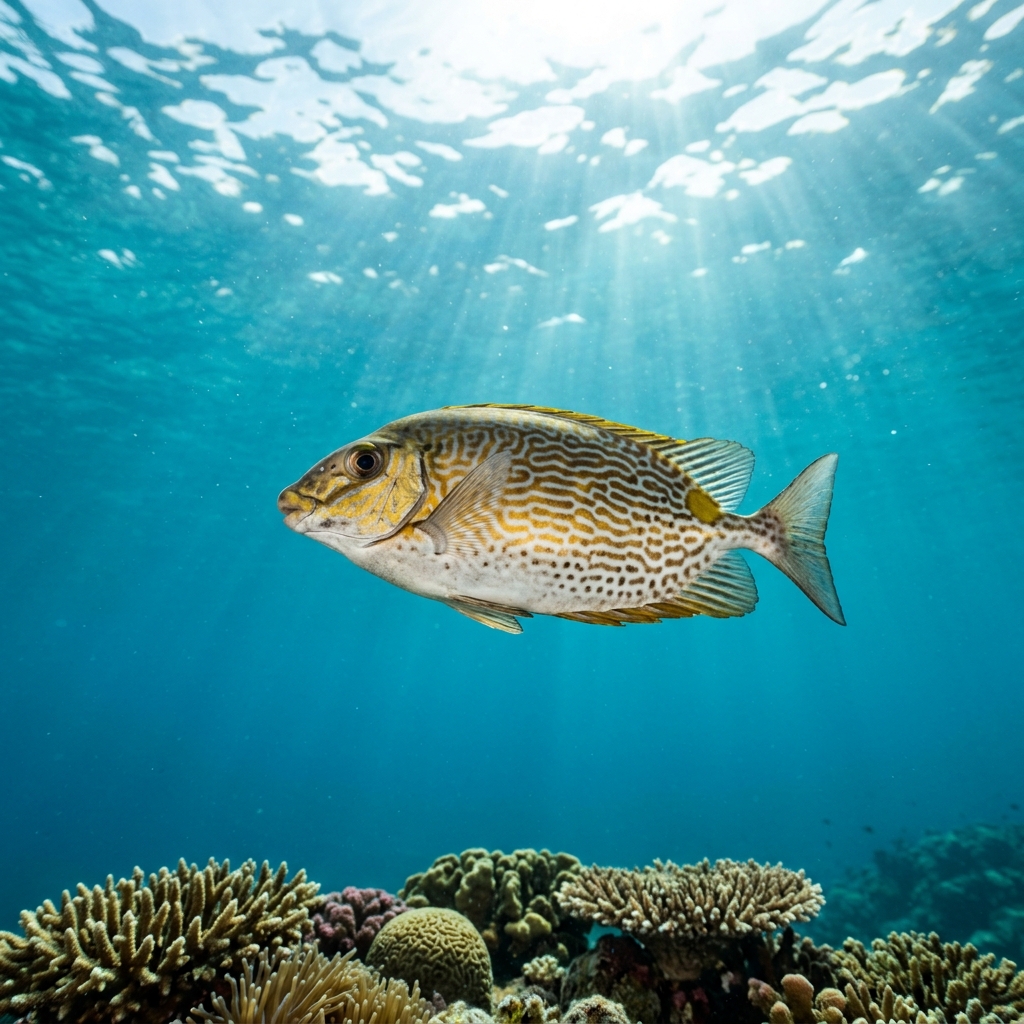
Grows to about 24 cm, with a deep, laterally compressed body coloured bright yellow to orange and etched with fine blue lines across the face and back. Look for a dark saddle-like blotch on the upper body near the tail, a key mark that separates it from plainer yellow reef fish. It moves in a slow, deliberate grazing pattern low over the reef, tail flicking gently as it picks at algae.
Divers typically find it browsing solo or in loose pairs over reef flats and coral rubble, nibbling at algae with unhurried, grazing movements. It is not particularly shy but keeps a sensible distance, drifting off into cover rather than bolting if you approach too fast. Most sightings come from shallow to mid-depth reef, well within the 3 to 30 m range it favours.
Like other rabbitfish, it carries venomous spines in its dorsal, anal and pelvic fins, which double as a defence rather than an offence, only a threat if you handle or corner the fish.
No clear seasonal pattern shows up in the sightings, and its comfort range of 24.7 to 29C spans tropical reefs year-round, so any month works at these sites.
Most reliably logged in Malaysia, especially along Peninsular Malaysia's east coast, and in Queensland, Australia, with strong numbers also in Thailand's Koh Tao and Khao Lak. It turns up consistently in the Inner Islands of Seychelles and in Raja Ampat, Indonesia, plus the Central Atolls of the Maldives.
Mapping where Coral Rabbitfish is logged…
Best bets are Malaysia's east coast, Queensland in Australia, and Thailand's Koh Tao and Khao Lak. It's also a steady sighting in the Seychelles' Inner Islands, Raja Ampat in Indonesia, and the Maldives' Central Atolls.
There's no strong season in the sighting data, and its 24.7 to 29C temperature range covers tropical reefs all year, so it's a year-round find at the sites above.
They carry venomous spines in their dorsal and other fins that can cause a painful sting if the fish is grabbed or bumped. Left alone while grazing, they pose no real risk to divers.
Look for a yellow to orange body with fine blue lines across the face and back, and a distinctive dark saddle patch near the tail. It grazes slowly and low over the reef rather than swimming actively in open water.
They typically reach around 24 cm, a modest, easy-to-overlook size that keeps them close to coral rubble and reef flats where they graze.
Its common name comes from its herbivorous, nibbling feeding style, but its real defence is a set of venomous spines hidden in the fins, used only when threatened, not for hunting.
Site and sighting data is aggregated from diver logs, iNaturalist and GBIF. For taxonomy and conservation status:
Soldierfish
3,612 sites