Pholidichthys leucotaenia
Black and white striped fish that swarm in eel-like balls on reef slopes in Visayas and Raja Ampat, best spotted year-round in warm water.
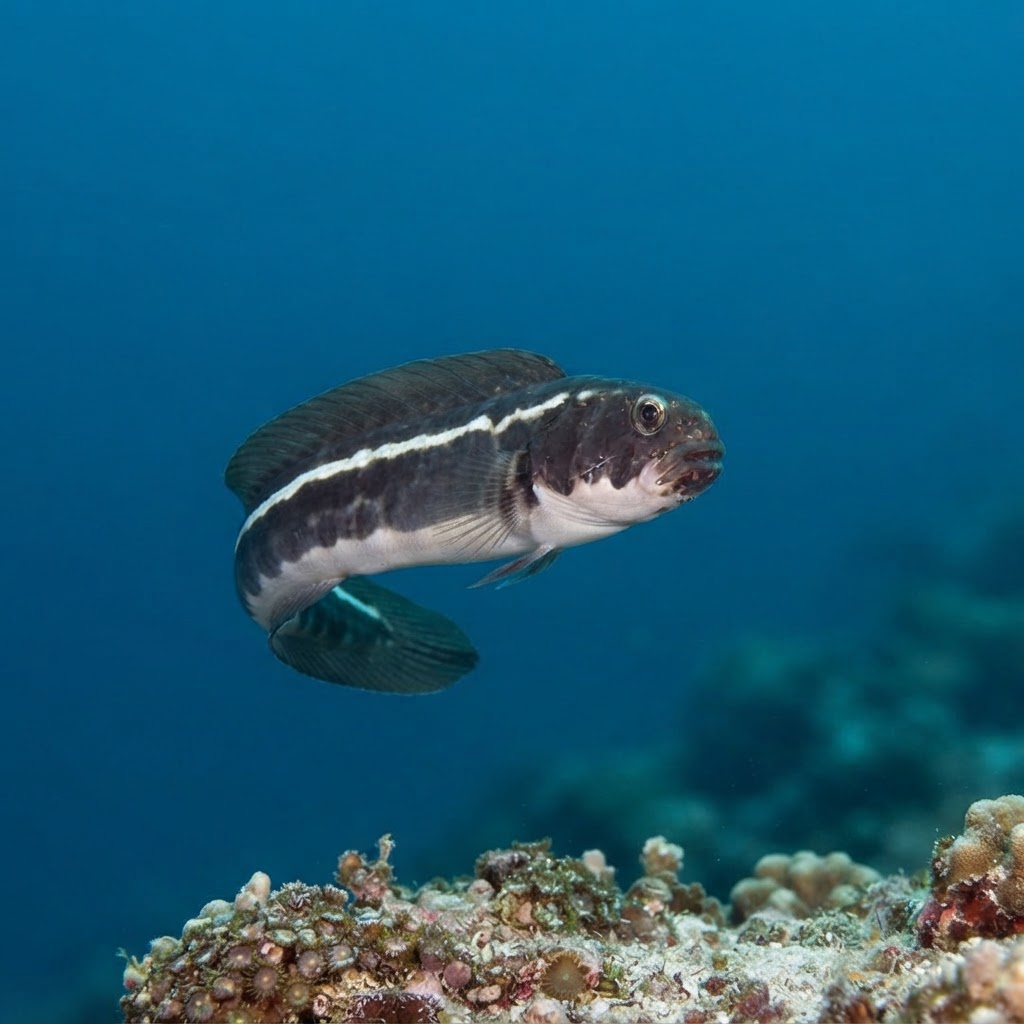
Look for a slender, eel-shaped body about 23 cm long with bold black and white horizontal stripes running head to tail. Adults are usually solitary and retreat into reef crevices, showing just the striped head and front third of the body. Juveniles are the real giveaway: they form dense, swirling balls of hundreds of striped fish that move together like a single eel-shaped mass over the reef.
Adults spend most of daylight hours tucked into burrows or crevices, poking out just the head to watch divers pass, which is why sightings are logged as uncommon even where the species is present. The real spectacle is the juveniles, which gather in tight, constantly rippling schools that mimic the movement of a single venomous eel, a strategy that likely helps deter predators. These juvenile balls hover close to the reef structure rather than out in open water, so divers usually find them by scanning crevices and rubble patches rather than the water column.
The juvenile schooling behaviour, where hundreds of young fish move as one undulating black-and-white mass, is thought to mimic the swimming pattern of a toxic eel or catfish, giving the group a defensive advantage disproportionate to any single fish's size.
No clear seasonal pattern shows up in the sighting data, and the species sits comfortably in warm water between roughly 27 and 29°C, so it is a year-round find on tropical Indo-Pacific reefs. Any month diving the Visayas or Raja Ampat gives a fair shot at it.
Most reliably logged across the Visayas in the Philippines, with strong numbers also coming from West Papua and Raja Ampat in Indonesia, plus occasional sightings in Sulawesi. It sits on reef-associated ground between about 3 and 30 metres, so both shallow house reefs and deeper slopes in these regions are worth checking.
Mapping where Convict Blenny is logged…
The most consistent sightings come from the Visayas region in the Philippines, with good numbers also reported from West Papua and Raja Ampat in Indonesia. Sulawesi has occasional records too, but the Philippines and Indonesia together cover the known range for divers.
There is no strong seasonal pattern in the sighting data, so it is considered a year-round species on the reefs where it occurs. Its comfort range of roughly 27 to 29°C matches typical tropical reef conditions in the Philippines and Indonesia throughout the year.
Check for a slim, eel-like body with sharp black and white horizontal stripes, growing to about 23 cm. Adults usually show just their striped head peeking from a crevice, while juveniles are unmistakable when they cluster into a swirling, eel-shaped ball of dozens or hundreds of fish.
They reach about 23 cm in length as adults, with a slender, elongated body shape more reminiscent of an eel or blenny than a typical reef fish.
Young convict blennies gather into dense, constantly rippling schools that move together as one undulating mass. This is widely thought to mimic the swimming motion of a venomous eel or catfish, which may discourage predators from attacking.
No, they pose no threat to divers and are not considered dangerous. They are shy and tend to retreat into crevices or reef structure rather than approach divers.
Site and sighting data is aggregated from diver logs, iNaturalist and GBIF. For taxonomy and conservation status:
Soldierfish
3,612 sites