Gerres subfasciatus
A silvery reef regular seen on 91 New South Wales dive sites, common year-round in water from 20.6 to 28.8C.
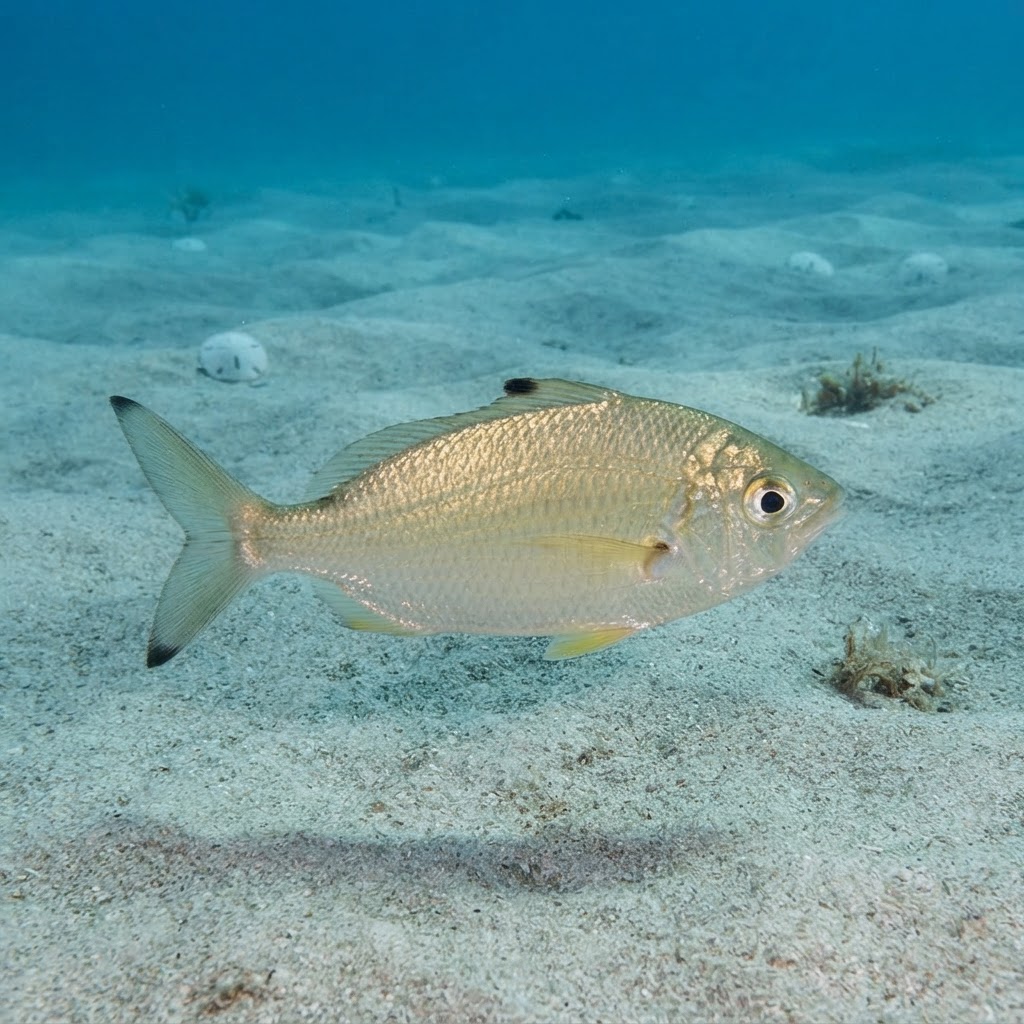
Small, laterally flattened fish around 14 cm, with a bright silvery body that flashes as it turns and a faintly upturned, protrusible mouth used to pick at sand. Look for faint vertical bars or shading along the flanks and a deeply forked tail, usually seen hovering low over sand or rubble patches rather than up in the water column. The dorsal fin has a slightly elongated first spine, giving the profile a subtle peak.
Divers most often find it hovering or slowly cruising just above sand and rubble, sometimes in loose small groups, picking at the substrate for food rather than schooling tightly like many reef fish. It is unbothered by divers, holding its position or drifting off a short distance rather than bolting, which makes it an easy, low-drama fish to photograph on a slow bottom section of a dive. Most sightings are on the sandy or silty fringes of reef rather than on hard coral itself.
That protrusible, downward-facing mouth is built for sifting small invertebrates out of sand, which is why it is almost always seen hanging low over soft substrate rather than picking at coral heads.
Sightings show no detectable seasonal pattern, and with a comfortable range of roughly 20.6 to 28.8C it is logged as a year-round resident rather than a seasonal visitor. Plan around good visibility and calm sand-flat conditions rather than a particular month.
Almost all logged sightings come from Australia, and within Australia this is overwhelmingly a New South Wales fish, turning up across a wide spread of sites there. Smaller numbers are logged further north in Queensland and on the other side of the country in Western Australia, so it is worth watching sandy patches and estuarine-influenced reef on dives anywhere along the eastern Australian coast.
Mapping where Common Silverbiddy is logged…
It is most reliably logged in New South Wales, Australia, across a large number of dive sites there, with smaller numbers of sightings further north in Queensland and over in Western Australia.
There is no strong seasonal pattern in the sightings, and it tolerates a wide temperature range of roughly 20.6 to 28.8C, so it is considered a year-round sighting rather than tied to a particular season.
Look for a small, flattened, silvery fish around 14 cm long hovering close to sand or rubble, with a forked tail and a distinctive downward-pointing mouth it uses to feed on the bottom.
They typically reach about 14 cm in length, making them one of the smaller fish you will spot cruising sandy patches on a reef dive.
No, they pose no threat to divers and simply go about feeding over sand, often staying put or moving off slowly rather than reacting defensively.
It has a protrusible mouth that extends downward to sift small invertebrates out of sand, which is why you will almost always find it hovering low over soft bottom rather than around hard coral.
Site and sighting data is aggregated from diver logs, iNaturalist and GBIF. For taxonomy and conservation status:
Soldierfish
3,612 sites