Halgerda wasinensis
White, ridged nudibranch with brown lines, logged year-round from KwaZulu-Natal to Zanzibar in East Africa's reef systems.
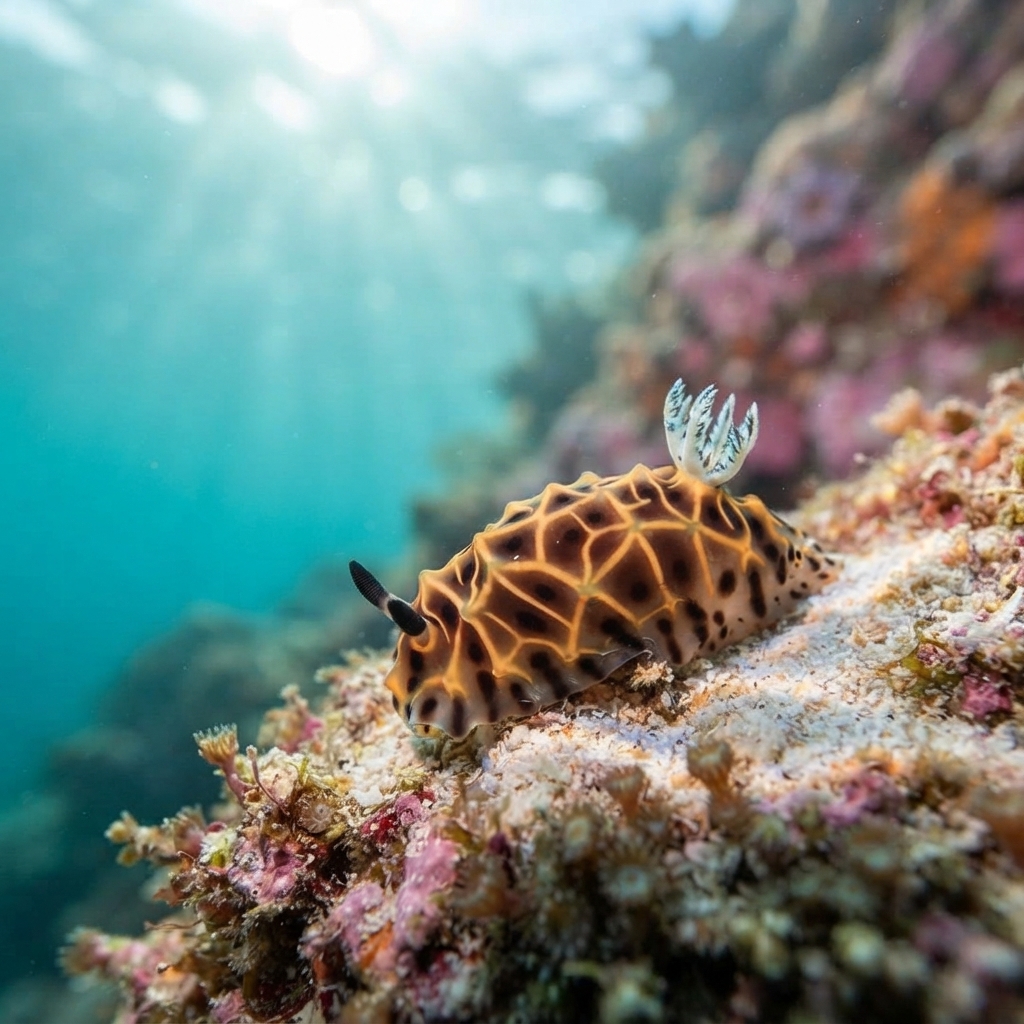
A white to cream body covered in raised ridges that form a distinct waffle-like grid pattern, with brown or chocolate-coloured lines tracing those ridges. The rhinophores (the pair of sensory stalks on the head) and the gill cluster at the rear are typically tipped in a contrasting colour, giving divers an easy visual anchor. Most are found small enough to miss on a quick reef scan, so it pays to check rubble and sponge-covered rock closely rather than swim past.
Like most dorid nudibranchs, this one moves slowly over rock, rubble and sponge-covered substrate while grazing, and it will not react to a diver's presence beyond continuing its crawl. Divers typically spot it during slow macro-focused dives or night dives when torch light picks out the ridged texture against darker background rock. It shows no flight response and can be photographed close up without disturbing it, provided you avoid touching the substrate around it.
The ridged, grid-like skin pattern that gives this species its
No clear seasonal pattern shows up in the data, and with a comfortable range of roughly 23 to 29 C it is present on these reefs across the year. Treat it as a year-round find rather than something to plan a trip around a particular month for.
Reef neighbours a diver could mistake it for. Use the identification notes above to tell them apart.
This one turns up reliably across East Africa's reef coastline, with the strongest logs coming out of KwaZulu-Natal in South Africa and Zanzibar in Tanzania. Inhambane and Ponta do Ouro in Mozambique and Diani in Kenya also produce steady sightings, making the whole Mozambique-Tanzania-Kenya-South Africa stretch the reliable zone for this species. Mafia Island, Shimoni and Watamu round out the picture with lighter but confirmed records.
Mapping where Chocolate Waffle Dorid is logged…
It is most reliably logged in KwaZulu-Natal, South Africa, and Zanzibar, Tanzania, with steady sightings also reported in Inhambane and Ponta do Ouro, Mozambique, and Diani, Kenya.
There is no strong seasonal signal in the sightings, and the species tolerates a wide temperature range of roughly 23 to 29 C, so it is considered a year-round find on East African reefs.
Look for a white to cream body with a raised, waffle-like ridge pattern traced in brown lines, plus contrasting-tipped rhinophores and gill tuft. It moves slowly over rubble and sponge and rarely reacts to divers.
No, this nudibranch poses no risk to divers. It has no sting or venom relevant to humans and simply crawls over the reef surface while grazing.
Exact size data is not established for this species, but like most Halgerda nudibranchs it stays small, typically within the centimetre-scale range found across the genus.
Its skin forms raised ridges arranged in a grid, giving it a waffle-textured surface that is unusual even among nudibranchs and makes it one of the more texturally distinctive species to photograph up close.
Site and sighting data is aggregated from diver logs, iNaturalist and GBIF. For taxonomy and conservation status:
Light-spotted Aegires
3,168 sites