Sebastes nebulosus
Black-and-yellow rockfish found in cold water off California and British Columbia, usually spotted alone on rocky reefs 5.5-12C.
Safety warning
The dorsal, anal and pelvic fin spines carry venom that causes a sharp, painful sting if you brush against them, so keep hands away from crevices and rock ledges where one might be resting. A sting is rarely serious but warrants first aid and medical attention if pain or swelling persists.
If you're stung
Venomous spinesGeneral first-aid guidance, not a substitute for professional medical care. In an emergency, call your local emergency number.
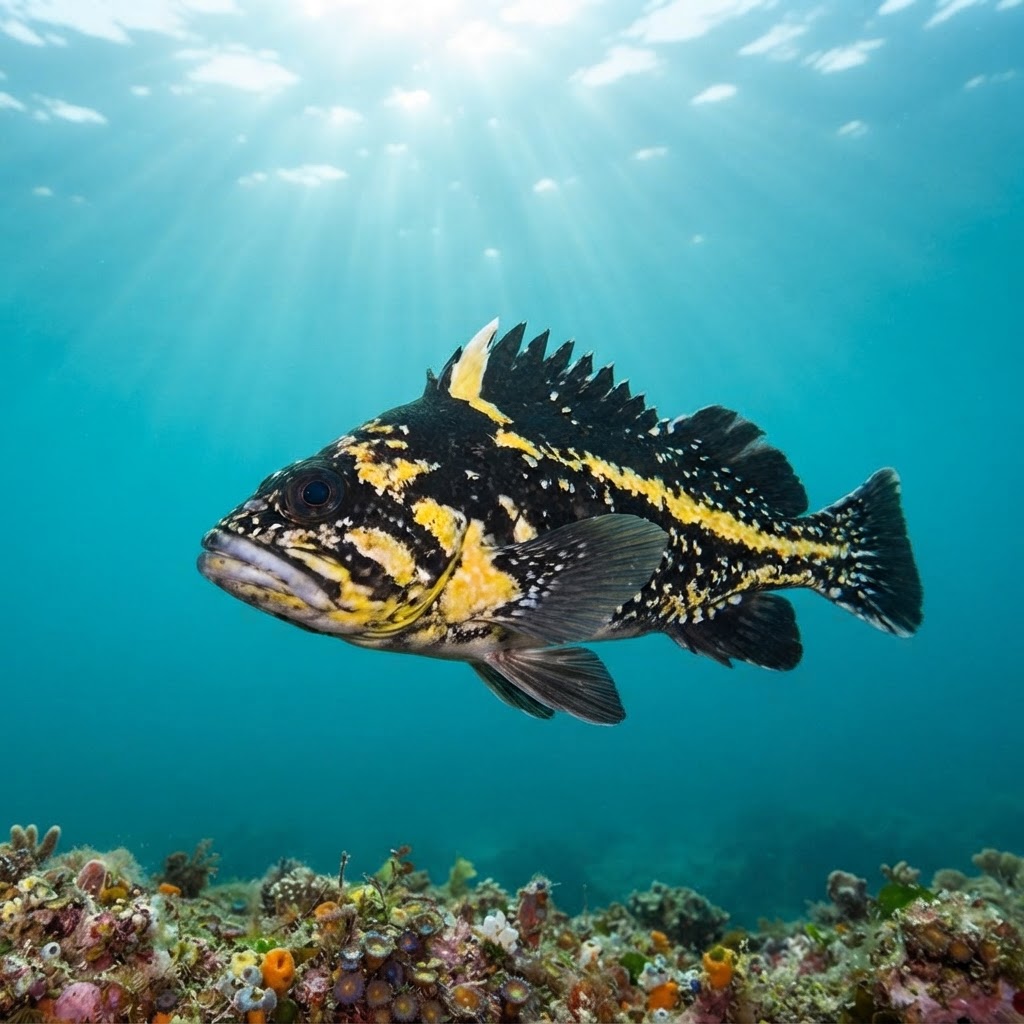
Look for a stocky, thick-bodied fish around 31 cm long, coloured black to dark grey with a bold yellow stripe running from behind the head down the back to the tail. The belly and lower flanks are speckled with yellow and white spots on a black background, a pattern that stands out even in low light. Like other rockfish it has spiny dorsal fins held stiffly upright, and it tends to sit tucked against rock rather than swimming in the open.
Divers typically find this one wedged into a rock crevice or sitting still on a ledge rather than out cruising the reef, matching its reputation as a homebody that rarely strays far from a chosen patch of rock. It is logged as rare to uncommon at the sites where it turns up, so sightings tend to be a single fish rather than a group. Expect it to hold its ground rather than bolt when you approach slowly.
Rockfish in this family are slow-growing and can live for decades on the same patch of reef, so a China Rockfish you find tucked into a crevice may have been holding that exact spot for years.
No clear season shows in the sighting data, so treat it as a year-round resident of cold rocky reefs, comfortable in the 5.5 to 12.2C range these divers logged it in. Cold-water visibility and conditions on the day will matter more to your chances than the calendar.
Logged in cold-water sites in the United States and Canada, with the strongest showing in California and a further presence in British Columbia. Sites are few and scattered rather than clustered, so this is a species you find on a specific rocky reef rather than across a whole region.
Mapping where China Rockfish is logged…
Sightings come from cold-water reef sites in California, USA, and British Columbia, Canada. It is not a species you can count on seeing, even at these sites it is logged as rare to uncommon.
There is no strong seasonal pattern in the sightings, so it is considered a year-round resident of cold rocky reefs between roughly 5.5 and 12.2C.
Yes, its dorsal and fin spines are venomous and can deliver a painful sting if touched. It is not aggressive, so the risk comes from accidental contact with a fish tucked into a crevice, not from being chased.
Check for a black body with a bright yellow stripe running along the back and yellow-and-white speckling on the flanks and belly. It sits low against rock rather than swimming in open water, and grows to about 31 cm.
They reach around 31 cm in length, a stocky, thick-bodied fish rather than a slender one.
Site and sighting data is aggregated from diver logs, iNaturalist and GBIF. For taxonomy and conservation status:
Pollack
282 sites