Centropyge loriculus
Spot the vivid orange-red flame angelfish in French Polynesia and Palau. Present year-round in warm tropical water. Here's where and how to find one.
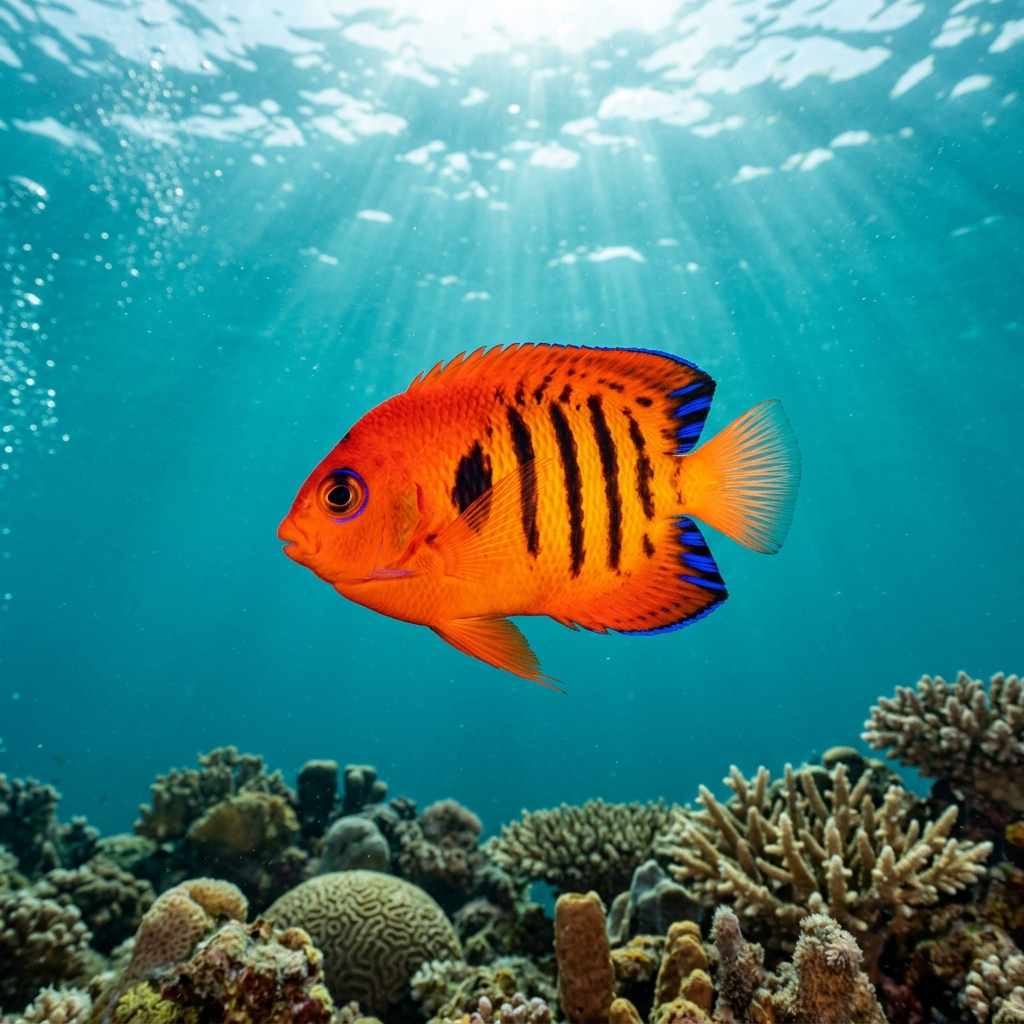
Few reef fish stop you in your tracks like this one: a vivid orange-red body crossed by four or five bold vertical black bars, with electric violet-blue edging on the dorsal and anal fins. It is a small fish, firmly in pygmy-angelfish territory, with a deep, disc-shaped body typical of the family. The blazing colouration leaves almost no room for doubt, though the bars can look darker in shaded crevices. Females are generally a touch more muted in colour than males.
You will most often find it close to the reef, darting between coral heads and rubble, rarely straying far into open water. It tends to be wary of divers and will duck into a crevice if approached too directly, so slow, patient observation from a distance pays off. Individuals are usually solitary or found in small loose groups, with a dominant male presiding over a small harem.
Like many pygmy angelfish, flame angelfish are protogynous hermaphrodites: if the dominant male in a group disappears, the largest female will change sex and take over his role.
No concentrated season stands out in the data, so the flame angelfish is treated as a year-round resident. It is comfortable in water between roughly 24 and 29 °C, which describes the stable tropical conditions at all of its top sites throughout the year.
French Polynesia dominates every sighting list, with the atolls of Rangiroa, Tikehau, Manihi, and Fakarava accounting for the lion's share of logged encounters. Palau, particularly the Ngemelis Islands, is the next strongest destination, followed by Hawaii. Smaller numbers of records come from the Cook Islands, New Caledonia, and the Marshall Islands.
Mapping where Flame Angelfish, Japanese Pygmy Angelfish is logged…
French Polynesia is far and away the most reliable destination, with strong records across Rangiroa, Tikehau, Manihi, and Fakarava. Palau's Ngemelis Islands area and the Hawaiian Islands are the next best options. Sightings also come from the Cook Islands, New Caledonia, and the Marshall Islands.
There is no single peak season in the sighting data. These fish live on stable tropical reefs in water that stays between about 24 and 29 °C year-round, so any time you visit French Polynesia, Palau, or Hawaii is a reasonable bet.
Look for a small, disc-shaped fish with an unmistakably vivid orange-red body crossed by four or five vertical black bars, and violet-blue edging along the dorsal and anal fins. No common reef fish at the same sites shares that combination of colours.
Flame angelfish are pygmy angelfish, meaning they stay small. Adults typically reach around 10 cm in length, which helps narrow down the ID: if an orange fish with black bars is larger than your hand, it is something else.
Yes. They are protogynous hermaphrodites, meaning individuals start life as females. When the dominant male of a small group disappears, the largest female transforms into a male, both behaviourally and physiologically. This is common among pygmy angelfish in the family Pomacanthidae.
Site and sighting data is aggregated from diver logs, iNaturalist and GBIF. For taxonomy and conservation status:
Rock Beauty
1,573 sites