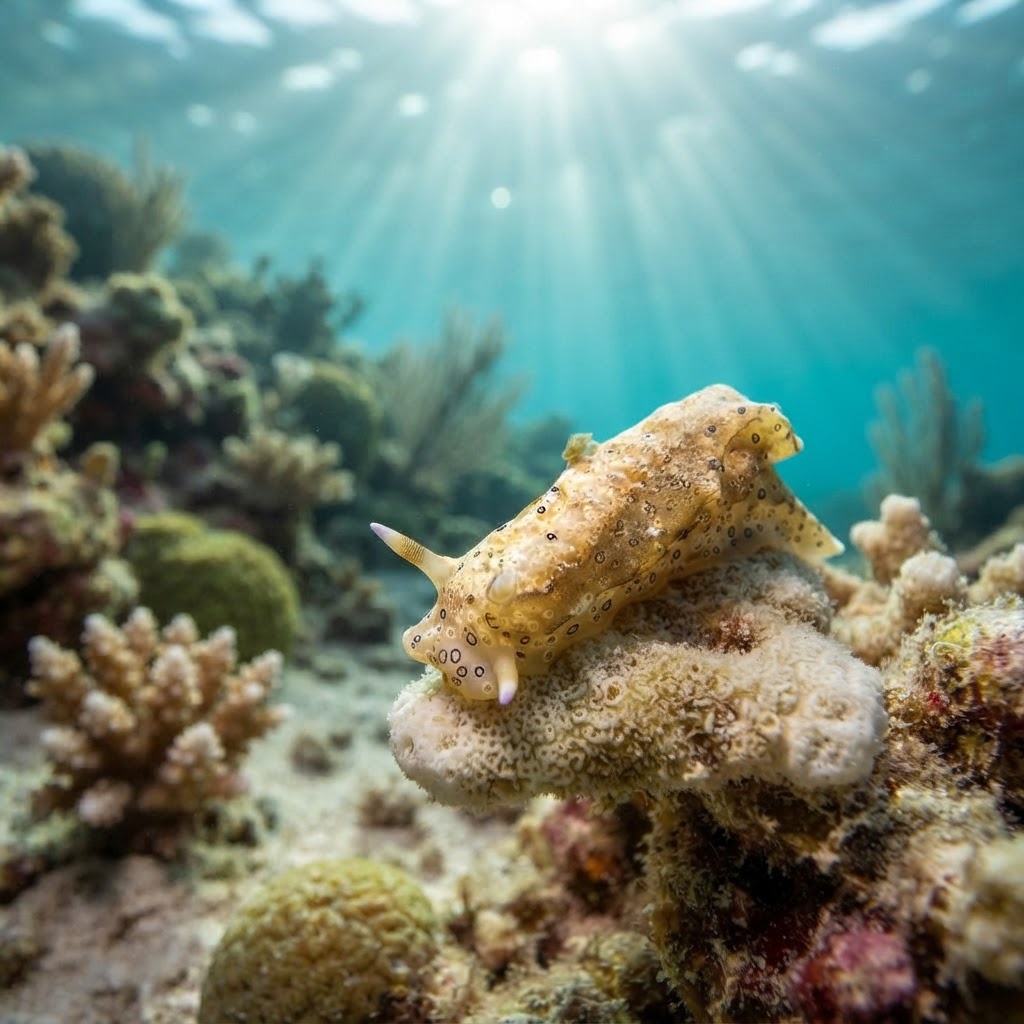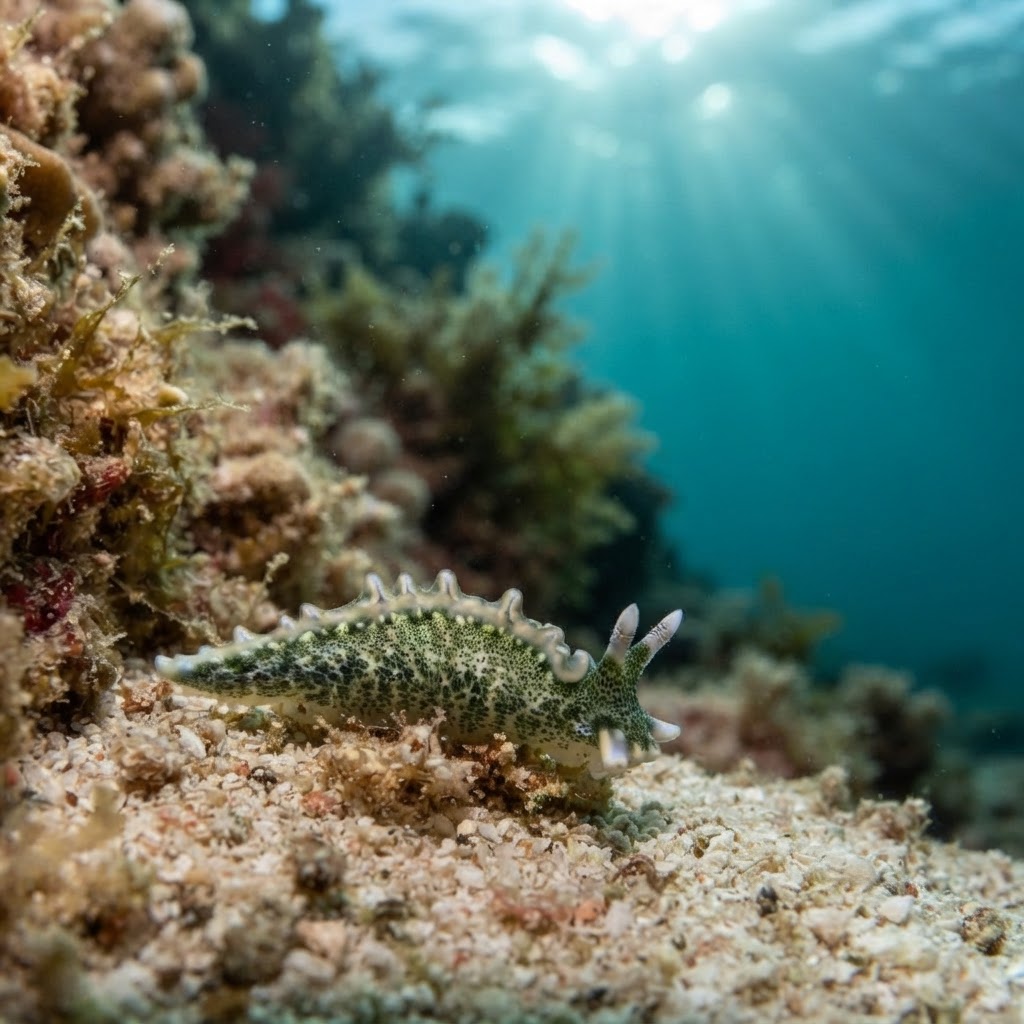
Thuridilla carlsoni
A tiny electric-blue sea slug logged most often on Queensland reefs, comfortable year-round in warm 22-30C water.
Barely a centimetre long, this sea slug shows an elongated slug body with wing-like parapodial lobes running along its flanks, coloured in shades of blue-green to turquoise with fine orange or yellow lines and dotting. Its two rhinophores (the paired sensory horns on the head) usually carry orange tips, which is the detail most divers zero in on with a macro lens. Look for it moving slowly over algae-covered rubble or rock rather than swimming in open water.
Divers find it grazing slowly across algae-covered rubble and rocky reef substrate, usually during the day when its colouring stands out under a torch or strobe. It does not flee or swim off when approached, so a slow, patient look with a macro lens is the best way to appreciate the pattern on its parapodia.
Like other sap-sucking slugs in its family, it feeds on algae and can retain some of the algae's photosynthetic pigments in its tissue, which is part of why its colouring reads so vividly green-blue underwater.
Sightings show no clear seasonal pattern, and with a comfortable range of roughly 22 to 30C it is likely present on tropical and subtropical reefs throughout the year rather than tied to one season.
Reef neighbours a diver could mistake it for. Use the identification notes above to tell them apart.
Most consistently logged in Australia, especially Queensland, with further sightings in New South Wales and Western Australia. Outside Australia it turns up occasionally in Luzon in the Philippines, in Bali, Indonesia, and in Hawaii, so it is worth a dedicated muck or reef-rubble search wherever you dive in those regions.
Mapping where Carlson's Thuridilla is logged…
Queensland is the strongest region for it, with further logs in New South Wales and Western Australia. It also turns up occasionally in Luzon in the Philippines, in Bali, Indonesia, and off Hawaii.
There is no strong season in the sighting data, and its comfortable temperature range of about 22 to 30C means it can be found on warm reefs at any time of year.
It is tiny, typically around 1 centimetre long, so divers usually need a macro lens or a close, patient look to spot and appreciate its colouring.
Check for a small blue-green slug with orange-tipped rhinophores and fine orange lines along wing-like body lobes, moving slowly over algae-covered rubble.
No, it poses no danger to divers. It is a small, slow-moving grazer that can be observed and photographed at close range without any risk.
It belongs to a group of sap-sucking slugs that can hold onto photosynthetic pigments from the algae they eat, which likely contributes to its bright blue-green colouring.
Site and sighting data is aggregated from diver logs, iNaturalist and GBIF. For taxonomy and conservation status:
Light-spotted Aegires
3,168 sites