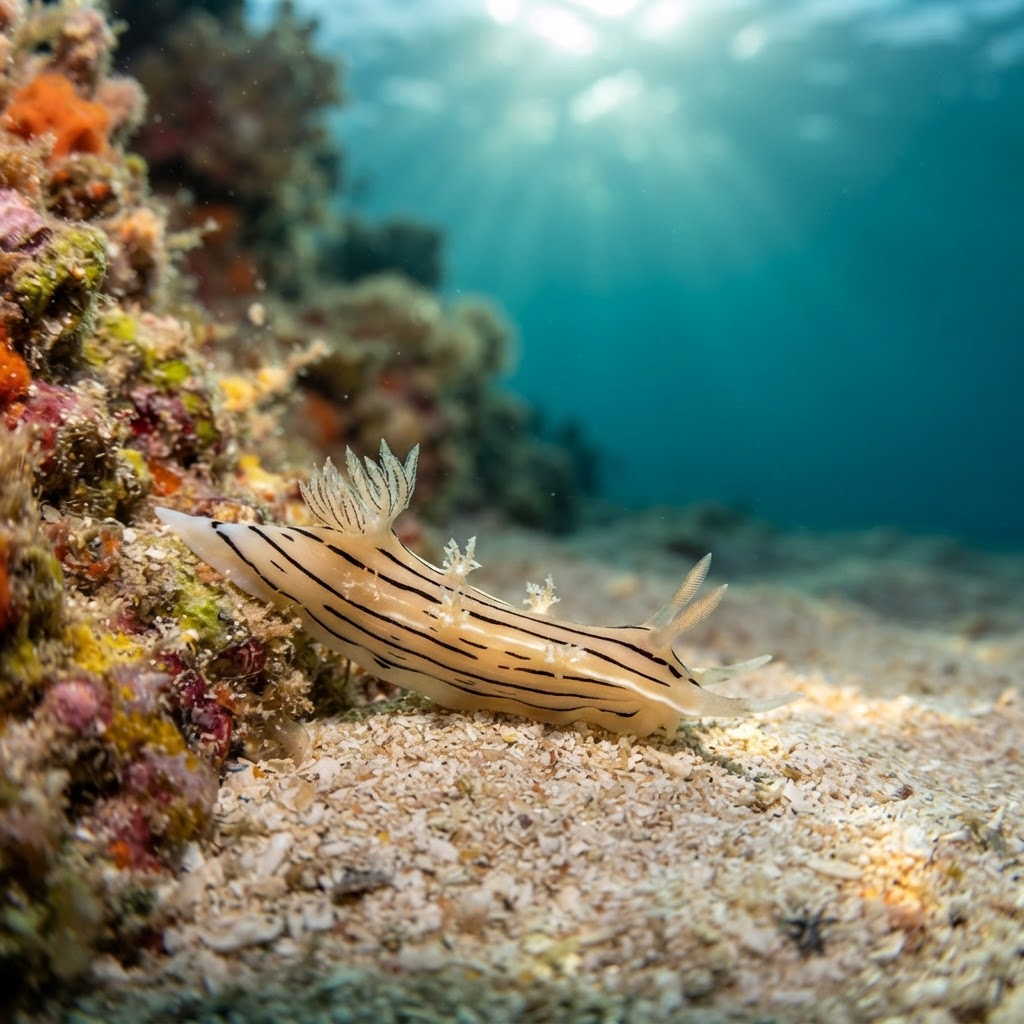
Candiella striata
An uncommon find on cool Mediterranean reefs, most often logged around Sicily, Tuscany and Occitanie in 14 to 20C water.
A small nudibranch best picked out by scanning rocky, algae-covered substrate rather than open sand, since it blends easily at a glance. Look for the ridged, frilly-edged body typical of the tritoniid family, held low and often tucked near sponges or hydroids it feeds on. Size in the water is modest, so a slow pass with a torch usually reveals it before you spot it swimming past.
Divers typically find it moving slowly across rock and algae-covered surfaces, grazing rather than swimming, which makes it an easy subject once located. It shows little to no reaction to divers and will carry on feeding if you hold steady with a light rather than crowding in. Most logs come from daytime dives on rocky reef, so it's not something you need a night dive to find.
Like other tritoniids, it almost certainly feeds on soft corals or hydroids, so divers who find one grazing are looking at a direct predator-prey relationship worth watching for a minute before moving on.
Sightings don't show a clear seasonal pattern, so treat it as a year-round possibility on Mediterranean dives. Its observed range of 13.8 to 19.8C covers much of the region's diveable season, from cooler winter conditions through to warmer summer water.
Reef neighbours a diver could mistake it for. Use the identification notes above to tell them apart.
This is a Mediterranean species through and through, most commonly logged in Italy, particularly around Sicily and Tuscany, with a strong secondary population along France's Occitanie coast and a smaller but reliable showing in Catalonia, Spain. Divers doing rocky reef and wall dives in these regions have the best odds of ticking it off.
Mapping where Striped Candiella is logged…
It's most reliably found in Italy, especially around Sicily and Tuscany, with good numbers also logged along France's Occitanie coast and in Catalonia, Spain. All records to date come from Mediterranean dive sites.
There's no strong seasonal pattern in the sightings, so it's considered a year-round find on Mediterranean reefs. It has been logged in water from about 14C up to nearly 20C, which spans most of the diving season in the region.
Look for a small nudibranch with a ridged, frilly-edged body sitting on rocky or algae-covered substrate rather than open sand. It moves slowly while grazing and is easiest to spot with a torch during a careful, slow scan of the reef.
Exact size data isn't confirmed, but like most tritoniid nudibranchs it stays small, typically only a few centimetres long, which is why a close, slow look at the substrate is needed to find one.
No, it poses no danger to divers. It's a small, slow-moving grazer that can be observed safely at close range without any risk.
As a member of the tritoniid family, it most likely feeds on soft corals or hydroids, grazing slowly across rock surfaces where these prey items grow. This feeding behaviour is often what gives away its location to observant divers.
Site and sighting data is aggregated from diver logs, iNaturalist and GBIF. For taxonomy and conservation status:
Light-spotted Aegires
3,168 sites