Paralichthys californicus
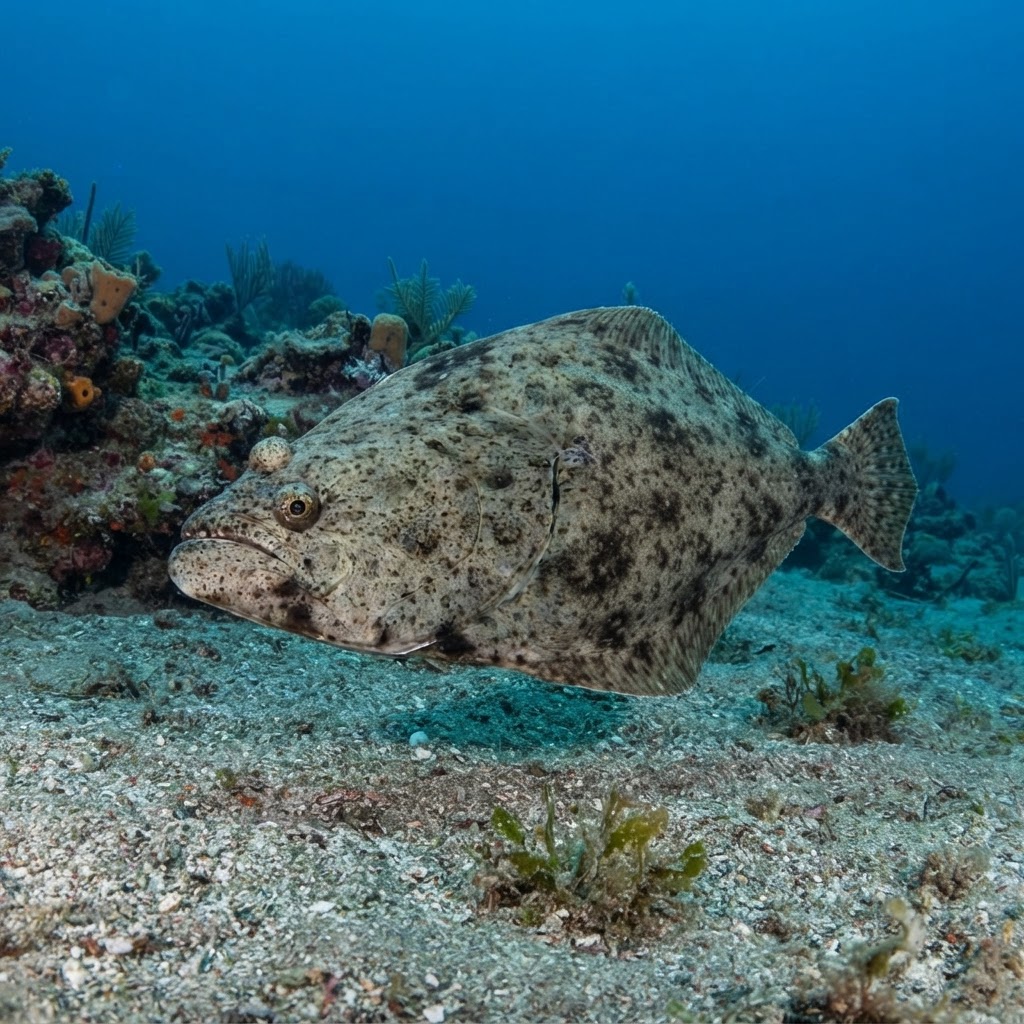
Uncommon but findable on California dive sites, this flat, sand-coloured predator lies buried with just its eyes showing in 12-24C water.
Lies flat on the sand with both eyes on the left side of its body, a body shape and habit that separates it instantly from any round-bodied reef fish. Mottled brown, grey and sandy tones let it disappear against the seafloor, often with only the eyes and a faint outline visible. Can grow past a metre, though most divers encounter smaller individuals partly buried or flicking away in a burst of sand when approached.
Spends most of its time motionless on sand or mixed sand-and-reef bottoms, buried or half-buried while waiting to ambush passing prey. Divers usually see it as a sudden puff of sand and a shape gliding a short distance before settling flat again, rather than an animal that holds still for a long look. Most active on or near the bottom, and easy to swim right over without noticing until it moves.
Like other flatfish, it starts life swimming upright with an eye on each side, then one eye migrates across the head as it matures into its flattened, bottom-dwelling adult form.
Sightings don't show a clear seasonal pattern, so treat this as a year-round possibility on California dives. Its recorded temperature range of 12.4 to 23.9C spans the region's typical seasonal swing, which likely explains the lack of a tight season.
Logged almost exclusively along the California coast in the United States, with the strongest sightings concentrated in California itself. It shows up as an uncommon find at most of these sites, with a handful of spots where divers report it more reliably as a common sighting.
Mapping where California Halibut is logged…
California dive sites are the reliable place to find it, with sightings logged along the California coast more than anywhere else in the data. It tends to turn up on sandy or mixed-bottom sites rather than hard reef.
There's no strong seasonal pattern in the sightings, so it's fair to treat this as a year-round possibility in California waters. It has been recorded across a wide temperature range, from about 12 to 24C.
Look for a flat, diamond-shaped body lying on the sand with both eyes on one side of its head. Its mottled brown and grey colouring blends into the seafloor, so often the first sign is a puff of sand as it darts a short distance and resettles.
They can reach around 106cm, making them one of the larger flatfish divers might encounter on the US West Coast. Most individuals seen while diving are smaller than this maximum.
No, they pose no threat to divers. They're a bottom-dwelling ambush predator that relies on camouflage and stillness, not aggression, and will typically flee rather than confront anything nearby.
It's born with one eye on each side like a normal fish, but as it develops, one eye migrates across the skull so both end up on the same side. This lets it lie flat on the seabed with both eyes facing upward to watch for prey and predators.
Site and sighting data is aggregated from diver logs, iNaturalist and GBIF. For taxonomy and conservation status:
Rainbow Runners
1,438 sites