Lyncina vitellus
Glossy brown shell with white spots, most often logged around New South Wales and Central Japan in 19 to 30C water.
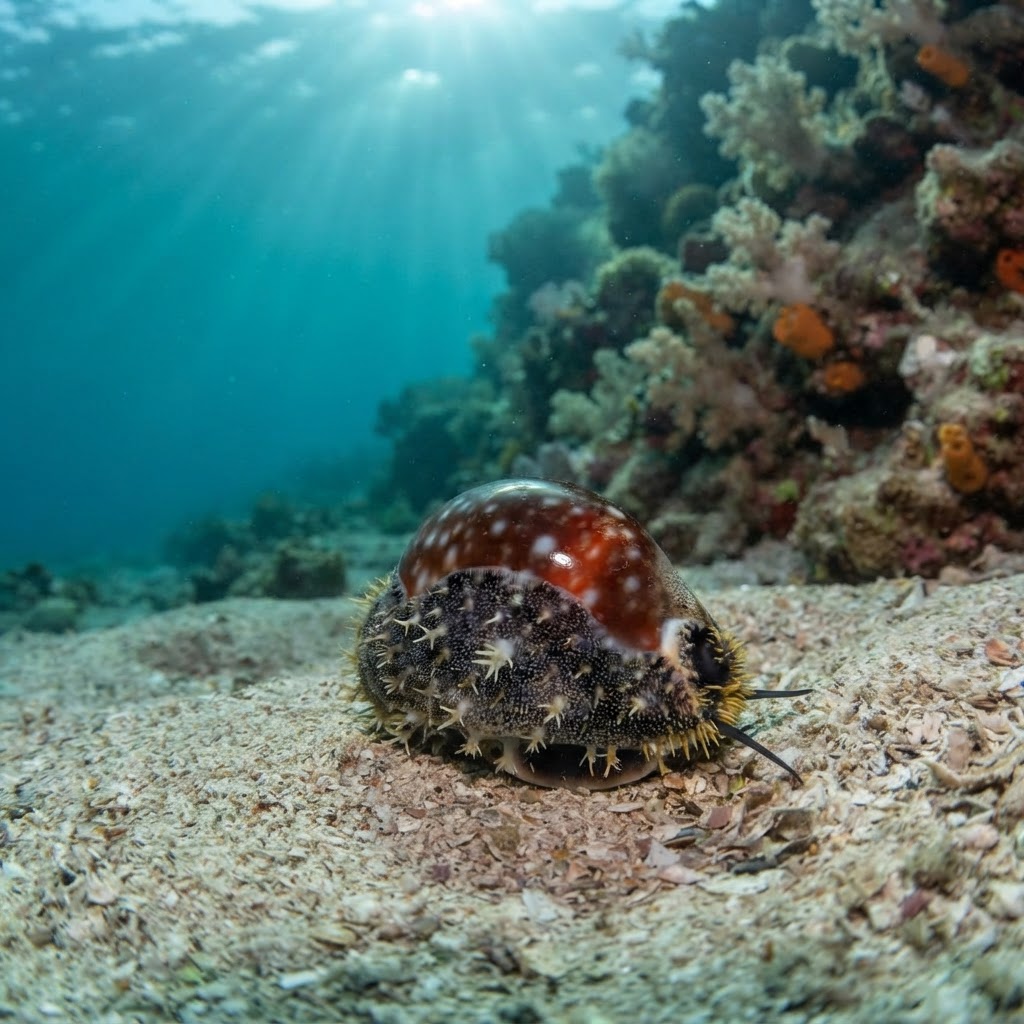
Look for a smooth, glossy oval shell about 7cm long, tan to reddish-brown, covered in scattered creamy white spots that fade toward the shell's edges. The mantle (the fleshy tissue that wraps over the shell when the animal is active) is often mottled and can partly or fully cover the shell while it is out feeding. It sits low and tight against rock or rubble, so divers usually spot the shell's sheen before anything else registers as alive.
Calf cowries are slow, benthic (bottom-dwelling) grazers that spend daylight hours tucked under rock ledges or wedged into crevices, often with only part of the shell visible. Night dives improve your odds since they become more active after dark, extending the mantle and moving across rock and rubble to feed. They show no reaction to divers beyond withdrawing into cover if disturbed, so a slow, careful light sweep along ledges is the best way to find one.
The mantle tissue that cowries extend over their shell while active is what keeps that glossy finish so pristine, since it constantly polishes and repairs the surface as the animal grows.
Sightings are spread across the year with no clear seasonal peak in the data, and the species turns up in water from about 19 to 30C, so it is worth searching for on any dive in its range rather than timing a trip around a season.
Most logged in New South Wales, Australia, which accounts for the bulk of sightings, with further records from Queensland. Central Japan is the next strongest area, with additional occasional reports from Okinawa, Guam's Apra Harbor, and Nouméa in New Caledonia.
Mapping where Calf Cowrie is logged…
New South Wales in Australia is the strongest area for sightings, with Queensland also producing records. Central Japan and Okinawa in Japan turn up regularly too, with occasional reports from Guam and New Caledonia.
There is no strong seasonal pattern in the sightings, so it is logged across the year. It tolerates a wide temperature range, from around 19 to 30C, which fits with year-round presence rather than a tight window.
Look for a glossy tan to reddish-brown oval shell around 7cm long, dotted with scattered creamy white spots. It usually sits tucked into rock crevices or under ledges, with the fleshy mantle sometimes covering the shell while active.
They typically reach around 7cm in shell length, a modest size that keeps them well hidden in rock crevices and rubble on the reef.
No, they pose no danger to divers. They are slow-moving, shell-bearing grazers with no venom or defensive behaviour of concern to humans.
The gloss comes from the mantle, a layer of tissue the animal extends over its own shell while feeding or moving. This tissue continually secretes material that keeps the shell's surface smooth and polished as it grows.
Site and sighting data is aggregated from diver logs, iNaturalist and GBIF. For taxonomy and conservation status:
Knobbed Triton
1,496 sites