Thuridilla vataae
A rare sea slug find best logged around Xiaoliuqiu, Taiwan, in warm 22.5 to 28.5C reef water year-round.
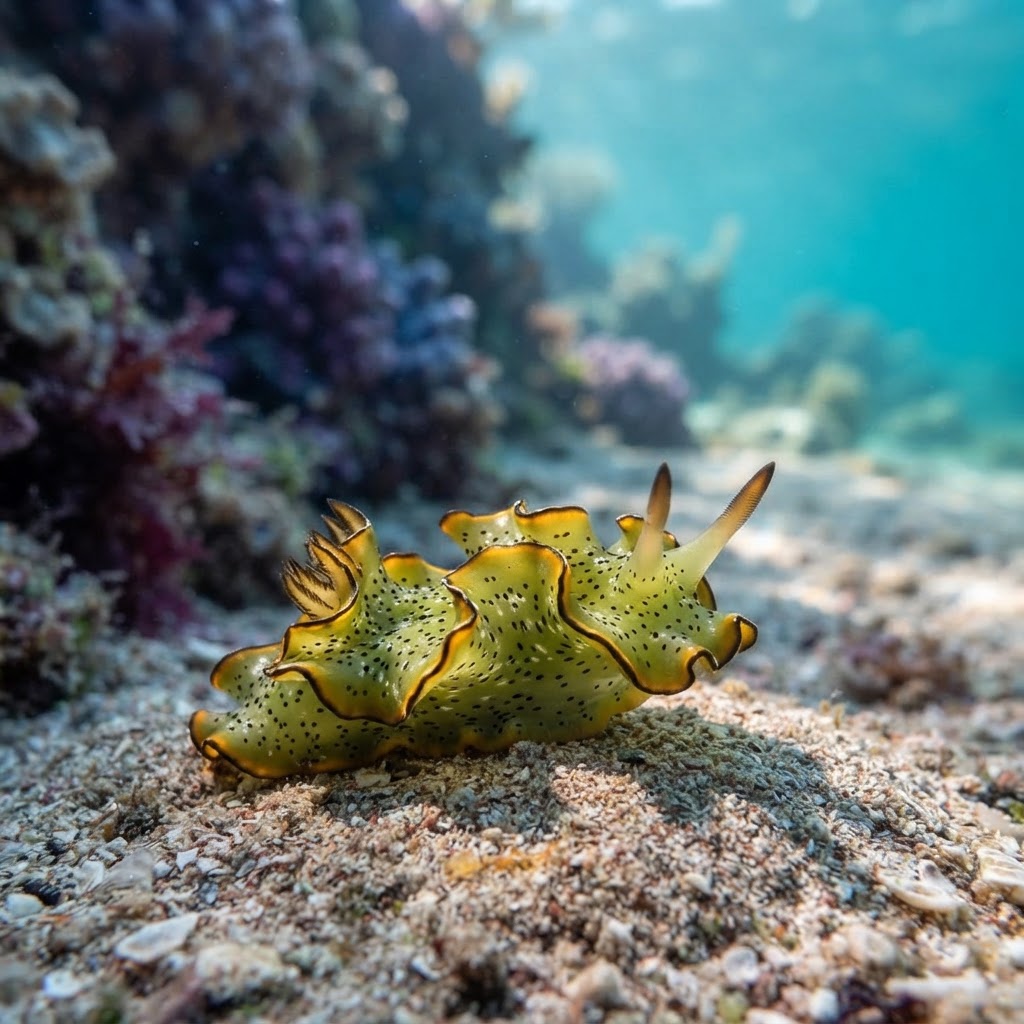
A small sea slug with a soft body and two rolled side flaps (parapodia) that fold up along the back, giving it a curled, taco-like profile. Colouring runs warm yellow to orange with fine darker lines or speckling along the flaps, which is the main feature divers pick out against reef rubble. It moves slowly and stays low, so look at algae-covered rock and coral rubble rather than open water.
Divers find it grazing slowly over algae-covered rock and rubble, usually tucked close to the substrate rather than out in the open. It shows no reaction to divers beyond its usual slow crawl, making it an easy subject once spotted, though its small size and rarity mean most divers only encounter it on a dedicated macro-focused dive.
Like other sap-sucking slugs in its family, it likely feeds on algae and can retain photosynthetic pigments from its food, a trick some relatives use to top up their energy with borrowed sunlight.
Sightings don't show a clear season, and the observed water temperature range of 22.5 to 28.5C spans most of the year on these reefs, so it's best treated as a year-round possibility rather than a seasonal target.
Reef neighbours a diver could mistake it for. Use the identification notes above to tell them apart.
Xiaoliuqiu in Taiwan is by far the most reliable place divers have logged this slug, accounting for nearly all recorded sites, with a single additional sighting from New South Wales, Australia. If you're specifically hunting it, Taiwan's Xiaoliuqiu reefs are the place to focus a muck or macro dive.
Mapping where Buttery Taco Slug is logged…
Your best odds are around Xiaoliuqiu in Taiwan, where most confirmed sightings come from. A single sighting has also been logged in New South Wales, Australia, but Taiwan is the reliable spot.
There's no strong season in the data, and it's been recorded in water from 22.5 to 28.5C, so it's realistic to look for it on any dive at these sites throughout the year.
Look for a small, slow-moving slug with rolled side flaps that curl up over its back like a taco shell, in warm yellow to orange tones with fine darker markings. It stays close to algae-covered rock and rubble rather than swimming in open water.
Exact size data isn't available for this species, but like most members of its family it stays small, typically in the centimetre range, making it a macro-photography subject rather than something spotted from a distance.
Yes, it's logged as rare at most of the sites where it has been recorded, with only a few sites reporting it as uncommon. Finding one is a real highlight for muck and macro divers rather than a routine sighting.
Site and sighting data is aggregated from diver logs, iNaturalist and GBIF. For taxonomy and conservation status:
Light-spotted Aegires
3,168 sites