Cryptolithodes typicus
A tiny cold-water crab that hides its legs under a shell-shaped carapace, most reliably logged around British Columbia in 7.5 to 13.5C water.
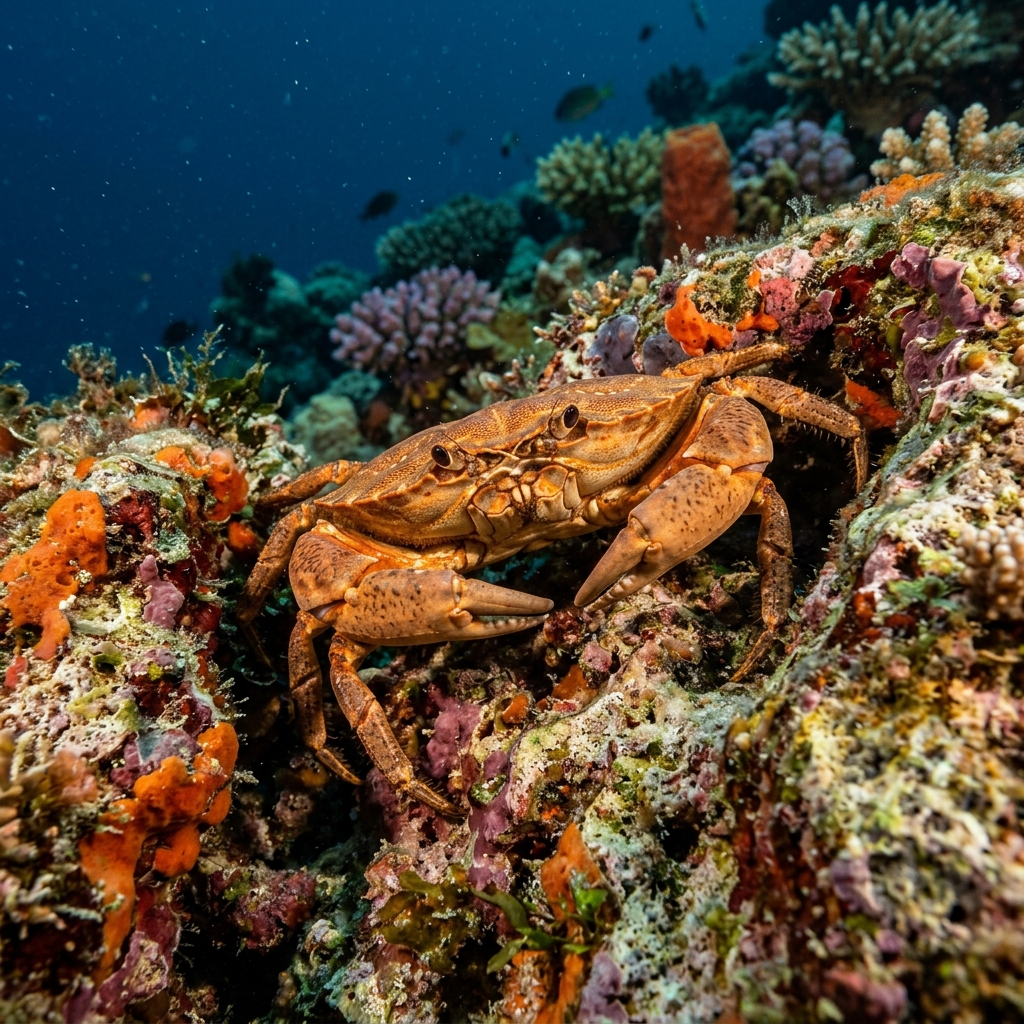
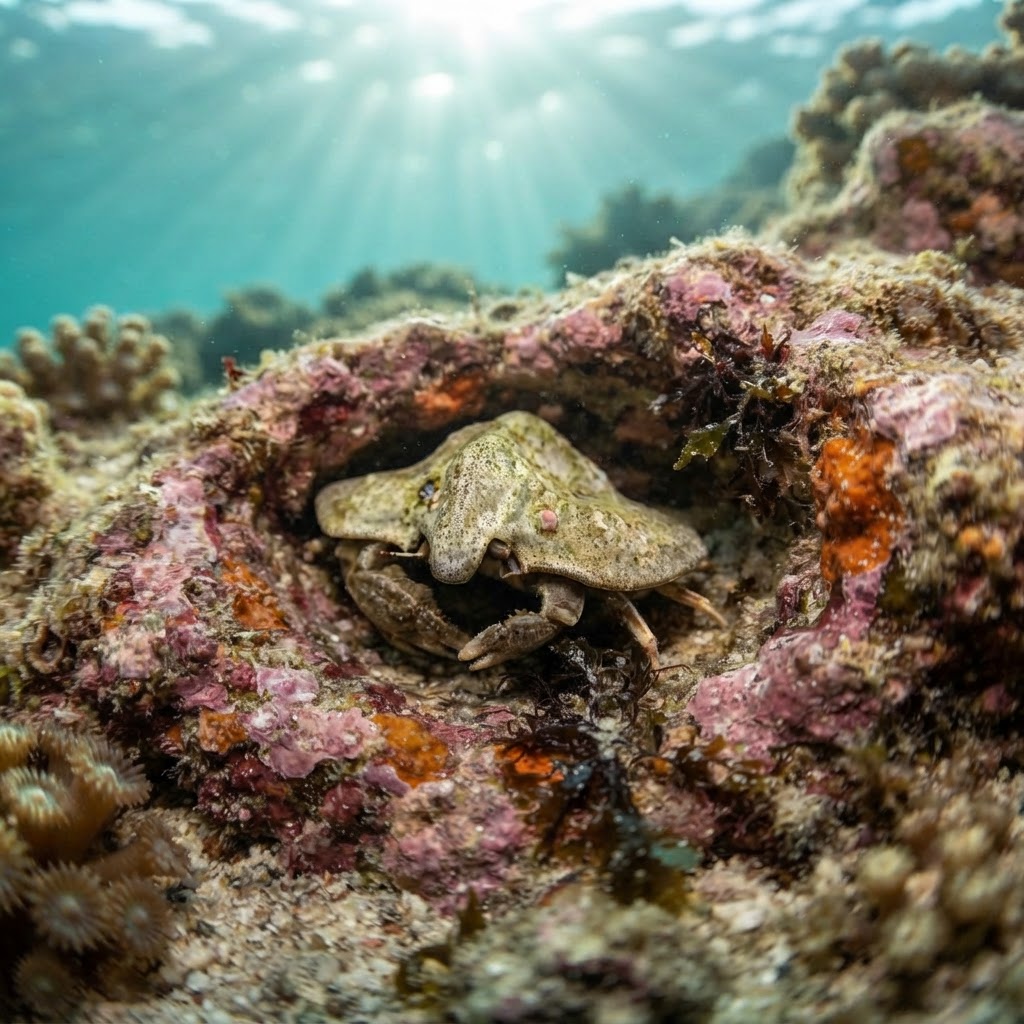
A flattened, fan-shaped shell that curves down over the sides completely hides the legs and claws when viewed from above, giving it a look closer to a limpet or chiton than a typical crab. Colour runs from mottled reddish-brown to purple or white, often patterned to match surrounding rock and coralline algae. At only about 6 cm across, it stays pressed flat against rock or nestled in crevices, and the smooth, scalloped shell margin is the single best tell against any other small crab.
Divers typically find it pressed flat against rock faces or wedged into crevices rather than moving in the open, relying on its shell-like shape and mottled colouring to disappear against the substrate. It sits still when approached rather than scuttling for cover, which makes it easy to swim past without noticing. Most logs describe it as an uncommon-to-rare find, so spotting one usually comes down to a slow, close look at rocky surfaces rather than a lucky midwater encounter.
That oversized, downward-curving carapace isn't just for looks, it works as a physical shield that tucks the legs and claws completely out of sight, turning the whole animal into a convincing rock or shell mimic rather than relying on speed to avoid predators.
Sightings show no detectable seasonal pattern, so treat this as a year-round find within its cold-water range. It's recorded in water between 7.5 and 13.5C, conditions that persist through much of the year in British Columbia and Alaska.
Most consistently logged in British Columbia, Canada, which accounts for the bulk of recorded sites, with additional sightings from Alaska, United States. Divers searching cold, rocky reef terrain along the Pacific Northwest coast have the best odds of finding one tucked into crevices.
Mapping where Butterfly Crab is logged…
British Columbia, Canada is the most reliable region, with further sightings logged in Alaska, United States. Look for rocky, cold-water reef habitat rather than sand or coral.
There's no clear seasonal pattern in the sightings, so it's considered a year-round find. It's recorded in water from 7.5 to 13.5C, which is typical of British Columbia and Alaska for much of the year.
Look for a flat, fan-shaped shell that curves down and hides the legs completely, giving it a limpet-like outline rather than a typical crab silhouette. Colouring is mottled reddish-brown, purple, or white to match the rock it sits on.
They stay small, reaching around 6 cm across the shell, which combined with their flat profile and camouflage makes them easy to overlook on a dive.
Its oversized carapace curves down over its own legs and claws, hiding them from view and turning the whole animal into a shell or rock mimic rather than something that looks like a crab at all.
No, they pose no danger to divers. They're small, slow-moving, and rely entirely on camouflage rather than any defensive behaviour toward divers.
Site and sighting data is aggregated from diver logs, iNaturalist and GBIF. For taxonomy and conservation status:
European Green Crab
2,469 sites