Trapania brunnea
A small brown-and-white nudibranch logged mostly on cool dives around Victoria, Australia, best found by patient reef scanning.
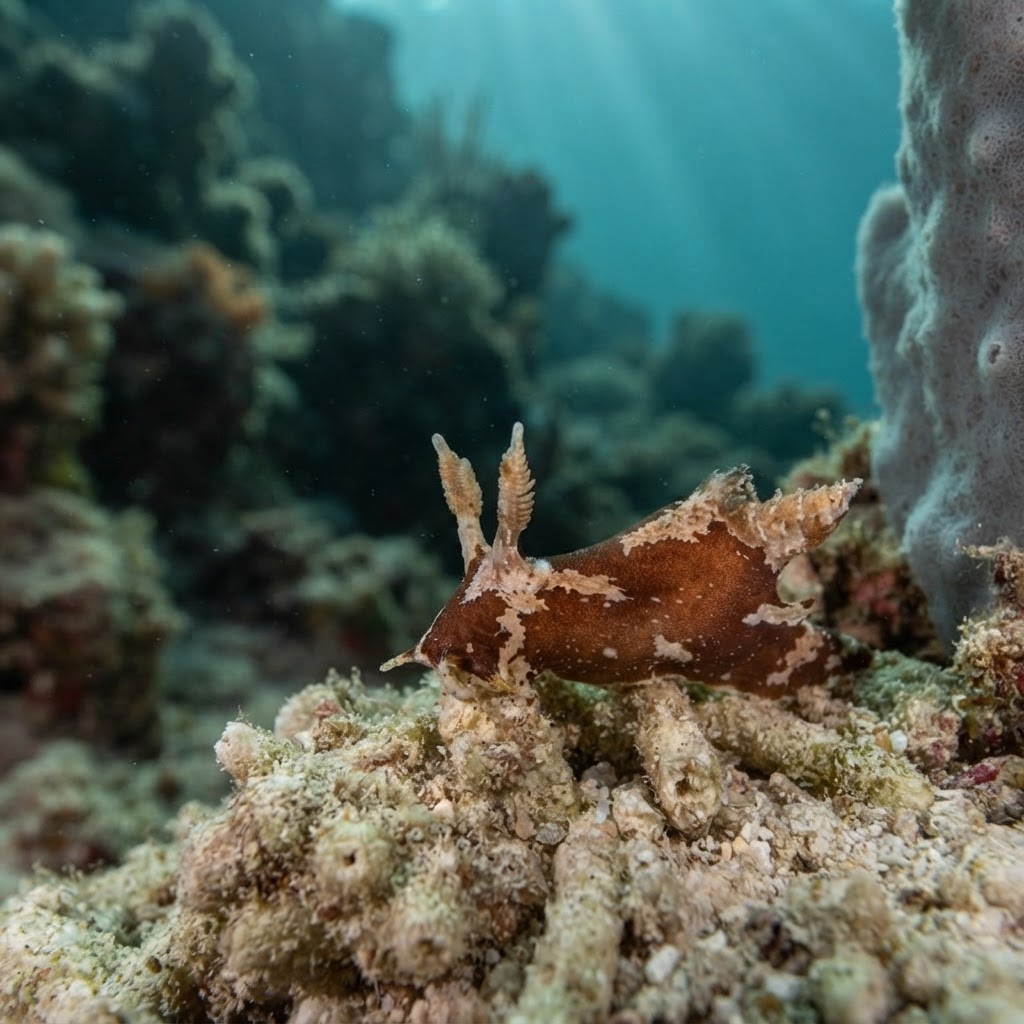
A small, slender nudibranch with a chocolate-brown body broken up by scattered white or cream-tipped bumps (tubercles) along its back and sides. Look for the pair of extra finger-like projections (extra gill-like extensions) near the head that mark it out as a Trapania rather than a more common dorid. Rhinophores (the sensory stalks on the head) are typically pale-tipped and held upright, giving a spiky silhouette against the darker body colour.
Divers find it slow-moving and stationary on rubble, sponge-covered rock, and low reef structure, usually while working a torch across a patch of substrate rather than spotting it from a swim-by. It shows no reaction to divers beyond retracting its rhinophores if touched, and sightings skew towards daytime dives at the sites where it has been logged. Most logs describe it as uncommon rather than a guaranteed find, so it rewards a slow, close look rather than casual scanning.
Like other Trapania species, it likely grazes on bryozoans and similar encrusting invertebrates, using its extra head appendages to help detect prey on the substrate rather than relying on vision.
There is no clear seasonal pattern in the sightings, and with a temperature niche spanning 14.8 to 22.0 C it seems to tolerate a good chunk of Victoria's annual range, so treat it as a year-round find rather than a seasonal target.
Reef neighbours a diver could mistake it for. Use the identification notes above to tell them apart.
This one is very much a Victoria, Australia species as far as logged sightings go, with sites clustered along that coastline making up the entire recorded spread. If you are hunting for it, temperate reef and rubble sites in Victoria are the reliable bet rather than tropical dive destinations.
Mapping where Brown Trapania is logged…
Sightings are concentrated in Victoria, Australia, where it has been logged across a spread of temperate dive sites. Outside this region it has not been reliably recorded, so it is one to look for specifically on southern Australian dives.
There is no strong seasonal signal in the data, and it has been recorded across a wide temperature range from 14.8 to 22.0 C, so it appears to be present year-round in Victoria rather than tied to a particular month.
Look for a small brown-bodied nudibranch with white-tipped tubercles scattered over its back and a pair of extra head appendages beyond the usual rhinophores. It moves slowly over rubble and sponge-covered surfaces, making it easy to overlook without a close, slow search.
Exact size data is not confirmed, but like most Trapania species it is small, generally falling in the centimetre-scale range typical of the genus rather than anything conspicuous on the reef.
No, they pose no risk to divers. They have no sting or bite of concern and are only ever handled, if at all, with great care to avoid damaging them.
Site and sighting data is aggregated from diver logs, iNaturalist and GBIF. For taxonomy and conservation status:
Light-spotted Aegires
3,168 sites