Crangon crangon
Sandy-bodied and half-buried, brown shrimp turn up on nearly every muddy dive in Zeeland, Netherlands, in water as cool as 8-14 C.
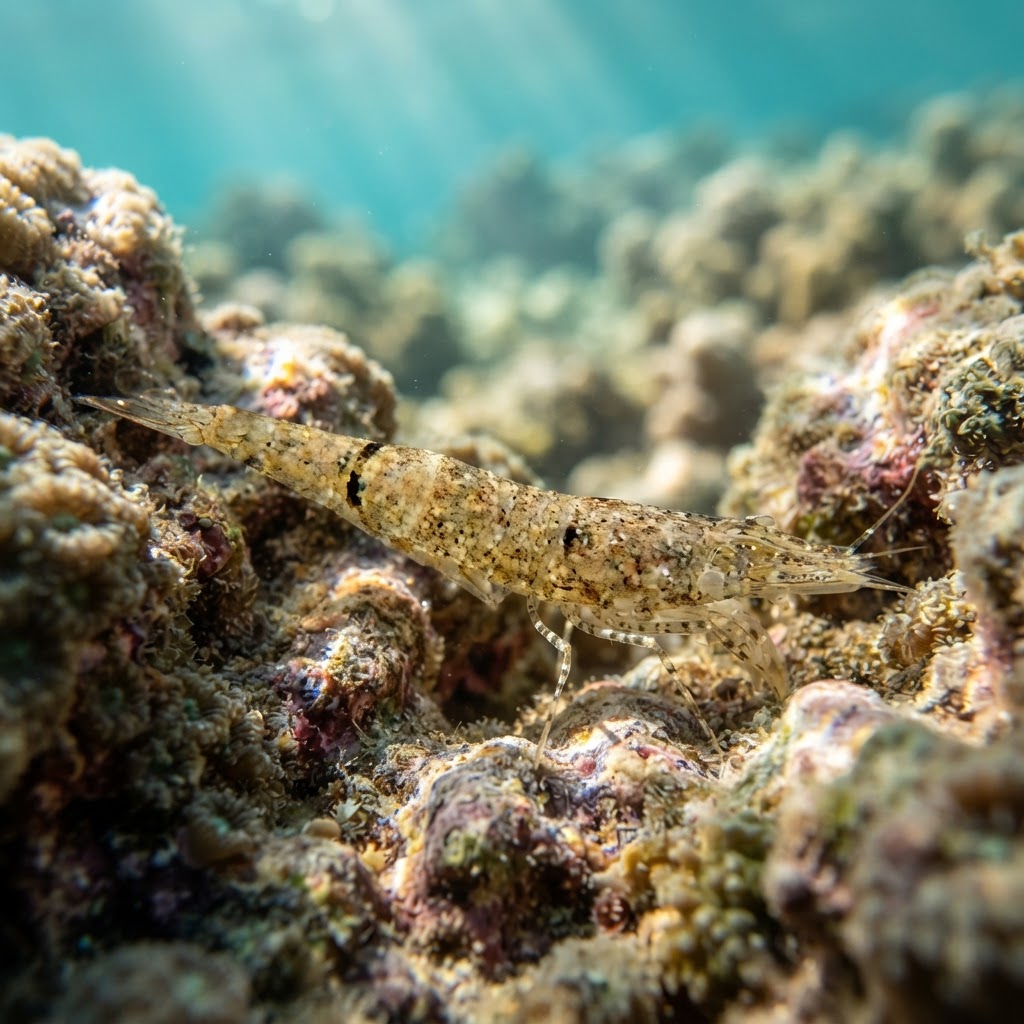
Grows to around 6 cm and matches the sand or mud it sits on, with a mottled grey-brown body covered in fine dark speckling that makes it nearly invisible until it moves. Look for a flattened, slightly curved body and long antennae poking up from the seabed while the rest stays buried. There's no bright colour or pattern to key on here, it's the camouflage itself that identifies it.
Spends most of daylight hours buried in sand or soft mud with just its eyes and antennae exposed, ambushing small prey that drift or crawl past. Divers usually notice it only when a puff of sediment gives it away as it darts a short distance and reburies itself. It's most active after dark, so night dives over sandy bottoms in Zeeland or the Wadden-adjacent sites tend to turn up more moving individuals.
It changes colour to match the substrate it's sitting on, shifting shade over days as it moves between different sediment types, which is part of why it's so easy to swim straight past.
Recorded across the year with no strong seasonal pattern in the data, and it sits comfortably in the observed 7.6 to 13.6 C range typical of northern European coastal water, so any time you're diving Zeeland's silty sites is worth a look.
Most reliably logged in Zeeland in the Netherlands, which accounts for the bulk of sightings, with further strong records from Jutland and Zealand in Denmark and Schleswig-Holstein in Germany. Divers in England, Jersey and Guernsey, Wales, Bohuslän in Sweden, and even the Dominican Republic have also logged it, so it's worth checking sandy and muddy patches on temperate dives well beyond the North Sea core.
Mapping where Brown Shrimp is logged…
Zeeland in the Netherlands is by far the strongest area, with further sightings across Jutland and Zealand in Denmark, Schleswig-Holstein in Germany, and parts of England, Wales, and the Channel Islands.
There's no clear seasonal pattern in the data, so they're logged year-round on sandy and muddy dive sites within their usual 7.6 to 13.6 C water range.
Look for a small, mottled grey-brown body about 6 cm long, half-buried in sand or mud with only its eyes and antennae showing. Camouflage is the main giveaway, not colour or pattern.
They typically reach around 6 cm, making them easy to overlook against a sandy or muddy seabed.
No, they pose no danger to divers and will simply bury themselves or dart away if disturbed.
They can shift their body colour over a few days to match whatever sediment they're currently sitting on, one of the best camouflage tricks among North Sea crustaceans.
Site and sighting data is aggregated from diver logs, iNaturalist and GBIF. For taxonomy and conservation status:
Sally Lightfoot Crab
2,422 sites