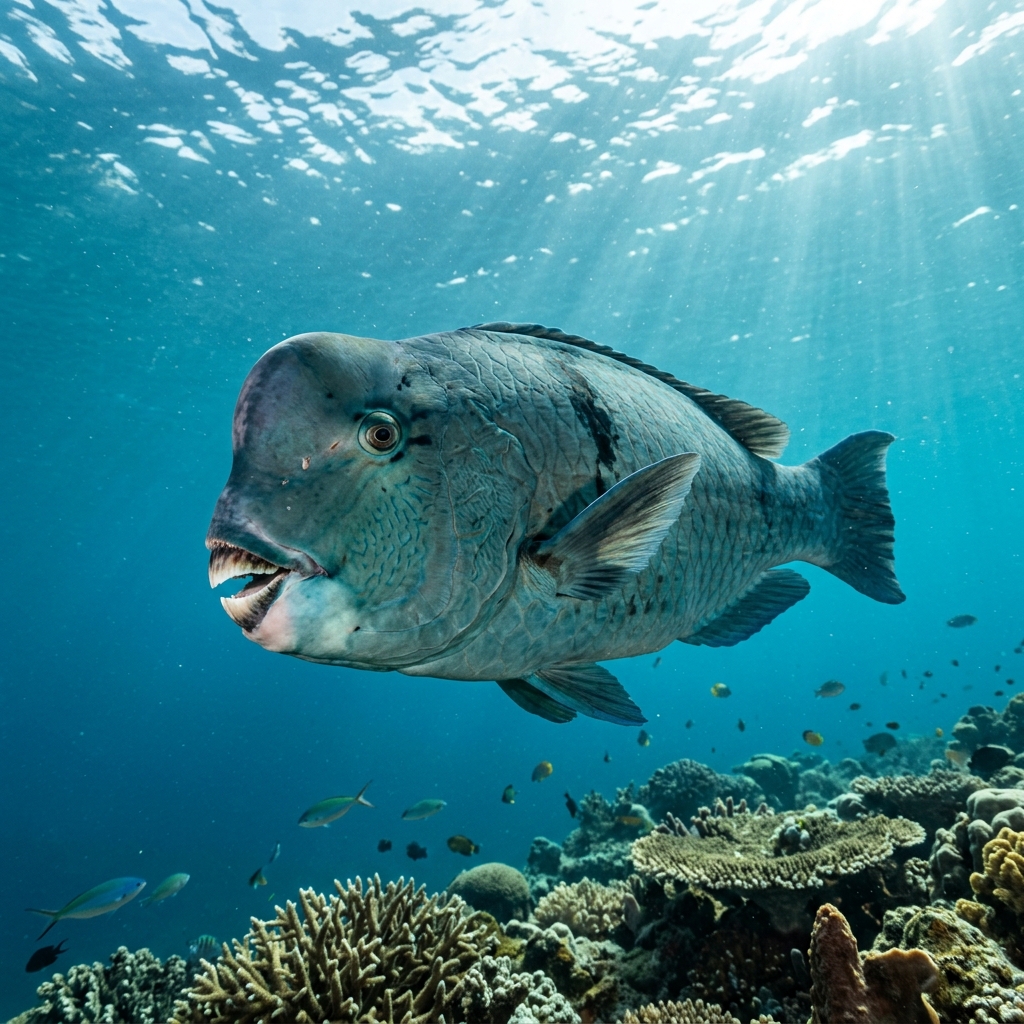
Bolbometopon muricatum
The largest parrotfish in the world, spotted in warm Indo-Pacific waters between 26-29 °C. Learn to identify its iconic forehead and where divers find it.
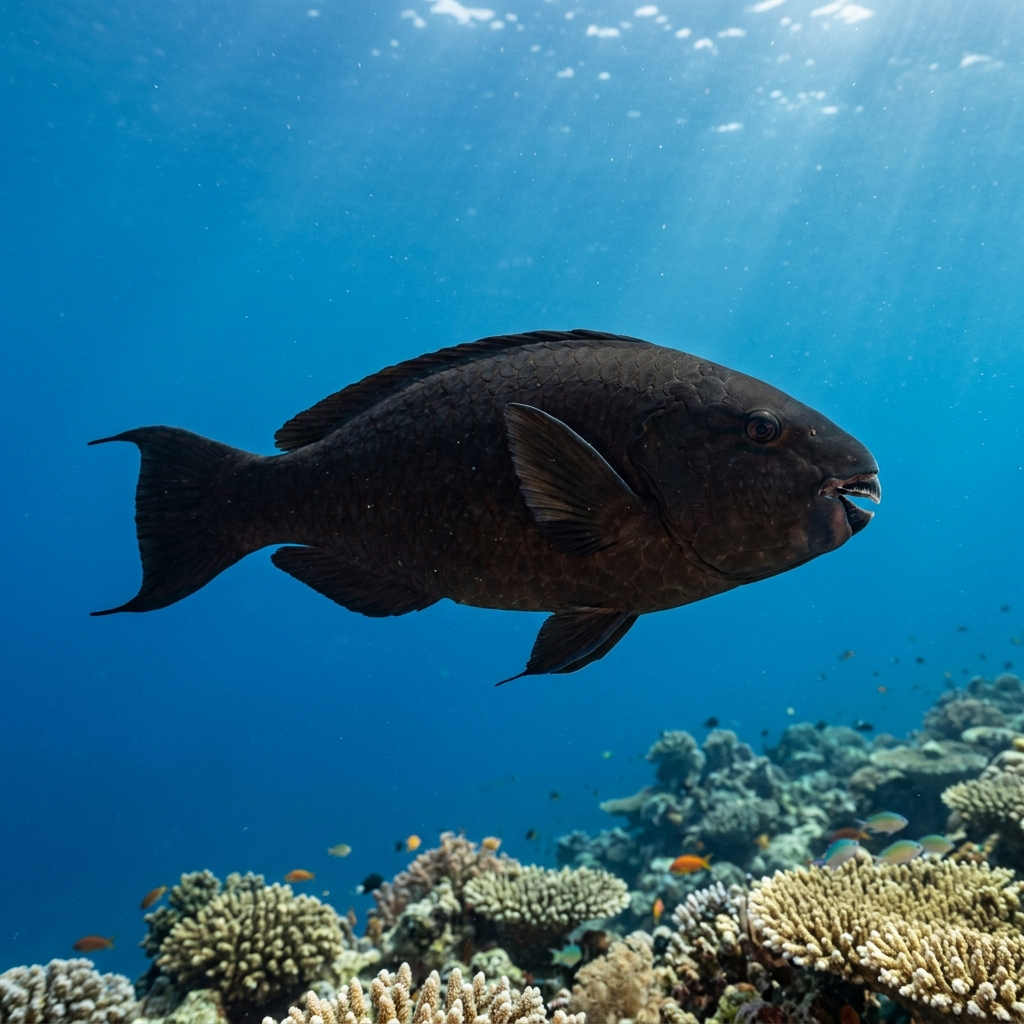
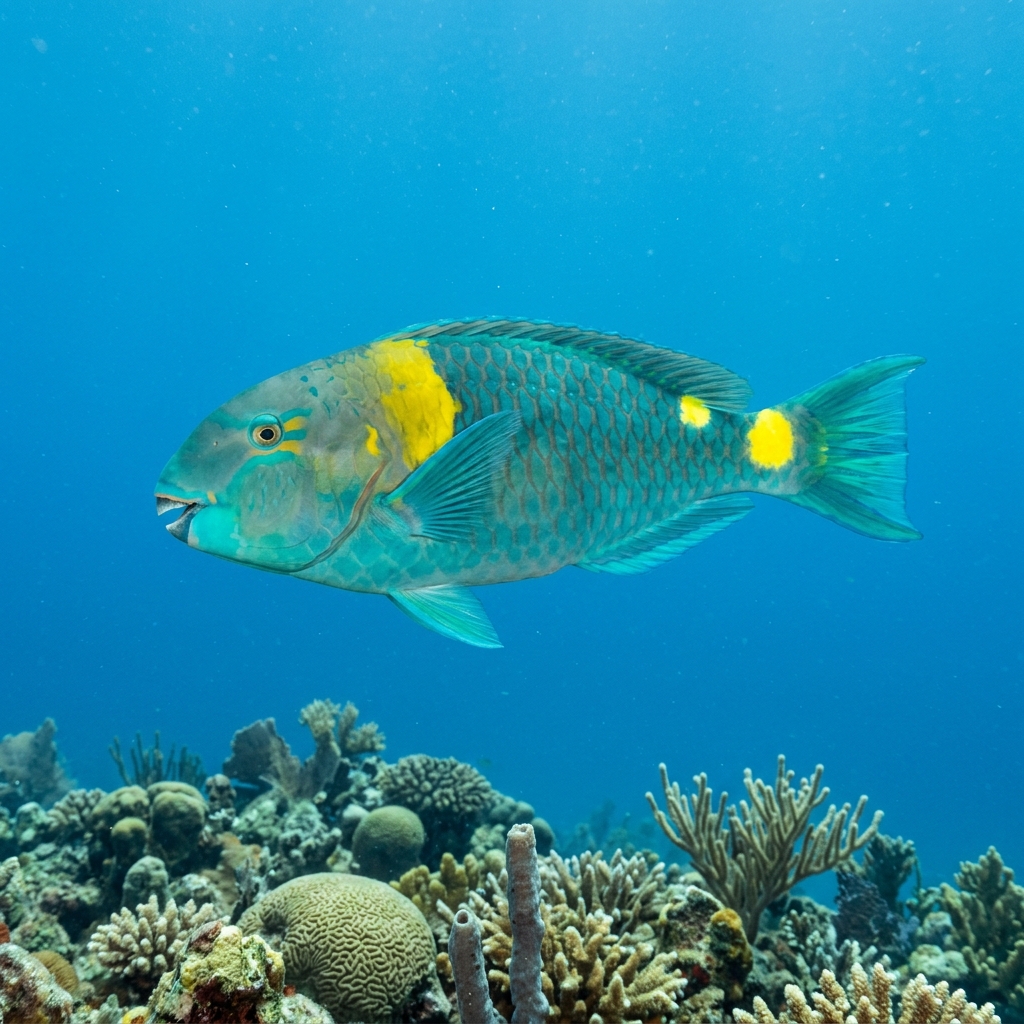
Size alone is a strong first clue, bumphead parrotfish are the largest parrotfish species, reaching over a metre in length and with a hefty, barrel-like body. The most distinctive feature is the pronounced bony hump on the forehead, which becomes more exaggerated in larger adults and gives the species its name. Body colouration is a dull greenish-grey to brownish-green, and the fused beak-like teeth (used for biting coral) are often pale and clearly visible at close range. Juveniles are brownish with faint white spots along the flanks, quite different from the plain adults.
Bumphead parrotfish are most famous for moving in large schools, sometimes numbering in the dozens, that sweep across coral reef flats at dawn, audibly ramming and biting chunks of coral with their hardened foreheads and beaks. Divers who time an early-morning dive to catch a school passing through often describe the sound as remarkable, a repeated crunching that carries clearly through the water. They are not aggressive toward divers but can be skittish in areas where they have been disturbed, so slow, calm approaches and minimal bubbles work best.
Each individual can produce hundreds of kilograms of sand per year by grinding coral into fine sediment, making them one of the reef's most significant sand producers and a key species in shaping tropical beach environments.
They occupy warm tropical waters consistently around 26 to 29 °C, suggesting year-round presence on suitable reefs with no strong seasonal signal in current sighting data.
Bumphead parrotfish are an Indo-Pacific species, with sightings reported across coral reef systems from the Red Sea through to the Pacific. Known hotspots include Palau, the Coral Triangle (Indonesia, the Philippines, Papua New Guinea), and parts of the Great Barrier Reef. Populations have declined in areas with heavy fishing pressure, so remote or well-protected reefs give the best chance of an encounter.
Mapping where Green Humphead Parrotfish is logged…
They are found across Indo-Pacific coral reef systems, with Palau, Indonesia, the Philippines, Papua New Guinea, and parts of the Great Barrier Reef among the best-known locations. Protected or remote reefs give the strongest chance of seeing them in schools.
They inhabit consistently warm tropical water (around 26-29 °C) and show no strong seasonal pattern, so they are essentially a year-round target on suitable reefs. Early morning dives tend to be most rewarding, as schools are most active and visible at dawn.
Look for a very large (over one metre), heavy-bodied fish with a dull greenish-grey colour and a prominent bony bump on the forehead. No other parrotfish combines that size with that distinctive hump. The pale fused beak is often visible at close range.
They are the largest parrotfish species, regularly exceeding one metre in length and recorded up to around 1.3 metres, with weights of over 40 kg reported for the largest individuals.
They use their hardened forehead hump and fused beak teeth to break off chunks of coral, accessing the algae and organic matter inside. This head-butting behaviour is audible underwater and is one of the most memorable things divers witness when a school passes through.
They are currently classified as Vulnerable by the IUCN. Overfishing, particularly spearfishing at night when they sleep in groups, has caused significant population declines across parts of their range. Diving in marine protected areas helps support ongoing conservation efforts.
The Green Humphead Parrotfish is listed as vulnerable by the IUCN. Observe from a distance, avoid touching or feeding it, and report sightings to local marine research organisations.
Listed as Vulnerable on the IUCN Red List, bumphead parrotfish are under pressure from spearfishing and habitat loss across much of their range. Divers can support their protection by choosing dive sites within marine protected areas and reporting sightings to citizen-science platforms.
Site and sighting data is aggregated from diver logs, iNaturalist and GBIF. For taxonomy and conservation status:
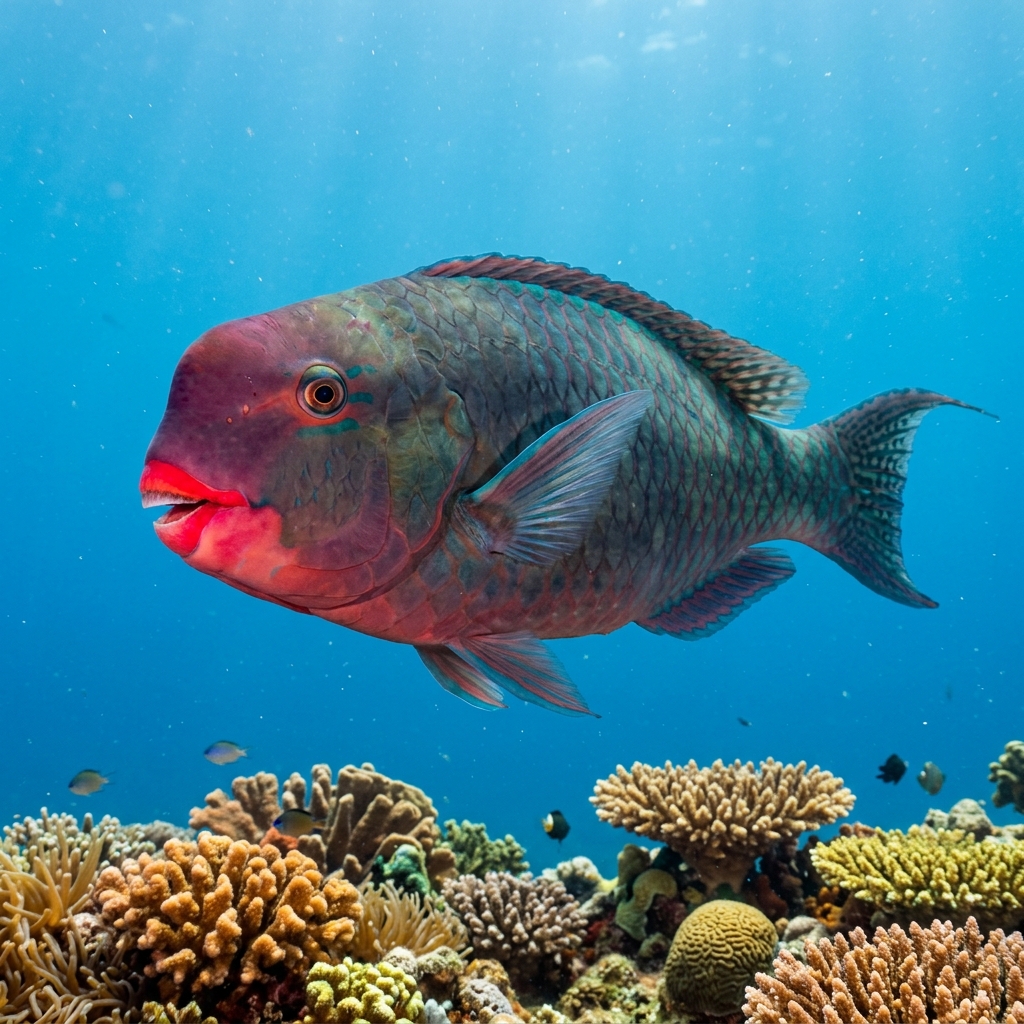
Redlip Parrotfish
2,789 sites