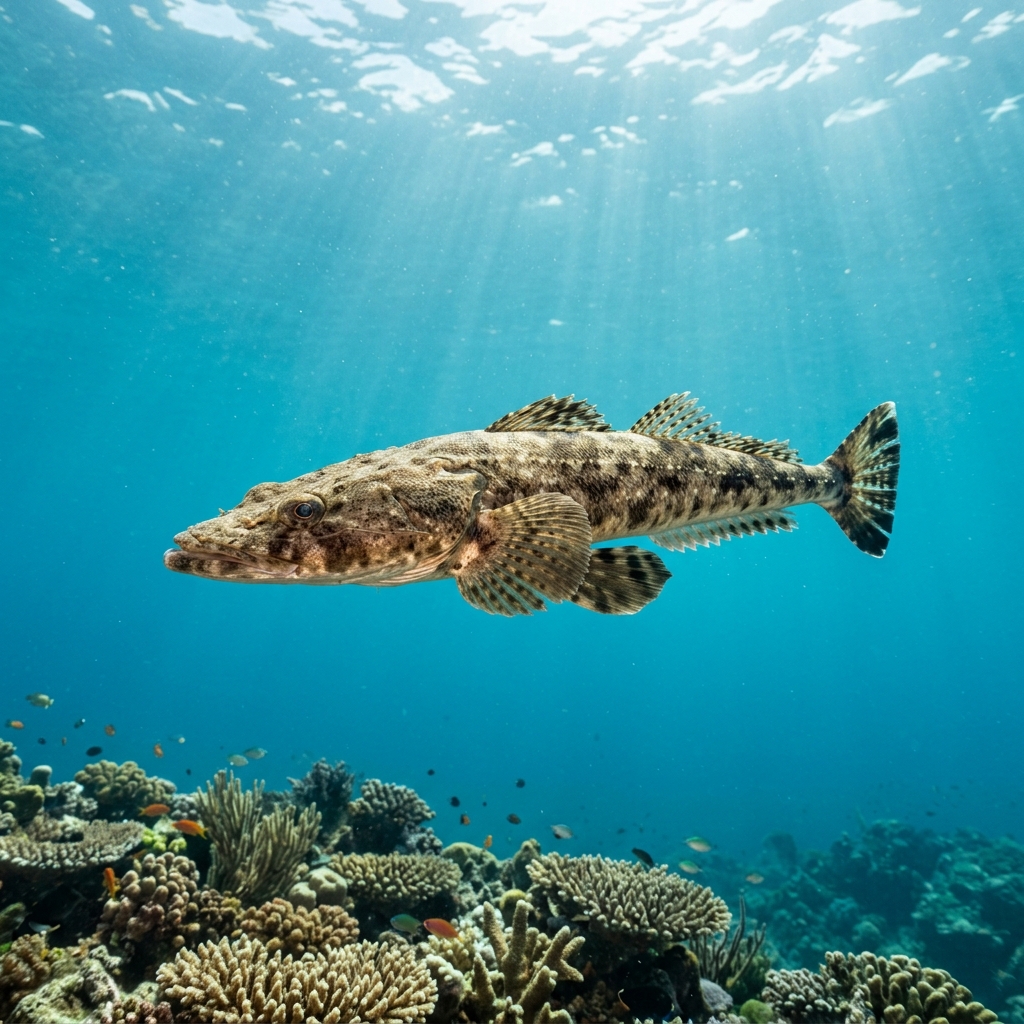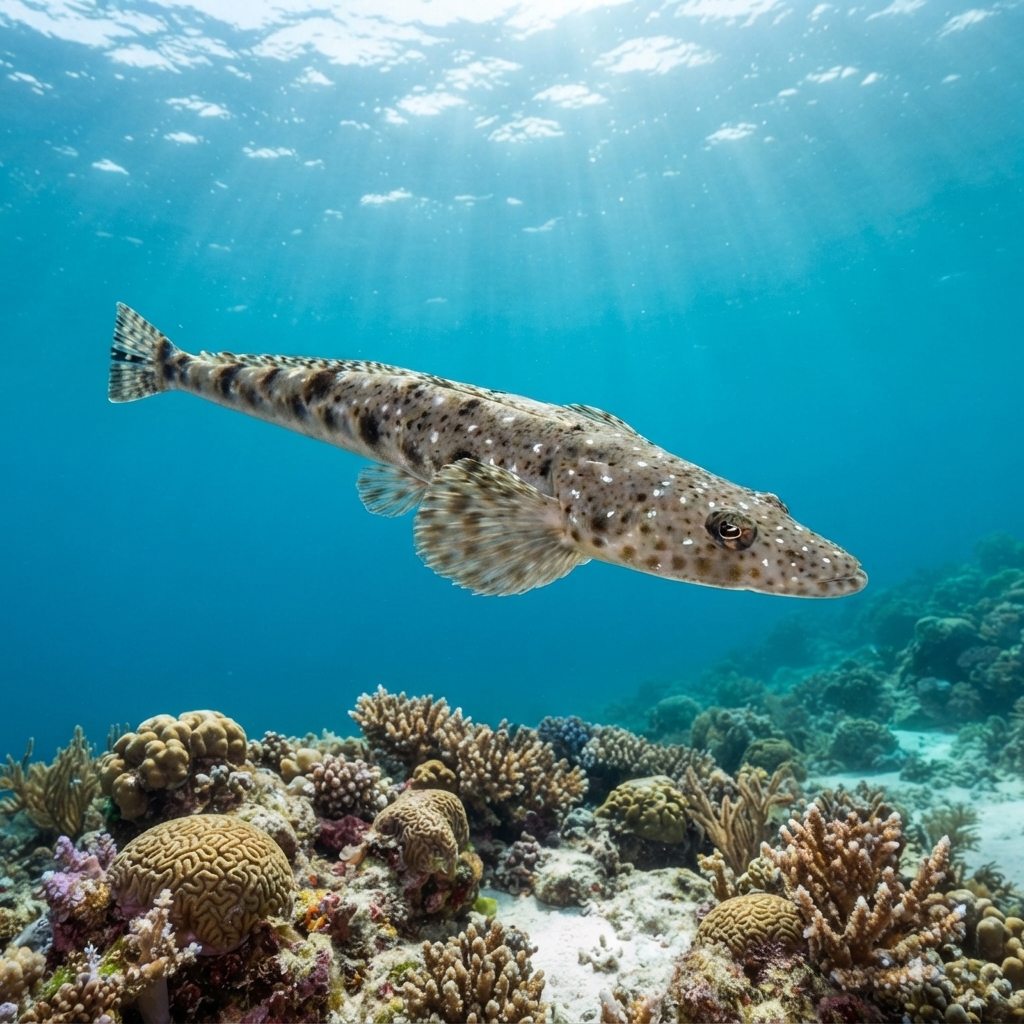
Platycephalus speculator
A rare but real find on Western Australia dives, this camouflaged flathead lies flat in sand in 15.7-23.8C water year-round.
A flattened, elongated body that lies pressed against sand or rubble, often near-invisible until it moves. Grows to around 63 cm, with a broad, depressed head and eyes set high so it can watch for prey while staying buried. Mottled brown and sandy tones break up its outline, with the small blue spots on the fins that give it its name visible mainly at close range.
Expect to find it lying motionless on sand, rubble or weedy bottom, relying on camouflage rather than flight to avoid attention. Divers who move slowly and scan the substrate rather than the water column have the best luck, since it tends to stay put until closely approached. Most logs describe it as rare to uncommon, so sightings feel like a real find rather than a given.
Like other flatheads, it ambushes prey from its buried position, using its flattened shape and sand-toned camouflage to disappear completely against the seafloor until something edible swims past.
Sightings are logged year-round with no clear seasonal peak, consistent with its wide observed temperature range of 15.7 to 23.8C. Plan around good visibility and calm sand-flat conditions rather than a particular month.
This one is very much a Western Australia speciality, with the strongest sighting record from sites there, plus smaller numbers logged in South Australia and Victoria. Outside Australia it barely registers in diver logs, so this is a target for southern Australian temperate dive trips rather than tropical itineraries.
Mapping where Bluespot Flathead is logged…
It's most reliably logged in Western Australia, with additional sightings in South Australia and Victoria. It's considered a temperate Australian species rather than one found on tropical reefs.
There's no strong seasonal pattern in sighting data, so it can turn up any time of year in water between roughly 15.7 and 23.8C. Focus on good bottom visibility over sand or weedy substrate rather than a specific season.
Look for a flattened, elongated fish lying still on sand or rubble, with a wide, depressed head and mottled brown camouflage. Small blue spots on the fins are the giveaway feature at closer range, though the fish often blends in so well it's easy to swim right past.
They reach around 63 cm in length, making them one of the larger bottom-dwelling ambush predators divers might encounter on southern Australian sand flats.
No, they're not considered dangerous to divers. Like most flatheads they rely on camouflage and staying still rather than any aggressive behaviour, though it's still sensible not to place hands on unfamiliar sand-dwelling fish.
It lies flat against sand or rubble and relies almost entirely on camouflage, staying motionless rather than swimming away from divers. This ambush strategy, combined with rare to uncommon sighting rates at most sites, is why finding one feels like a real result.
Site and sighting data is aggregated from diver logs, iNaturalist and GBIF. For taxonomy and conservation status:
Madeira Rockfish
2,773 sites