Scorpis violacea
Blue Maomao school New Zealand's reefs from Northland to Fiordland. Best sightings Nov, Apr in water as warm as 23°C. Here's where to find them.
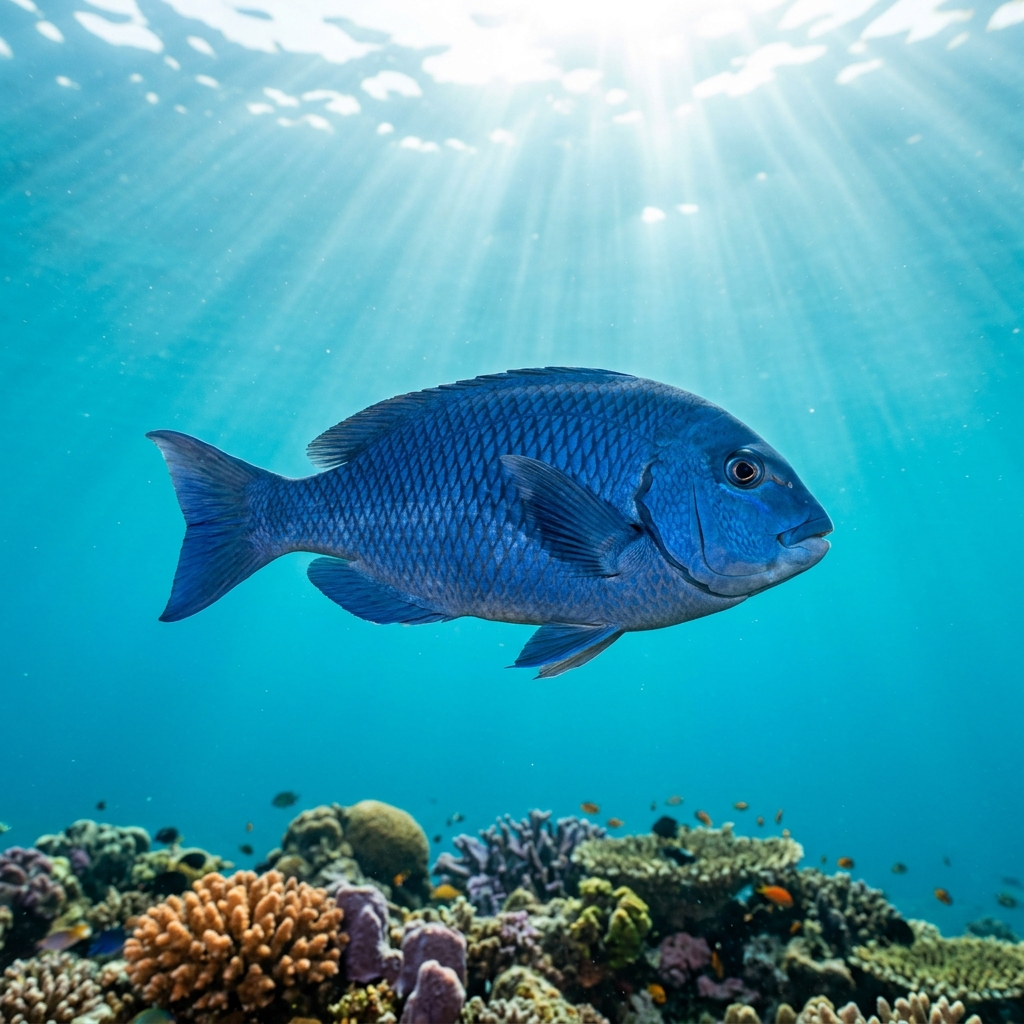
Around 28 cm long, blue maomao are a deep blue-violet on the back fading to silver on the belly, with a streamlined, laterally compressed body that sits somewhere between a snapper and a sweep in shape. Look for the distinctly forked tail and the even, unmarked colouration underwater; there are no bold stripes or spots to confuse the eye. They are almost always seen in schools, often hovering in mid-water above reef edges, which itself is a useful field clue.
Blue maomao are a benthopelagic (living near the bottom but also freely swimming in open water) species that typically forms loose to tight schools in the water column above rocky reef. They feed on zooplankton and small invertebrates, often streaming into current-washed channels and surge zones where food is delivered to them. They are generally unbothered by divers and will often allow close approach if you move slowly and avoid cutting through the school.
Blue maomao can form enormous aggregations at certain New Zealand reef systems, particularly around pinnacles and offshore islands where current concentrates their planktonic food. These shoaling events are some of the most visually impressive reef fish encounters in New Zealand waters.
Sightings concentrate between November and April, which tracks the warmer end of New Zealand's water-temperature range (up to around 23°C). Winter diving can still produce encounters, especially in northern sites, but summer and autumn are your best bet.
Blue maomao are a New Zealand endemic, logged at sites from the subtropical north all the way down to Fiordland and Stewart Island. The strongest concentration of sightings comes from the Coromandel and Bay of Plenty coast and the Northland and Auckland region, with reliable records also from Central New Zealand and the East Coast. If you are diving the Poor Knights Islands or the Aldermen Islands, blue maomao are among the fish you should expect to see.
Mapping where Blue Maomao is logged…
Blue maomao are found only in New Zealand waters. The best-represented regions are Coromandel and Bay of Plenty, and Northland and Auckland, with further sightings along the Central New Zealand and East Coast regions. Offshore dive sites around islands in northern New Zealand are particularly reliable.
Sightings peak between November and April, corresponding to New Zealand's spring and summer when water temperatures rise toward 23°C. Winter dives in the far north can still produce sightings, but the November to April window gives you the strongest odds.
Look for a school of 28 cm, deep blue-violet fish with silver bellies, a streamlined body, and a clearly forked tail. The even, unmarked colouration and habit of schooling in mid-water above rocky reef are the two quickest field clues. Juveniles are paler and more silver.
Blue maomao typically reach around 28 cm. In the water they look roughly hand-sized, similar in length to a snapper juvenile but with a noticeably deeper, more compressed body.
No. Blue maomao pose no risk to divers. They are curious and often approach at close range. No venomous spines, aggressive territorial behaviour, or bite risk has been recorded.
Schooling is both a feeding strategy and an anti-predator behaviour. By gathering in current-swept areas above reefs, large groups can efficiently filter zooplankton and small invertebrates from the water column while reducing each individual's risk from predators. At sites with strong current, these aggregations can be very large.
Site and sighting data is aggregated from diver logs, iNaturalist and GBIF. For taxonomy and conservation status:
Boarfish
936 sites