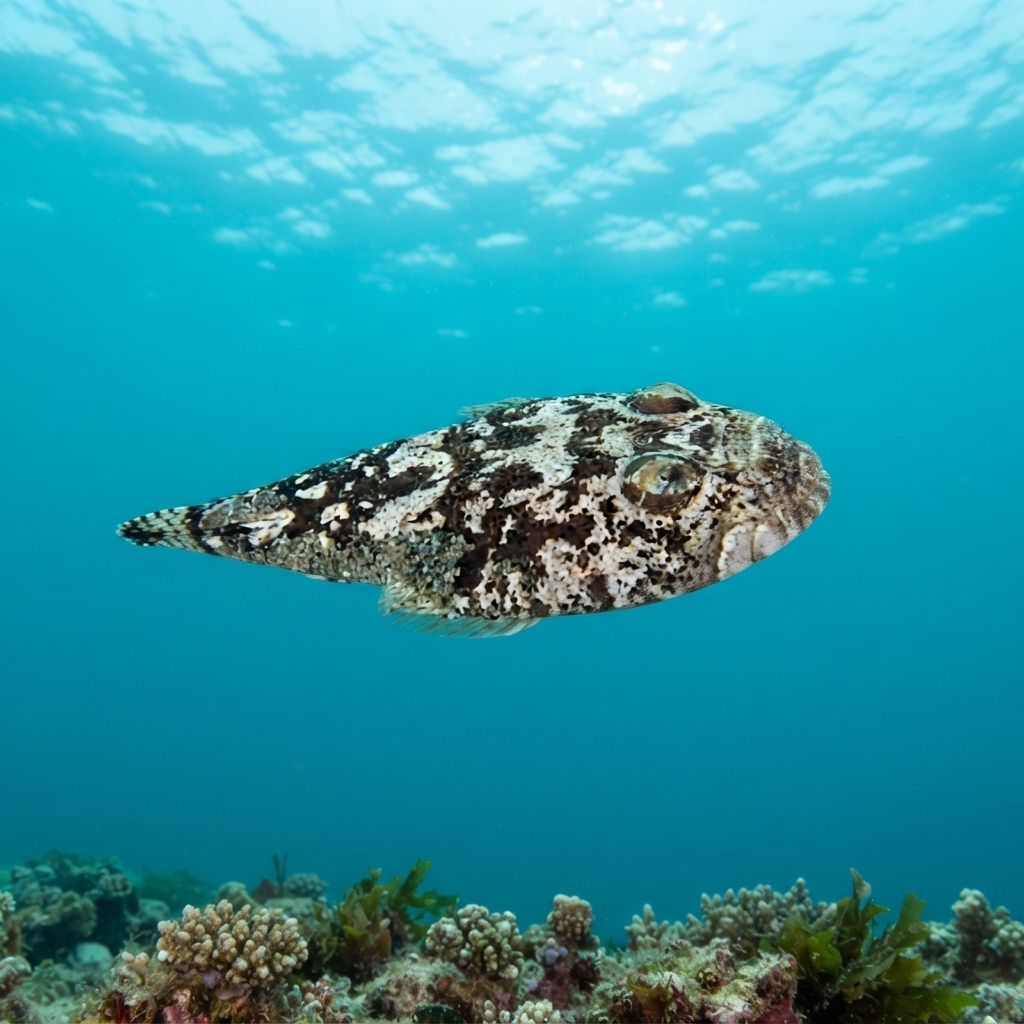
Uranoscopus bicinctus
Buried in sand across Sulawesi and Luzon, this stargazer waits eyes-up for prey in water 23-29C. Here's how to spot one.
Safety warning
Carries venomous spines near the gill covers and can deliver a painful sting if handled or accidentally touched while buried in sand. Keep hands off sandy patches you haven't visually cleared, and never try to touch or dig one out for a photo.
If you're stung
Venomous spinesGeneral first-aid guidance, not a substitute for professional medical care. In an emergency, call your local emergency number.
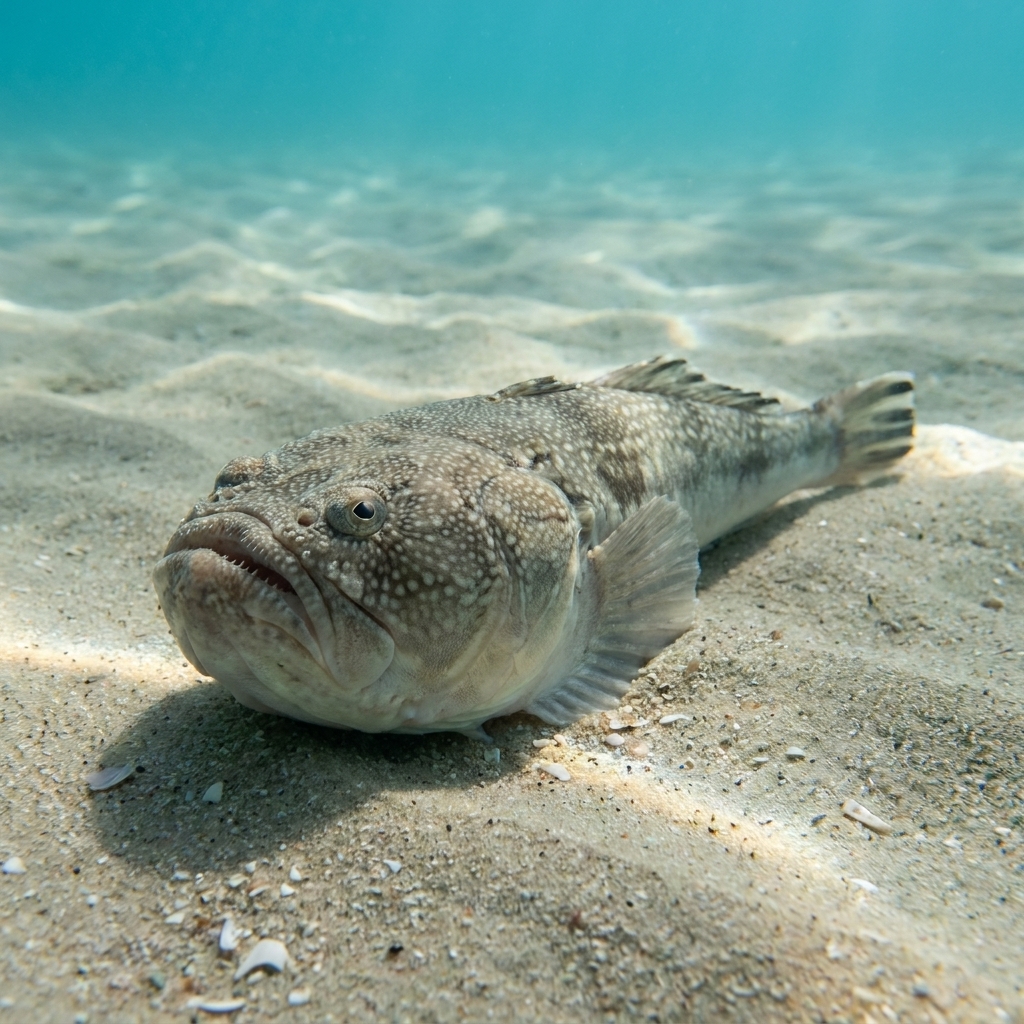
Grows to around 21cm and spends most of its time buried in sand with only its flattened, upward-facing eyes and mouth exposed. Look for a mottled brown-and-cream body pattern with darker bands across the back, a broad flat head, and a downturned mouth full of small teeth. Because it lies mostly hidden, the giveaway is usually just the eyes and gill line breaking the sand's surface, not the full body.
Spends almost all its time buried in sand or fine rubble, ambushing small fish and invertebrates that wander too close to its upturned mouth. Divers usually spot it during slow macro-focused dives scanning sandy patches near reef edges, often on night dives when it's more likely to be lying in the open. It tends to stay still when approached, relying on camouflage rather than fleeing, though a startled fish will bolt and rebury itself in a burst of sand.
Stargazers ambush prey by staying almost entirely buried and waiting for something to swim within striking range, using their upward-set eyes to track targets while the rest of the body stays hidden.
No clear seasonal pattern shows up in the sightings, and it's been logged in water from 22.9 to 29.0C, so it's a year-round target on these Indo-Pacific sand flats and reef edges.
Most reliably found in Indonesia, particularly around Sulawesi, with a second cluster of sightings in the Philippines around Luzon. At the sites where it turns up it's logged as uncommon rather than a guaranteed find, so it rewards divers who search sandy patches carefully rather than swim past them.
Mapping where Blackbanded Stargazer is logged…
The strongest sightings come from Sulawesi in Indonesia and Luzon in the Philippines, where divers find it buried in sandy patches near reef edges. It's logged as uncommon even at these sites, so it takes a deliberate search rather than a casual pass.
There's no detected seasonal pattern, and it's been recorded across a wide temperature range from 22.9 to 29.0C, so it can turn up year-round on Indo-Pacific sand flats.
Yes, they carry venomous spines near the gills and can sting if touched or stepped on. The risk comes mainly from accidental contact since they lie buried and camouflaged in sand, so watch where you place your hands and fins.
Look for a flat mottled brown head with upward-facing eyes poking just above the sand, usually with a banded pattern visible across the back if more of the body is exposed. The rest of the body typically stays buried, so the eyes and mouth outline are the main clue.
They reach around 21cm in length, making them a modest-sized find best spotted by looking for the eyes rather than the whole body.
It buries itself almost completely in sand and ambushes prey that swims too close, using upward-facing eyes to track targets while staying hidden. This burying ambush strategy is shared across the stargazer family and makes them easy to miss on a dive.
Site and sighting data is aggregated from diver logs, iNaturalist and GBIF. For taxonomy and conservation status:
Soldierfish
3,612 sites