Berthellina delicata
An uncommon orange sea slug found on Hawaii's reefs in water between 24 and 30C, logged year-round by local divers.
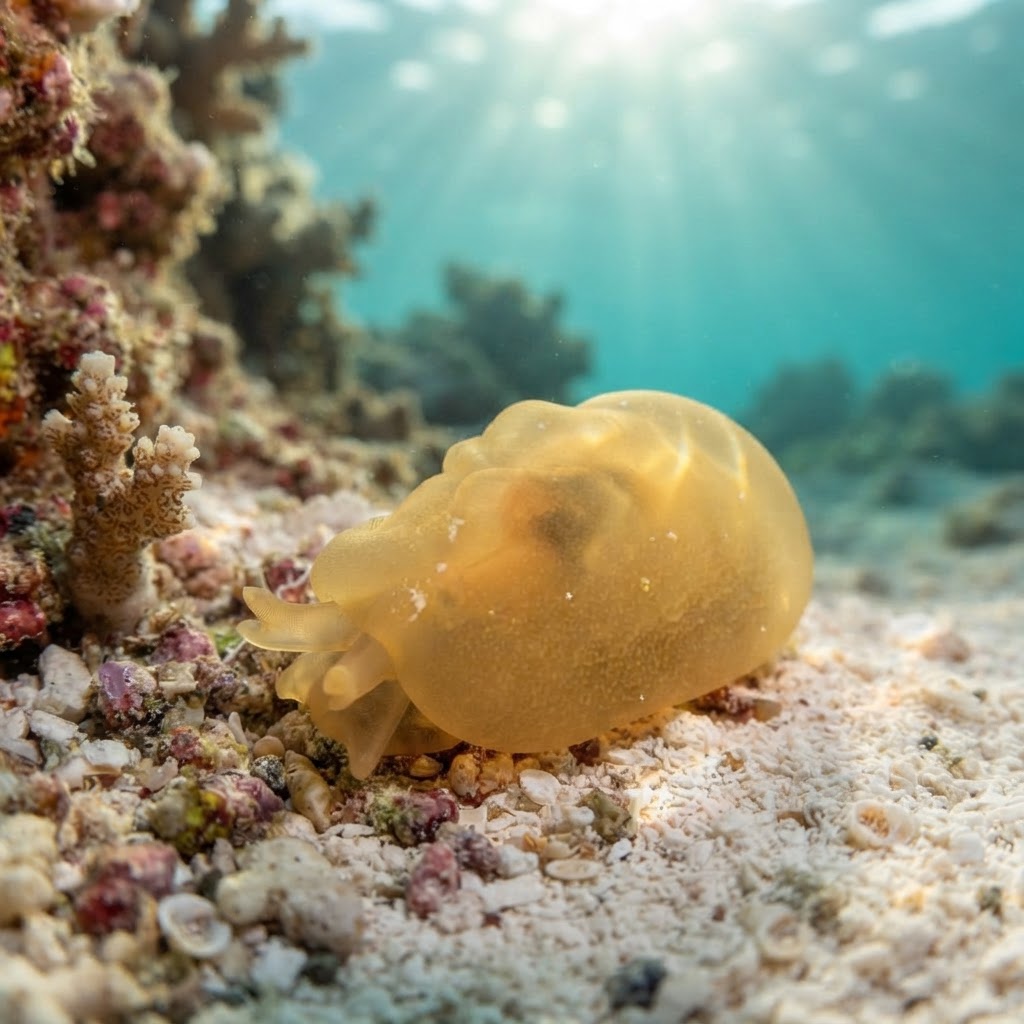
A soft, oval-bodied sea slug with a smooth, unribbed mantle in shades of orange to reddish-brown, lacking the frilly gills or rhinophore horns typical of true nudibranchs. It has a slug-like, almost featureless profile when crawling, with the mantle covering most of the body and a pair of small, rolled rhinophores tucked near the front. Divers usually spot it as a small, uniformly coloured blob on rock or rubble rather than by any bold pattern.
Divers find it moving slowly across rock, rubble, and reef surfaces where it grazes, staying low and largely ignoring passing divers. It is not a fast or reactive animal, so a slow, careful eye scanning crevices and encrusted surfaces is the best way to pick one out. Most sightings happen during the day on typical recreational dives rather than through any special night behaviour.
Unlike the true nudibranchs it is often lumped in with, this species belongs to a separate group of sea slugs (side-gilled slugs) that carries its gills tucked under the edge of the mantle rather than exposed on the back.
Sightings show no clear seasonal pattern, and with water temperatures observed between roughly 24 and 30C year-round, Hawaii's reefs stay within its comfort range in every month. Treat it as a species you might find on any dive rather than one tied to a particular season.
Reef neighbours a diver could mistake it for. Use the identification notes above to tell them apart.
Logged sightings for this species come almost entirely from Hawaii, making it a local find for divers exploring the islands' reefs. Within the United States, it turns up across multiple Hawaiian dive sites, though always as an uncommon encounter rather than a guaranteed one.
Mapping where Berthellina delicata is logged…
Sightings are concentrated in Hawaii, United States, where it has been logged at a range of dive sites. It has not been reported outside this region in current diver observation data.
There is no detectable seasonal pattern, and Hawaii's reef water stays within its observed comfort range of roughly 24 to 30C throughout the year, so sightings can happen on any dive.
Look for a smooth, oval, orange to reddish-brown body without the frilly external gills or horn-like rhinophores of typical nudibranchs. It moves slowly over rock and rubble and lacks any bold contrasting pattern.
No, this species poses no known threat to divers. It is a slow-moving, benthic sea slug that can be observed and photographed without any special precautions.
Exact size data is not well documented for this species, but like related side-gilled slugs it stays small enough that divers need to look closely to spot it against rock and rubble.
It belongs to the side-gilled slugs, a group distinct from true nudibranchs, with its gill structure hidden under the mantle edge rather than displayed openly on its back.
Site and sighting data is aggregated from diver logs, iNaturalist and GBIF. For taxonomy and conservation status:
Blue Dragon
3,163 sites