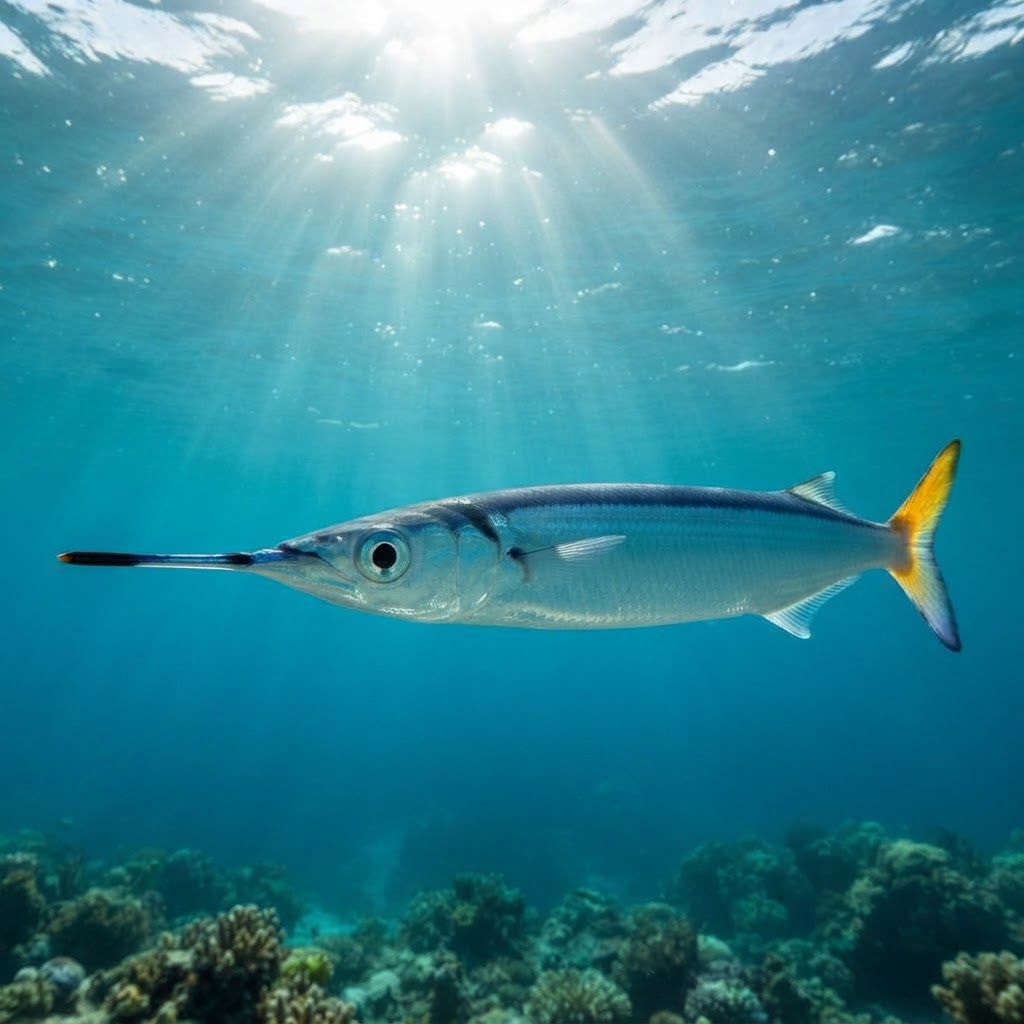
Hemiramphus brasiliensis
Slender silver ballyhoo skim reef surfaces from Florida to the BVI year-round in 20.5-28C water. Here's where to spot them.
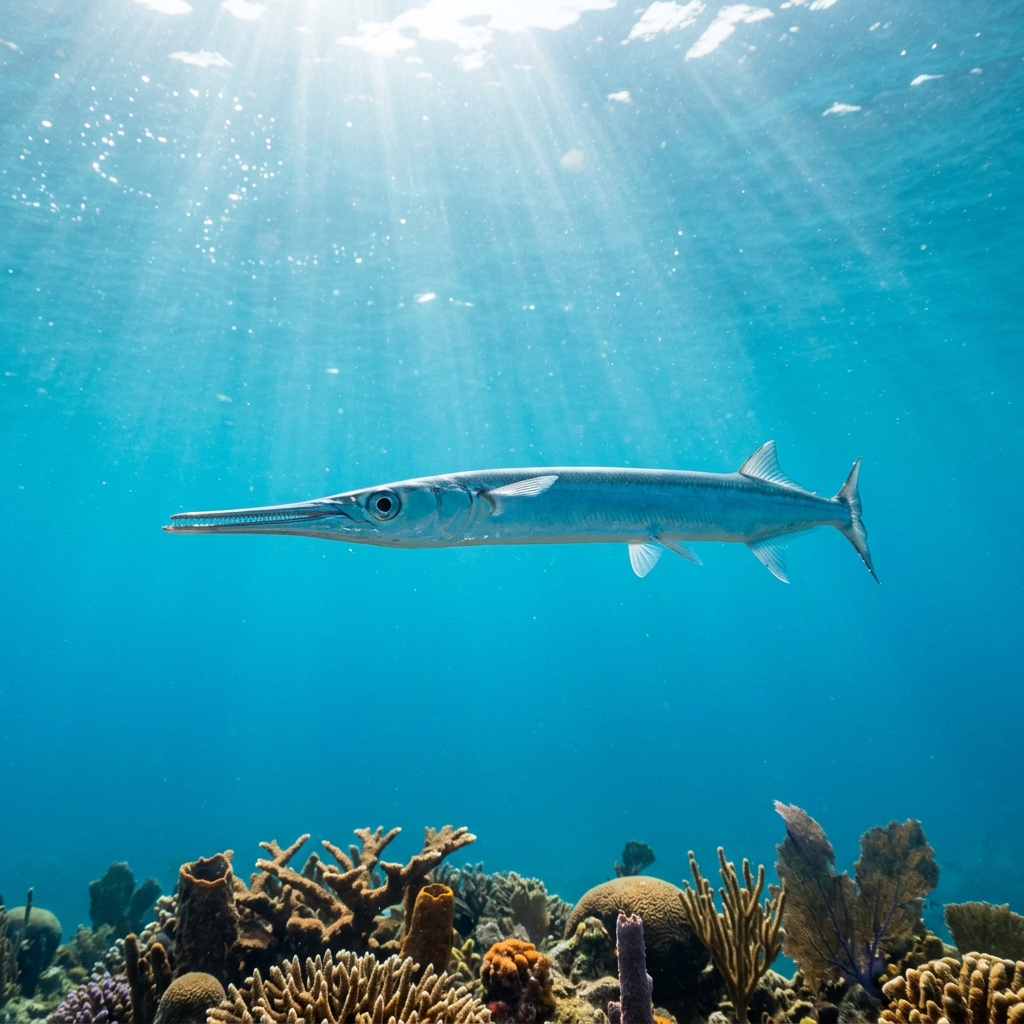
Look for a long, needle-thin silver fish cruising just under the surface, rarely deeper than a few metres. The giveaway is the extended lower jaw (like a miniature swordfish beak) with a short upper jaw, paired with a slender, almost translucent body and a faint blue-green stripe down the flank. They often travel in loose surface schools rather than alone.
Watch the surface, not the reef, and you'll usually find them skimming in loose schools just under the waterline, sometimes skipping across the surface when spooked by a boat or a splashy entry. They're generally indifferent to divers below them, more interested in drifting plankton and algae near the surface than in anything happening on the reef itself. Most sightings happen in the shallow first few metres of a dive or during the surface swim to the mooring line.
That elongated lower jaw isn't for hunting large prey, it's mostly a filter-feeding and foraging tool, and juveniles start out with both jaws short before the lower one stretches out as they mature.
No clear seasonal pattern shows up in the data, and with a comfortable range of 20.5 to 28.1C, ballyhoo are present on Caribbean reefs year-round.
Most often logged in Florida, in the US Virgin Islands around Saint Thomas, and across the British Virgin Islands near Tortola. Also a reliable sighting in Sint Maarten and Saint Martin, Ambergris Caye in Belize, Carlisle Bay in Barbados, and Bayahibe in the Dominican Republic.
Mapping where Ballyhoo is logged…
They turn up widely across the Caribbean, with strong logs in Florida, the US and British Virgin Islands, Sint Maarten/Saint Martin, Belize's Ambergris Caye, and Carlisle Bay in Barbados. Look near the surface rather than deep on the reef.
There's no strong season in the sighting data, so they're considered a year-round fish on tropical reefs where the water stays between about 20.5 and 28.1C.
Look for a slim, silvery fish just under the surface with a long, thin lower jaw sticking out past a short upper jaw. They're usually seen in loose surface schools rather than alone, and rarely go deeper than a few metres.
They typically reach around 38cm, giving them a slender, elongated look in the water rather than a bulky body shape.
No, they pose no threat to divers. They're a harmless surface-dwelling fish that tends to ignore divers below and is more concerned with feeding near the waterline.
Their long lower jaw develops only as they mature, juveniles have short, even jaws, and the adult beak is used mainly for foraging near the surface rather than hunting prey.
Site and sighting data is aggregated from diver logs, iNaturalist and GBIF. For taxonomy and conservation status:
Butterfish
1,423 sites