Squatina australis
Spot Australian Angel Shark in South Australia and Tasmania in cool 14-20 °C waters. Know what to look for before you dive.
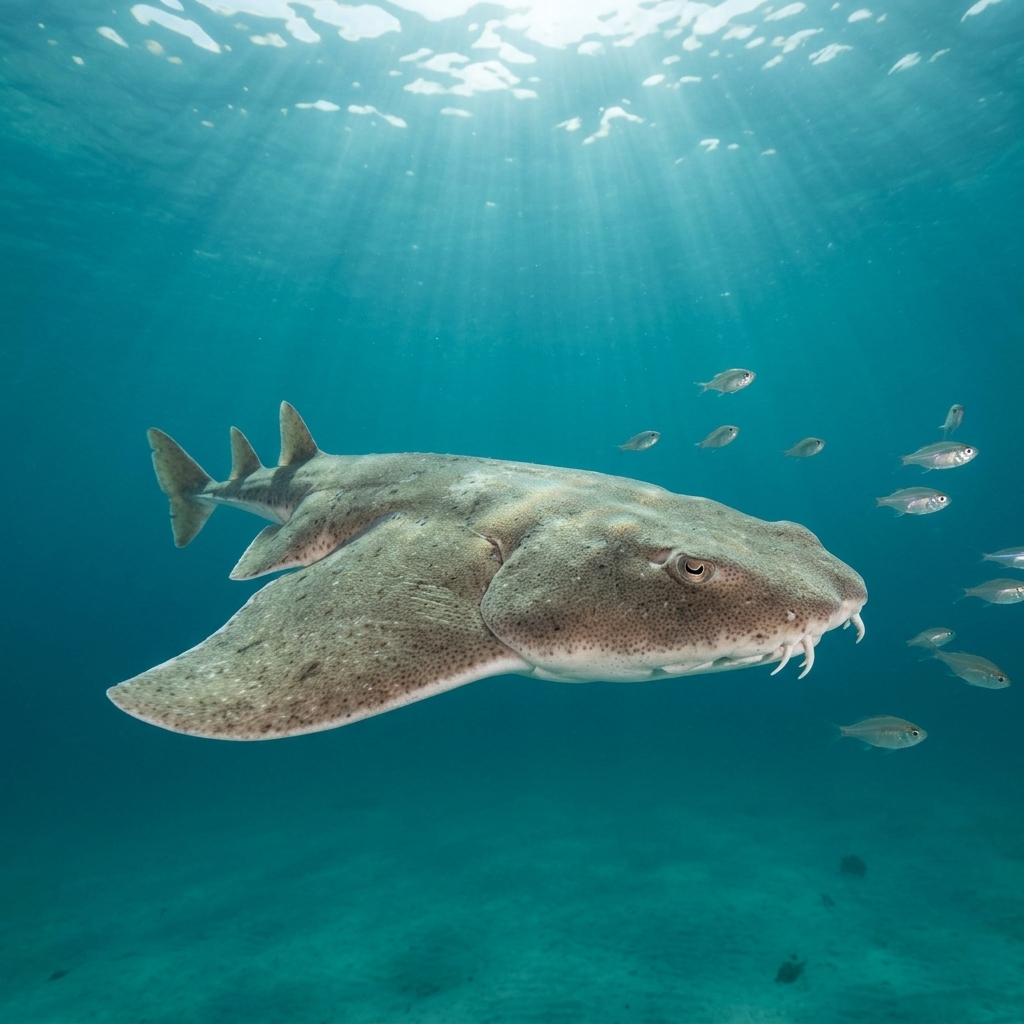
A flattened, ray-like shark that lies motionless on sandy or rubble bottoms, easily mistaken for part of the seabed. The broad, wing-like pectoral fins extend outward from the body, and the mottled grey-brown dorsal surface is heavily speckled to match the substrate. Unlike a ray, the gill slits are on the sides of the head rather than the underside, and the eyes sit on top of the flattened head. Look for the subtle ridge along the snout edge and the two small dorsal fins set far back near the tail.
Like all angel sharks, this species is an ambush predator that spends the bulk of its time partially buried in sand or resting flat on the bottom, relying on camouflage rather than movement. When approached by divers it typically stays put, making it surprisingly easy to observe at close range once you have spotted it. Most encounters are on sandy patches adjacent to reef in the depth range typical of temperate Australian coastal diving.
Angel sharks are among the few sharks that hunt by lying in wait and striking upward with remarkable speed, engulfing prey that swims over them. This ambush technique, combined with near-perfect camouflage, is why most divers walk right past one without realising it is there.
There is not enough monthly sighting data to point to a defined season, so this species should be treated as potentially year-round in its range. It is observed in water temperatures of 14 to 20 °C, consistent with the cooler temperate conditions of southern Australia throughout the year.
Australian Angel Shark is almost entirely an Australian species, with the strongest concentration of sightings across South Australia, Tasmania, and Western Australia. Victoria and Queensland also appear in the data, making the southern and south-eastern Australian coastline the core range to target. A handful of model-predicted sites appear around the Canary Islands, but confirmed diver observations come from Australia.
Mapping where Australian Angel Shark is logged…
The best places to look are along the southern and south-eastern coast of Australia, particularly South Australia, Tasmania, and Western Australia. Victoria and Queensland also feature in the records. This is a temperate-water species, so the cooler coastal reefs and sandy bays of these regions are your best bet.
There is no clear seasonal peak in the available data, so encounters appear possible year-round. The species prefers cool water between 14 and 20 °C, which matches the climate of southern Australia across most of the year. Checking local dive conditions and visibility is more useful than targeting a specific month.
Look for a completely flattened shark resting on sand, with broad pectoral fins spread like wings. The dorsal surface is mottled grey-brown to blend with the substrate. The key difference from a ray is the side-facing gill slits and the presence of two small dorsal fins near the tail. They are often partially buried, so scan sandy patches carefully.
They are not considered dangerous to divers under normal circumstances. Like other angel sharks, they can bite if harassed or stood on, so the sensible approach is to observe from a respectful distance without touching or attempting to uncover a buried individual.
Sightings are logged as uncommon to rare across the sites where they are recorded. Their excellent camouflage means they are probably overlooked more often than they are absent, so slow, attentive dives over sandy areas give you the best chance of an encounter.
The Australian Angel Shark is currently assessed as Least Concern on the IUCN Red List. While this is a reassuring status, angel sharks as a family face significant pressures globally, so treating any encounter with care and avoiding disturbance is good practice.
Site and sighting data is aggregated from diver logs, iNaturalist and GBIF. For taxonomy and conservation status:
Tiger Shark
1,616 sites