Priacanthus arenatus
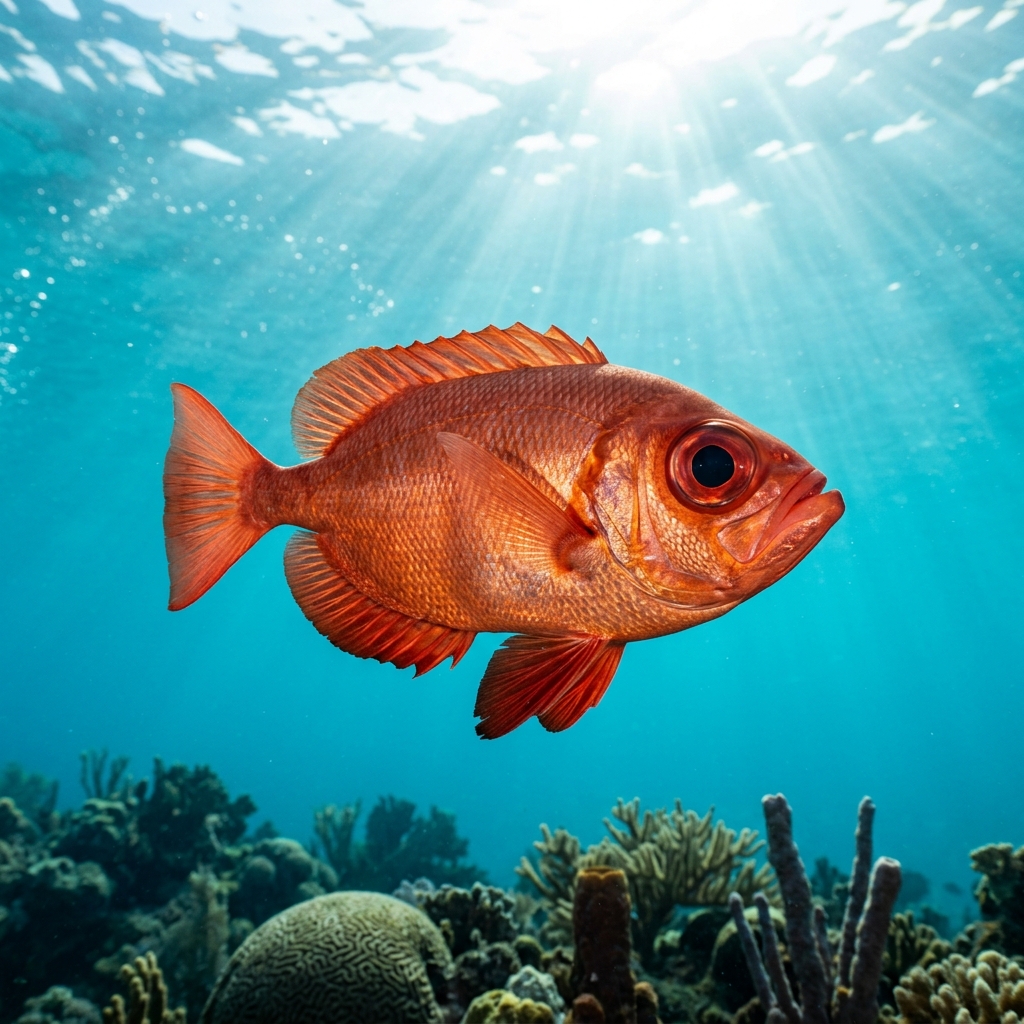
Big red eyes and a deep, blushing-red body: find Atlantic Bigeye on ledges in Rio de Janeiro, Santa Catarina and Sint Maarten year-round.
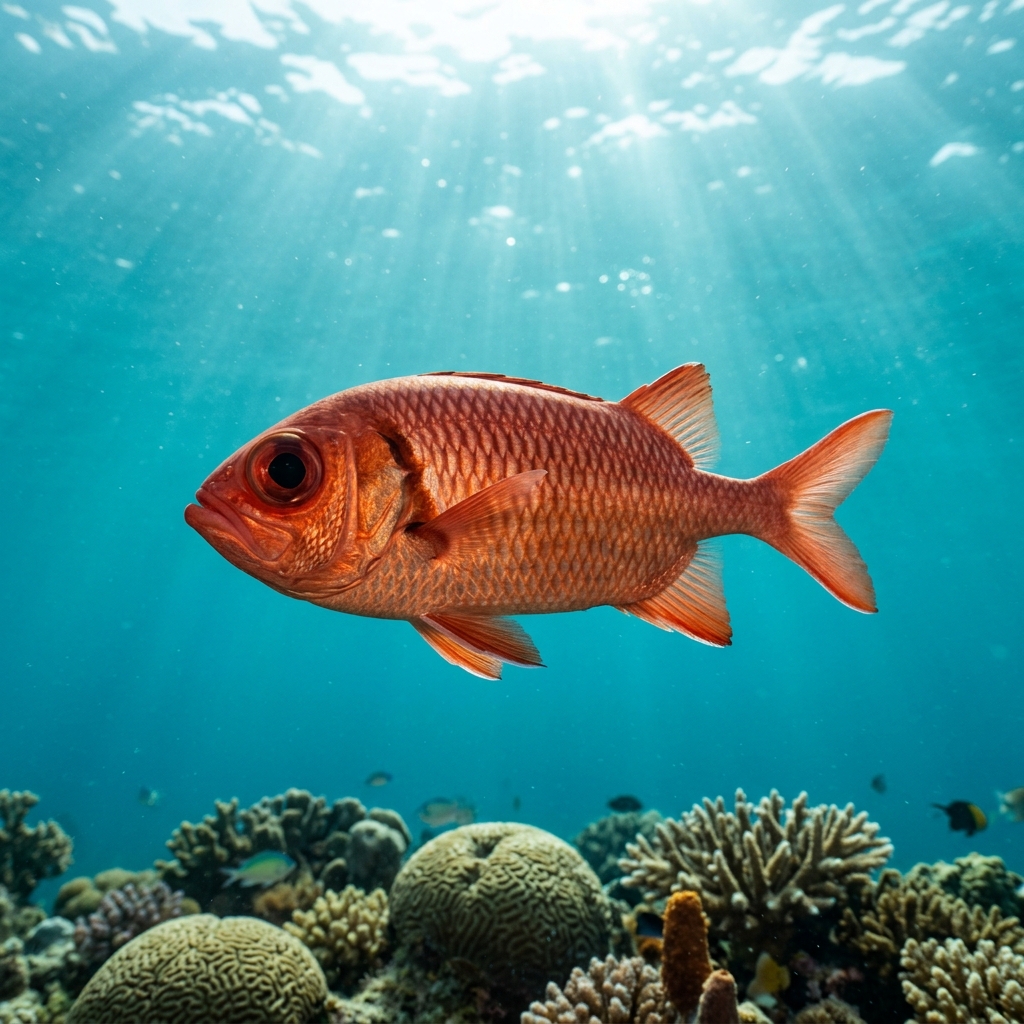
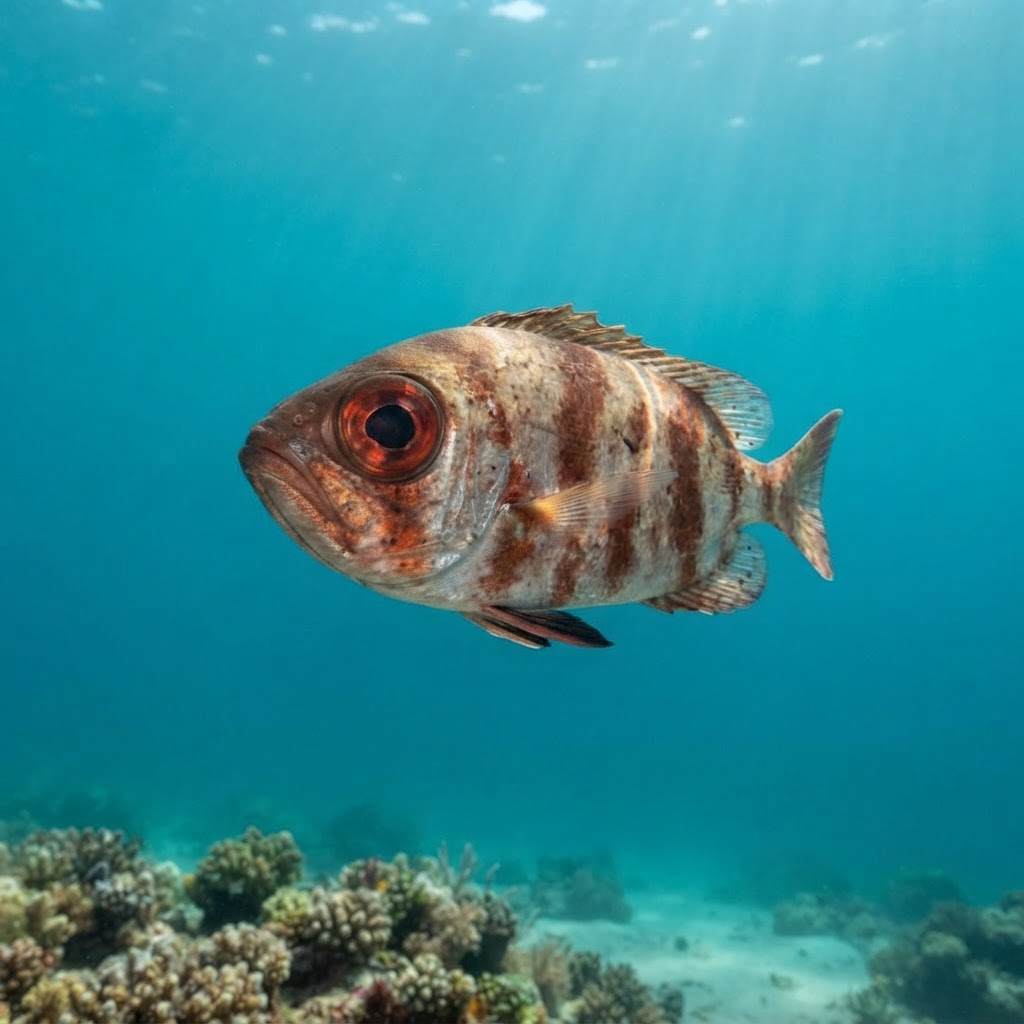
Deep, laterally compressed body in shades of red to pinkish-orange, growing to around 35 cm, with eyes noticeably oversized for its head, a trait that gives the whole family its name. It tends to hang near cover with a slightly humpbacked profile and large fins that fan out when it's relaxed. Colour can shift toward a mottled or blotchy red when resting versus a more uniform wash when active.
Usually spotted tucked under ledges, in crevices or hovering just off the reef face, often in loose groups rather than alone. It's a slow, unhurried swimmer that tends to hold its position rather than bolt when divers approach, making it an easy fish to get a good look at once you spot the red glow in your torch beam. Those big eyes suggest a fish more active around dusk and at night, so it's often found sheltering in shadow during the day.
Those oversized eyes are built for low light, which is why this fish spends daylight hours tucked into shaded overhangs and becomes more active after dark.
No clear seasonal pattern shows up in the sighting data, and its comfort range of roughly 17 to 28 C spans everything from cooler Brazilian winters to warm Caribbean water, so it's a fair year-round target wherever it's found.
Most reliably logged in Brazil, especially around Rio de Janeiro and Santa Catarina, where it turns up on rocky reefs and ledges. Sint Maarten in the Caribbean is another strong spot, with additional sightings off Florida in the United States.
Mapping where Atlantic Bigeye is logged…
Brazil is the strongest region, particularly Rio de Janeiro and Santa Catarina, with reliable sightings also logged around Sint Maarten and off Florida.
There's no strong season in the data, and its wide temperature tolerance from around 17 to 28 C means it's seen across the year rather than in one narrow window.
Look for a deep-bodied, reddish fish around 35 cm with strikingly large eyes, usually hovering near a ledge or crevice rather than out in open water.
They typically reach about 35 cm in length, a manageable size that makes their oversized eyes and deep red body easy to pick out even at a distance.
Its outsized eyes are adapted for low-light vision, helping it feed and stay alert during dusk and nighttime hours when it's most active outside its daytime shelter.
Site and sighting data is aggregated from diver logs, iNaturalist and GBIF. For taxonomy and conservation status:
Soldierfish
3,612 sites