Stenorhynchus spp.
Arrow crabs are logged year-round across the Caribbean and Canary Islands. Here's how to spot them and where divers see them most.
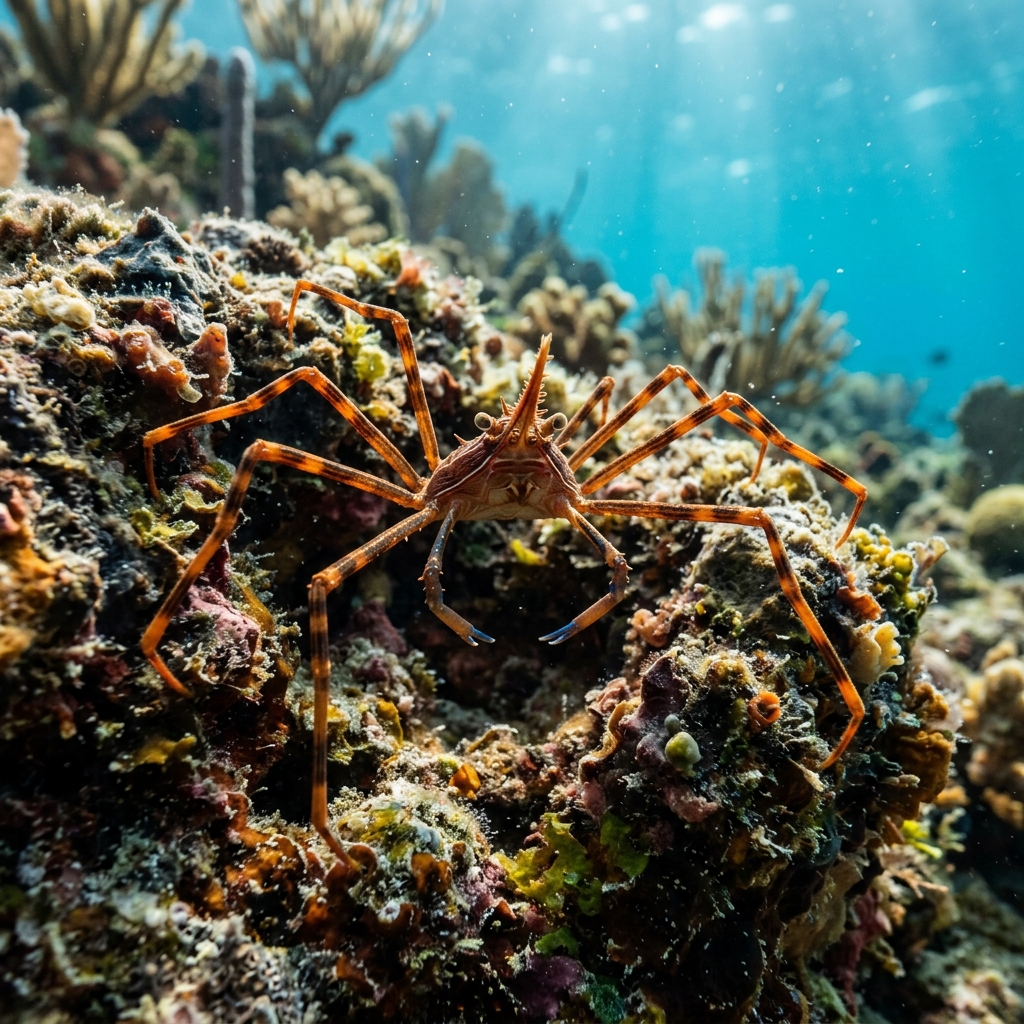
A sharply triangular rostrum (the pointed spike projecting forward from the head) and extraordinarily long, spindly legs make arrow crabs unmistakable among reef crustaceans. The body is small, often just a few centimetres across, but the legs can span several times that width, giving the animal an almost spider-like silhouette. Colouration ranges from pale cream to tan or reddish-brown, usually with fine dark lines or banding along the legs and carapace. They tend to perch openly on sponges, corals, or among sea urchin spines, which makes them surprisingly easy to spot once you know the shape to look for.
Arrow crabs are typically found perched motionless on sponges, sea fans, or nestled among the spines of long-spined sea urchins, where they seem to feel secure. They are generally unbothered by divers approaching slowly and will hold position long enough for a good look or photograph. Feeding activity, picking at small invertebrates or detritus, is often visible if you watch for a few moments without disturbing them.
Arrow crabs are well known for a cleaning behaviour: they pick parasites and dead tissue from fish that visit them, much like the more famous cleaner shrimps. Spotting one actively working on a reef fish is a highlight of any close observation.
Sightings are recorded year-round with no concentrated season, which fits the genus's preference for warm tropical and subtropical water in the 19 to 29 °C range, temperatures that persist throughout the year at most of its top dive destinations.
Arrow crabs are most commonly logged across the Caribbean basin, with the Yucatán Peninsula, Roatán, Grand Cayman, and Bonaire all ranking among the most reliable regions. The Canary Islands, especially Tenerife, represent the strongest Atlantic population outside the Americas, and Cape Verde also contributes solid sightings. Florida and the US Virgin Islands round out the North American options.
Mapping where Arrow Crabs is logged…
Arrow crabs are logged across a wide stretch of the tropical Atlantic and Caribbean. The Yucatán Peninsula, Roatán, Grand Cayman, and Bonaire are among the most reliable spots. Outside the Americas, the Canary Islands, particularly Tenerife, and Cape Verde offer strong sightings in warm Atlantic waters.
They are present year-round at most of their top destinations. Because the genus thrives in water between roughly 19 and 29 °C, which tropical and subtropical Caribbean and Atlantic reefs maintain throughout the year, there is no single best season, any dive trip works.
Look for a tiny triangular body with a long, sharp spike pointing forward and an improbably wide span of thin, banded legs. The overall shape is more spider than crab. They are usually found sitting still on a sponge, sea fan, or tucked among urchin spines rather than moving across open sand.
The body (carapace) of most arrow crabs is only a few centimetres long, but the legs can extend the animal's total span to 10 cm or more depending on the species. In the water they look larger than they are because of those long limbs.
Arrow crabs are opportunistic feeders: they pick at small invertebrates, bristle worms, and organic debris, and are also known to act as cleaners, removing parasites from fish. That cleaning behaviour is one of the more interesting things to watch for when you find one.
Site and sighting data is aggregated from diver logs, iNaturalist and GBIF. For taxonomy and conservation status:
European Green Crab
2,469 sites